Court of Wick
Apple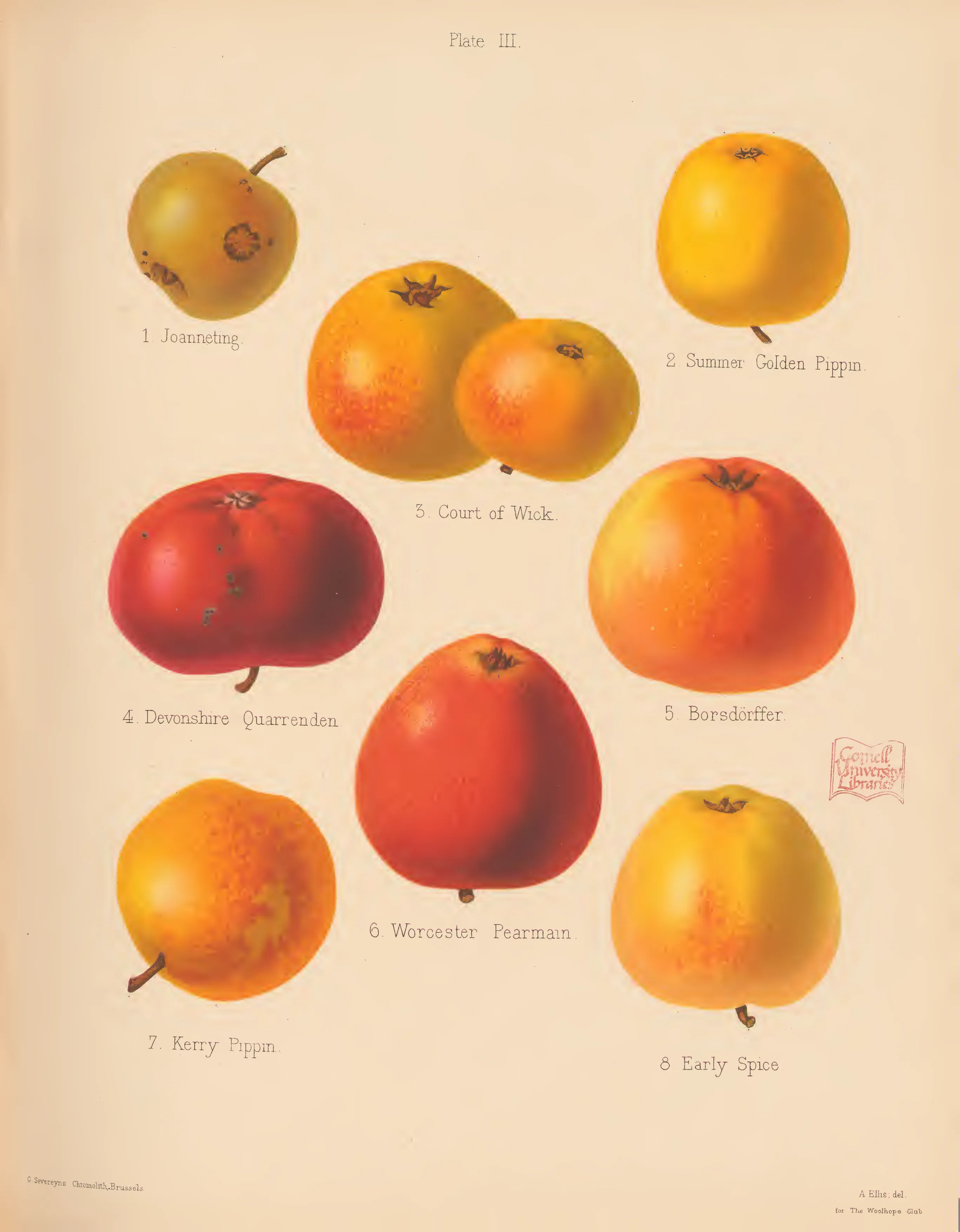
Court of Wick
Origin / History
Court of Wick is an English variety said to have originated at Court of Wick, in Somersetshire, raised from a pip of the Golden Pippin (Herefordshire Pomona). Bunyard specifies it was raised near Yatton, Somerset, and introduced to commerce in 1790 by Messrs. Wood, of Huntingdon. It is described as "a good old sort, now little grown" (Bunyard), and as a highly-flavored English dessert apple of the Golden Pippin class. Warder notes it "has so many synonyms as evidences of its popularity," though it "has not been a favorite in this country" (i.e., America), only occasionally succeeding well. Downing concurs that it "does not succeed well with us," and Thomas states bluntly "Fails here."
Tree
The tree attains middle (medium) size, with a spreading growth habit (Bunyard). It is very healthy, very hardy — suited to the North (Elliott) — and bears abundantly, with good fertility. It will succeed on almost every soil, and is not subject to attacks of blight and canker (Herefordshire Pomona). Leaf medium, long oval, sharply serrate (Bunyard).
On the sunny side of the tree it is often an exception to find a Court of Wick apple untouched by birds and insects, which attack the fruit with avidity owing to its rich colour and fine flavour (Herefordshire Pomona).
Fruit
Size: Below medium / small. Bunyard gives dimensions of 2¼ by 1¾ inches. Warder describes it as "very small."
Form: Regular and handsome; variously described as roundish ovate (Herefordshire Pomona, Elliott), roundish oblate, somewhat flattened (Downing), roundish ovate approaching oblate (Thomas), or round, truncated abruptly, much flattened (Warder). Bunyard describes it as rounded, square, regular.
Stem / Stalk: Short and slender (Herefordshire Pomona, Bunyard); Warder, by contrast, describes the stem as long and slender, as does Elliott ("long, slender").
Cavity: Rather wide (Warder); smooth and even, lined with thin russet (Herefordshire Pomona); shallow and russet (Bunyard).
Calyx / Eye: Variously described as small and open with reflexed segments (Warder); large and open, with long acuminate and reflexed segments (Herefordshire Pomona); long, wide-spread segments (Elliott); open (Bunyard).
Basin: Wide, very shallow (Warder); wide, shallow, and even (Herefordshire Pomona); shallow (Elliott); wide (Bunyard).
Skin: When fully ripe, a fine clear yellow, with bright orange, which sometimes breaks out in a faint red next the sun, and covered all over with russety freckles (Herefordshire Pomona). Greenish yellow in the shade, becoming a warm orange with a little red in the sun (Downing); greenish yellow in shade, little red and dotted with russet specks in sun (Elliott). Warder describes the surface as yellow, covered russet. Bunyard gives the colour as pale yellow, flushed with rich orange. In some places, as on the Hastings Sand, and in some localities in Herefordshire, the colour becomes a fine clear orange with a somewhat carmine cheek on the side next the sun (Herefordshire Pomona).
Flesh / Flavor: Flesh yellow (rich yellow per Warder), tender, crisp, very juicy, rich and highly flavoured (Herefordshire Pomona); crisp and juicy with a high poignant flavor (Downing); firm, juicy, with flavor acid, aromatic, rich, spicy, sharp (Warder); sharp sub-acid, crisp, juicy (Elliott); crisp, yellow, richly flavoured, slightly acid (Bunyard); crisp, juicy, rich (Thomas). The rich and delicious flavour is described as not inferior to that of the Golden Pippin (Herefordshire Pomona). For those who like a firm, spicy, sprightly fruit for dessert, this may be esteemed (Elliott).
Core / Seeds: Core small, ovate, closed, meeting the eye (Warder); core large (Elliott — note conflict with Warder). Seeds numerous, large, brown (Warder); seeds ovate (Elliott).
Season
Variously given: October to March (Herefordshire Pomona); October to February (Downing, Elliott); December to March (Bunyard); December and January (Warder); autumn (Thomas).
Uses
Dessert. One of the best and most valuable dessert apples (Herefordshire Pomona).
Subtypes / Variants
Not described in source.
Other
Quality: "good in its way" (Warder); "Very good" (Downing). Warder notes "it has little to recommend it in its looks." The fruit is reported especially attractive to birds and insects on the sunny side of the tree (Herefordshire Pomona).
Book Sources
Described in 6 period pomological works
Nursery Catalog Sources
Found in 3 catalogs (1897–1911) from England
- Kelway & Son , Langport, Somerset , England — 1897
- Central Experimental Farm , Dominion Department of Agriculture, Agassiz, British Columbia (under test; Bulletin No. 3, Second Series) — 1900
- James Veitch & Sons , Ltd., Royal Exotic Nursery, Chelsea, London (also Coombe Wood, Langley, and Feltham) , England — 1911
View original book sources (6)
— John A. Warder, American Pomology: Apples (1867)Court of Wyck.
This spicy English apple, which has so many synonyms as evidences of its popularity, has not been a favorite in this country, but occasionally succeeds well; it has little to recommend it in its looks.
Fruit very small, round, truncated abruptly, much flattened, regular; Surface yellow, covered russet.
Basin wide, very shallow; Eye small, open; Segments reflexed.
Cavity rather wide; Stem long, slender.
Core small, ovate, closed, meeting the eye; Seeds numerous, large, brown; Flesh rich yellow, firm, juicy; Flavor acid, aromatic, rich, spicy, sharp; Quality good in its way; Use, "dessert;" Season, December, January.
— Woolhope Naturalists Field Club, The Herefordshire Pomona (1885)
- COURT OF WICK.
[Syn. : Fry's Pippin ; Golden Drop ; Knightwick Pippin ; Phillips Reinette ; Wood's Huntingdon ; Weeks' Pippin ; Yellow Pippin]
This variety is said to have originated at Court of Wick, in Somersetshire, and to have been raised from a pip of the Golden Pippin.
Description.—Fruit ; below medium size, roundish ovate, regular and handsome. Skin ; when fully ripe of a fine clear yellow, with bright orange, which sometimes breaks out in a faint red next the sun, and covered all over with russety freckles. Eye ; large and open, with long acuminate and reflexed segments, set in a wide, shallow and even basin. Stalk ; short and slender, inserted in a smooth and even cavity, which is lined with thin russet. Flesh ; yellow, tender, crisp, very juicy, rich and highly flavoured.
It is one of the best and most valuable dessert apples. The rich and delicious flavour of the fruit is not inferior to that of the Golden Pippin. In season from October to March.
The tree attains the middle size, is very healthy and hardy, and bears abundantly. It will succeed on almost every soil, and is not subject to attacks of blight and canker. In some places, as on the Hastings Sand, the colour of the fruit becomes a fine clear orange with a somewhat carmine cheek on the side next the sun ; the same rich tint is observed in some localities in Herefordshire. This richness of colour with its fine flavour, is doubtless the cause of this fruit being attacked with such avidity by birds and insects. On the sunny side of the tree it is often an exception to find a Court of Wick apple untouched by these marauders.
— A.J. Downing, The Fruits and Fruit Trees of America (1900)Court of Wick.
Court of Wick Pippin. Golden Drop. Philip's Reinette. Court de Wick. Wood's Huntingdon. Knightwick Pippin. Rival Golden Pippin. Barlow. Week's Pippin. Fry's Pippin. Transparent Pippin. Yellow.
A highly-flavored English dessert Apple of the Golden Pippin class, which does not succeed well with us.
Fruit below the middle size, regularly formed, roundish oblate, somewhat flattened, greenish yellow in the shade, but becoming a warm orange, with a little red in the sun. Flesh yellow, crisp, and juicy, with a high poignant flavor. Very good. October to February.
— F.R. Elliott, The Western Fruit Book (1865)Court of Wick.
Barlow, Philip's Reinette, Court de Wick, Week's Pippin, Fry's Pippin, Court of Wick Pippin, Wood's Huntingdon, Rival Golden Pippin, Golden Drop, Transparent Pippin, Knightwick Pippin, Yellow.
Foreign. For those who like a firm, spicy, sprightly fruit for dessert, this may be esteemed. Tree, very hardy — suited to the North. Fruit, small, regular, roundish ovate, flattened, greenish yellow in shade, little red and dotted with russet specks in sun ; stem, long, slender ; calyx, with long, wide-spread segments ; basin, shallow ; core, large ; seeds, ovate ; flesh, yellow, sharp sub-acid, crisp, juicy. October to February.
— John J. Thomas, The American Fruit Culturist (1903)Court of Wick. Small, roundish ovate, approaching oblate, greenish-yellow and orange; crisp, juicy, rich. Fails here. Autumn. English.
— E.A. Bunyard, A Handbook of Hardy Fruits (1920)COURT OF WICK. Ronalds, p. 12. (Fry's Pippin, Golden Drop, Woods Huntingdon.) Dessert, December to March, small, 2¼ by 1¾, rounded, square, regular. Colour, pale yellow, flushed with rich orange. Flesh, crisp, yellow, richly flavoured, slightly acid. Eye, open in a wide basin. Stem, short, in a shallow russet cavity. Growth, medium, spreading; fertility good. Leaf, medium, long oval, sharply serrate. Origin, raised near Yatton, Somerset, and introduced to commence in 1790, by Messrs. Wood, of Huntingdon. A good old sort, now little grown.