Cracking
Apple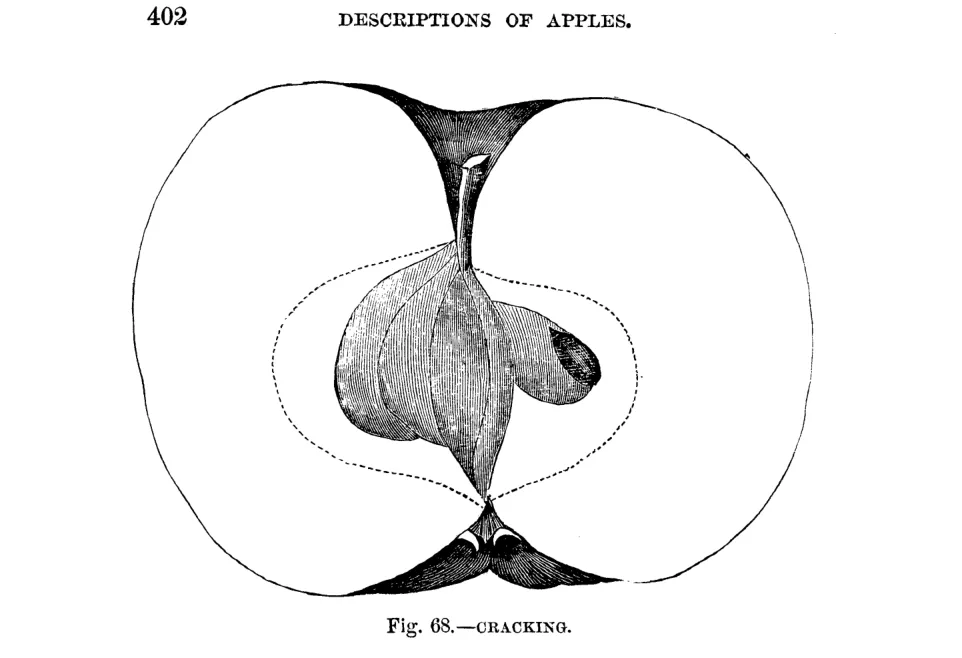
Cracking
Origin and History
Cracking originated in eastern Ohio, specifically on the farm of Henry Barger, Harrison County. It was noted by Warder (1867) as having originated in the eastern part of Ohio, consistent with Downing's more precise attribution to Harrison County.
Tree
The tree is spreading, vigorous, and productive. Young shoots are reddish brown and slightly downy (Downing). Warder describes it as a strong grower and productive.
Fruit
Size and Form: Large. The two primary sources describe the form somewhat differently: Warder calls it oblate, somewhat uneven and irregular but handsome; Downing describes it as roundish, slightly flattened, inclining to conic, and obscurely ribbed.
Stem: Warder describes the stem as short and rather stout; Downing gives it as medium length. Cavity acute, wavy, and brown (Warder); Downing describes the cavity as rather deep and slightly russeted.
Calyx and Basin: Calyx closed. Basin wide and folded (Warder); corrugated (Downing).
Skin: Surface smooth. Color is greenish-yellow until ripe, when it is often tinged with red (Warder); Downing describes it as pale yellow with a slight tinge of red. The two sources conflict on the dots: Warder notes them as numerous, minute, indented, and green; Downing describes the dots as large but thinly sprinkled.
Flesh and Flavor: Flesh yellow (Warder) or yellowish white (Downing). Warder describes the texture as breaking and juicy; Downing as crisp, tender, and juicy. Flavor subacid. Quality: Warder rates it nearly first rate; Downing rates it Good.
Core and Seeds: Core wide, open, clasping the eye (Warder); Downing independently notes the core as large. Seeds large, pointed, and dark (Warder).
Season
Warder gives the season as September and October; Downing gives October and November. The sources slightly disagree on timing, suggesting it may ripen into November in some conditions or locations.
Uses
Kitchen and table (Warder). Downing specifically notes it as valuable for cooking.
[NOTE: The Encyclopedia of Practical Horticulture (Lowther, 1914) entry for Cracking consists only of a coded tabular record — "L rob y G k 2* 2*" — with no prose description. No additional identification details can be extracted from this source.]
Book Sources
Described in 3 period pomological works
View original book sources (3)
— John A. Warder, American Pomology: Apples (1867)Cracking.
This variety had its origin in the eastern part of Ohio. The tree is a strong grower and productive.
Fruit large, oblate, somewhat uneven and irregular, but handsome; Surface smooth, greenish-yellow until ripe, when it is often tinged with red; Dots numerous, minute, indented and green.
Basin wide, folded; Eye medium, closed.
Cavity acute, wavy, brown; Stem short, rather stout.
Core wide, open, clasping the eye; Seeds large, pointed, dark; Flesh yellow, breaking, juicy; Flavor sub-acid; quality nearly first rate; Use, kitchen and table; Season September and October.
— A.J. Downing, The Fruits and Fruit Trees of America (1900)Cracking.
Origin, farm of Henry Barger, Harrison Co., O. Tree spreading vigorous, and productive. Young shoots reddish brown, slightly downy.
Fruit fair, large, roundish, slightly flattened, inclining to conic, obscurely ribbed, pale yellow, with a slight tinge of red, thinly sprinkled with large dots. Stalk medium, in a rather deep slightly russeted cavity. Calyx closed in a corrugated basin. Flesh yellowish white, crisp, tender, juicy, subacid. Good. Core large. Valuable for cooking, October, November.
— Granville Lowther (ed.), Encyclopedia of Practical Horticulture (1914)Cracking. L rob y G k 2* 2*