Cullasaga
Apple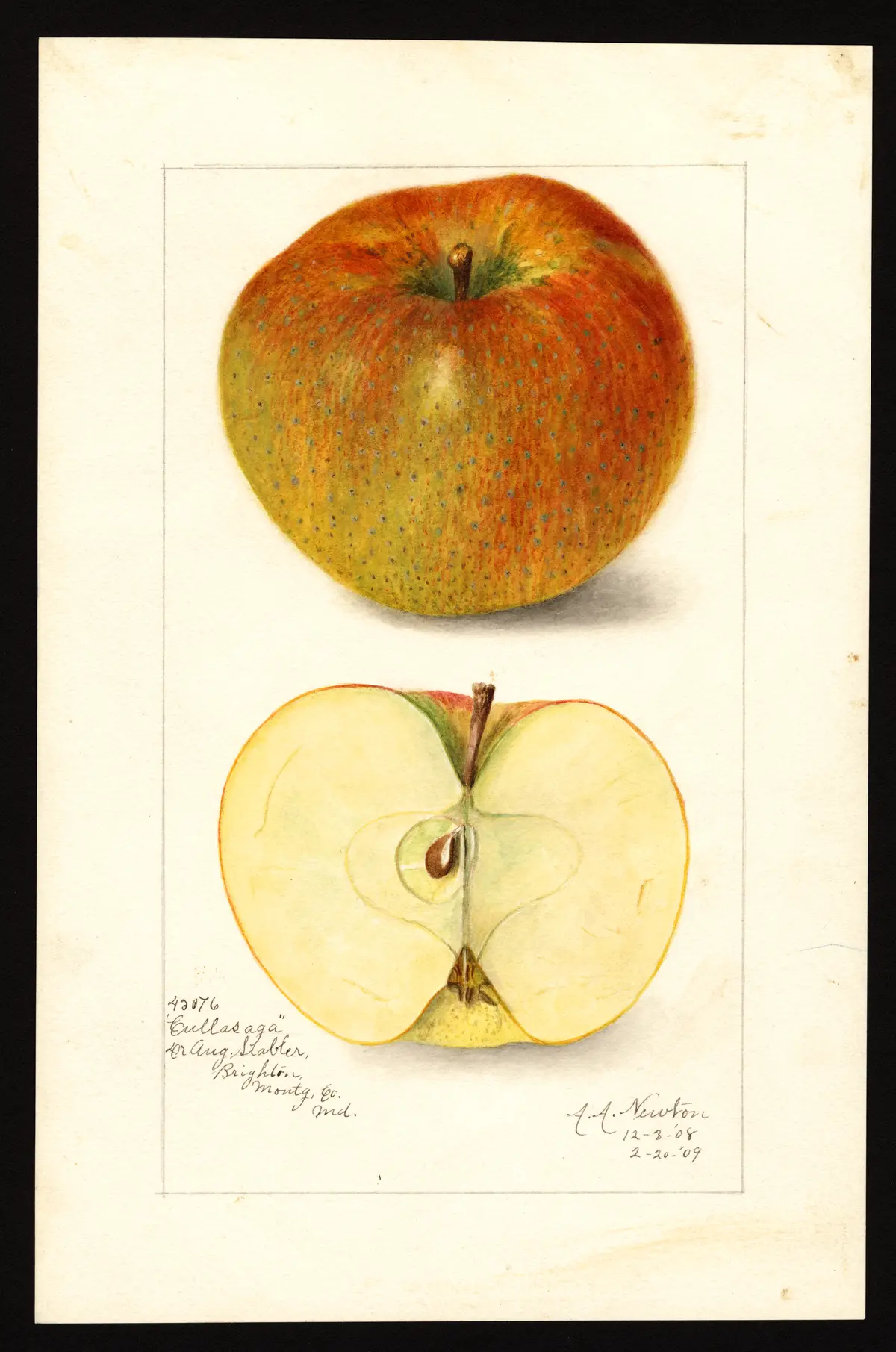
USDA Pomological Watercolor Collection
Cullasaga
Origin / History
Raised by Miss Ann Bryson, Macon County, North Carolina (Downing). Elliott entered it in 1865 under the spelling "Callasaga," as American, from Macon, N. C. A Southern winter apple. Elliott: "Valued highly South." Downing calls it "a standard winter fruit for the South." Thomas calls it "a well-known, long-keeping, valuable Southern fruit."
Tree
A good grower and very productive (Downing). In Lowther's station tables (1914) it was reported by no stations in the Northern Division, by 2 stations in the Central Division, and by 7 in the Southern Division. Each entry is marked as also reported in another division.
Fruit
Size: Medium to large, above medium, or rather large.
Form: Roundish, inclining to conic or slightly conical, the sides sometimes unequal (Downing). The earlier Downing text quoted by Warder gives it as roundish, inclining to oval, flattened at base and crown. Lowther's table records the form as "re."
Stem: Small, short; slender (Thomas).
Cavity: Deep, surrounded by russet.
Calyx: Open; large (Elliott).
Basin: Shallow, corrugated or furrowed; wide (Elliott).
Skin: Yellowish, mostly shaded and striped with dark crimson, or striped crimson on yellow. Elliott describes it as "dull brown on greenish yellow russet." Lowther's table records the color as "ys."
Dots: Whitish, sprinkled over the surface; few (Budd & Hansen).
Flesh and flavor: Flesh yellow to yellowish. Very mild, rich, aromatic (Thomas). Downing gives it as rather compact, moderately juicy, mild subacid. The earlier Downing text quoted by Warder, and Thomas, call it tender; that text adds juicy, "with a very mild, rich, almost saccharine flavor." Quality "good" (Downing; Lowther).
Core and seeds: Not described in source.
Season
The recorded season runs from October into April. Most authors give a winter season, November or January through April. Lowther's table gives winter. Thomas calls it long-keeping. Elliott alone gives October and November.
Uses
Suited for market use (Lowther).
Subtypes / Variants
Not described in source.
Other
Not described in source.
Book Sources
Described in 6 period pomological works
Nursery Catalog Sources
Found in 2 catalogs (1901–1913) from Illinois
- Benjamin Buckman (personal inventory) , Farmingdale , Illinois — 1901
- Benjamin Buckman (personal inventory) , Farmingdale , Illinois — 1913
View original book sources (6)
— F.R. Elliott, The Western Fruit Book (1865)Callasaga.
American : from Macon, N. C. Fruit, above medium, roundish, dull brown on greenish yellow russet ; calyx, large ; wide furrowed basin. October, November. Valued highly South.
[Additional entry in this volume: "Cullasaga", pp. 134–134]
Callasaga.
American : from Macon, N. C. Fruit, above medium, roundish, dull brown on greenish yellow russet ; calyx, large ; wide furrowed basin. October, November. Valued highly South.
— John A. Warder, American Pomology: Apples (1867)Cullasaga.
Origin Macon County, North Carolina. Good grower; a standard winter fruit for the South.
Fruit medium or large, roundish, inclining to oval, flattened at base and crown, skin yellowish, mostly shaded and striped with dark crimson, and sprinkled with whitish dots; Stem small and short, inserted in a deep cavity, surrounded by russet; Calyx open, set in a shallow, corrugated basin; Flesh yellow, tender, juicy, with a very mild, rich, almost saccharine flavor. January to April. —[Downing.]
— A.J. Downing, The Fruits and Fruit Trees of America (1900)CULLASAGA.
Raised by Miss Ann Bryson, Macon Co., N. C. Good grower, and a standard winter fruit for the South. Very productive.
Fruit medium or large, roundish, inclining to conic, sides sometimes unequal. Skin yellowish, mostly shaded and striped with dark crimson, and sprinkled with whitish dots. Stalk small and short, inserted in a deep cavity, surrounded by russet. Calyx open, set in a shallow corrugated basin. Flesh yellowish, rather compact, moderately juicy, mild subacid. Good. November to April.
— John J. Thomas, The American Fruit Culturist (1903)Cullasaga. Rather large, roundish; slightly conical, striped crimson on yellow; stalk short, slender; cavity deep, russeted; calyx open; basin shallow, furrowed; flesh yellow, tender, very mild, aromatic, rich. A well-known, long-keeping, valuable Southern fruit. North Carolina.
— J.L. Budd & N.E. Hansen, American Horticultural Manual, Part II: Systematic Pomology (1914)Cullasaga.—Originated by Miss Ann Bryson, Macon Co., North Carolina. Tree a good grower and very productive.
Fruit medium to large; roundish, inclining to conic, sides sometimes unequal; surface yellowish, mostly shaded and striped with dark crimson; dots few, whitish; cavity deep; stem small, short; basin shallow, corrugated; calyx open. Flesh yellowish, rather compact, moderately juicy, mild subacid, good. November to April.
— Granville Lowther (ed.), Encyclopedia of Practical Horticulture (1914)Cullasaga is medium in size, of form re, color ys, good in quality, suited for market use, and ripens in winter. No reports were recorded for the Northern Division. The variety was reported by 2 stations in the Central Division, with the asterisk indicating it is also reported in another division, and by 7 stations in the Southern Division, with the asterisk likewise indicating it is also reported in another division.