Danvers Sweet
Apple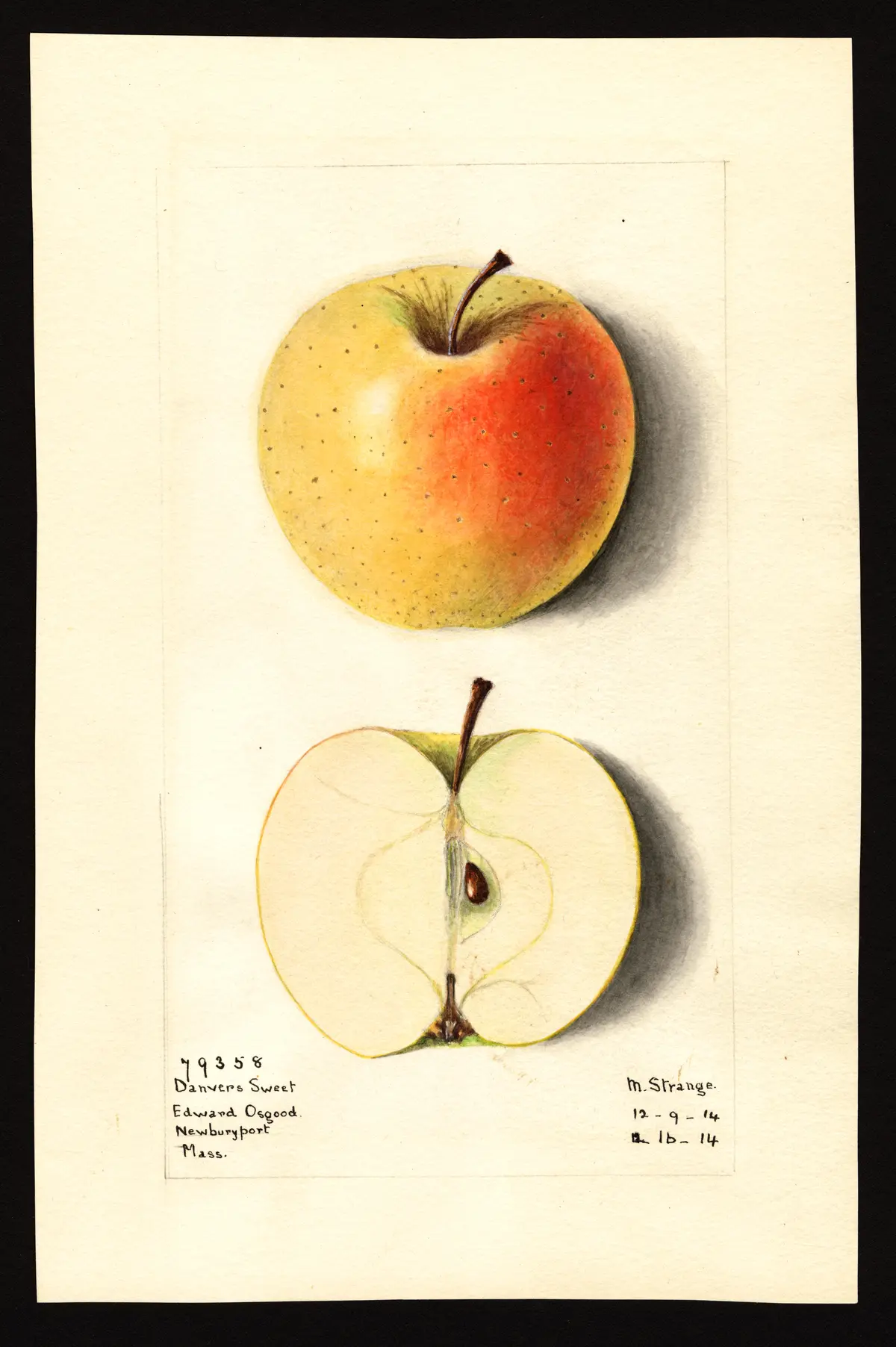
USDA Pomological Watercolor Collection
Danvers Sweet
Origin / History
Danvers Sweet originated in the town of Danvers, Massachusetts, from which it takes its name. The original tree was still standing in 1832, on Kenrick's authority as cited by Beach. Elliott records it only as "American." Kenrick and most of the earlier authors published the variety as Danvers Winter Sweet.
About seventy-five years before Beach wrote, Kenrick and Manning recommended it as a profitable market apple, very productive and worthy of extensive cultivation. Danvers Sweet was included in the American Pomological Society's first list of varieties worthy of being recommended. Downing says it "has been for a long time one of the best market apples," but adds, "we think it inferior to the Ladies' Sweeting." Beach (1905) finds the fruit of good marketable size and very good in quality, but "rather dull green and not particularly attractive in color." He reports it now nearly obsolete in New York State and no longer recommended for planting.
It was planted in spring 1895 at the Central Experimental Farm, Agassiz, British Columbia. Lowther's station table records it as reported by 4 stations in the Northern Division and 6 stations in the Central Division, and as reported in more than one division.
Tree
Vigorous; a good, rapid to very rapid grower, very thrifty (Warder), spreading (Elliott). It was a vigorous grower at Agassiz.
Young shoots dark grayish brown to dark brown, with grayish scarf-skin, slightly downy to pubescent. Elliott alone gives the shoots as yellowish.
Productive to very productive, an abundant bearer, yearly productive (Elliott).
Fruit
Size: Medium to large, of good marketable size, pretty uniform in size and shape (Beach). Most accounts give medium or somewhat above: medium or rather large, above medium, medium to sometimes large. Warder calls it large.
Form: Roundish oblong to roundish inclined to conic, sometimes a little oblate; regular, obscurely ribbed (Thomas). Most authors give roundish oblong, or roundish, remotely oblong or conical, and the Agassiz test gives oblong, conical. Warder describes it as globular, truncate, sometimes globular-oblate, and Lowther as roundish oblate.
Stem: Slender, knobby, inclining to one side; pubescent (Beach). Thomas measures it three-quarters to one inch long. The length is in conflict: Warder calls it long, Beach short to medium.
Cavity: Rather large, wide or broad, rather deep to deep, acute to acuminate; brown (Warder). Beach finds it sometimes partly russeted and often distinctly furrowed.
Calyx: Small to medium; woolly (Elliott); closed (Warder), usually closed (Beach). Segments long (Warder); lobes pubescent, sometimes separated at the base (Beach). Calyx tube funnel-shape with rather narrow limb; stamens median or above (Beach).
Basin: Smooth, narrow to rather narrow, moderately abrupt to abrupt, regular. Beach finds it furrowed and wrinkled, varying from large and wide to rather small and narrow. The depth is in conflict: Elliott calls it shallow, Warder deep.
Skin: Smooth, uneven in Warder's account; moderately thin, tough (Beach). Greenish yellow, becoming a rather dull rich yellow, sometimes with an orange blush. The Agassiz test gives the blush as dull. Beach describes the skin as grass-green somewhat shaded with yellow, sometimes with a faint bronze blush.
Dots: Numerous, medium, prominent or conspicuous, with white and green bases (Warder); many submerged and whitish, others areolar with russet center (Beach); small russet specks (Elliott).
Flesh and flavor: Yellow, or greenish with a decided yellow tinge (Beach). Breaking, fine-grained to moderately fine, juicy to rather juicy. The texture is in conflict: Elliott, Downing and the Agassiz test call the flesh firm, Beach very tender.
Sweet to very sweet, and rich. Quality "very good" by most accounts. Warder, and Beach in his technical description, give "good to very good."
Core and seeds: Core medium to large; round, regular (Warder); axile, with cells symmetrical and core lines clasping (Beach). Warder and Beach give the core closed; Elliott calls it large and open. Carpels rather flat, roundish to roundish obovate, slightly emarginate, mucronate, smooth (Beach).
Seeds brown to dark rich brown, pointed to obtuse, ovate (Elliott) to narrow, numerous (Warder). The size is in conflict: Warder calls them long, Beach medium or below.
Season
The recorded season runs from November into April. Most authors give the whole winter, ending in April; Downing calls it fit for use the whole winter and often till April. Warder alone gives a short season, December and January.
Uses
A baking apple; it bakes well. Elliott calls it a "valuable winter fruit for baking or stock." Lowther gives its use as both kitchen and market.
Subtypes / Variants
Not described in source.
Other
Figured by Thomas (Fig. 408).
Book Sources
Described in 7 period pomological works
- Beach, The Apples of New York Vol. 1 (1905)
- Budd & Hansen, Systematic Pomology (1914)
- Lowther (ed.), Encyclopedia of Practical Horticulture (1914) — listed as Danvers' Sweet
- Warder, American Pomology: Apples (1867) — listed as Danvers' Winter Sweet
- Downing, Fruits and Fruit Trees of America (1900) — listed as Danvers Winter Sweet
- Elliott, The Western Fruit Book (1865) — listed as Danver's Winter Sweet
- Thomas, The American Fruit Culturist (1903) — listed as Danvers Winter Sweet
Nursery Catalog Sources
Found in 6 catalogs (1845–1913) from Illinois, Massachusetts
- Winship's Nursery (Brighton Nurseries , operated by the Winship family), Brighton (Boston) , Massachusetts — 1845 — listed as Danvers Winter Sweet
- Azell Bowditch (Nursery / Fruit Catalog) , Boston , Massachusetts — 1850 — listed as Danvers Winter Sweet
- Joseph Breck & Co. , Boston , Massachusetts — 1855 — listed as Danvers Winter Sweet
- Central Experimental Farm , Dominion Department of Agriculture, Agassiz, British Columbia (under test; Bulletin No. 3, Second Series) — 1900 — listed as Danvers Winter Sweet
- Benjamin Buckman (personal inventory) , Farmingdale , Illinois — 1901
- Benjamin Buckman (personal inventory) , Farmingdale , Illinois — 1913
View original book sources (8)
— F.R. Elliott, The Western Fruit Book (1865)Danver's Winter Sweet.
Epse's Sweet.
American. Tree, vigorous, spreading, shoots yellowish, yearly productive; valuable winter fruit for baking or stock.
Size, medium; form, roundish oblong; color, dull yellow, with orange blush, and small russet specks; stem, slender, inclining to one side; calyx, small, woolly; basin, shallow, rather narrow; flesh, yellow, firm, sweet; core, large, open; seeds, ovate pointed, dark rich brown. December to April.
— John A. Warder, American Pomology: Apples (1867)Danvers' Winter Sweet.
Origin Danvers, Massachusetts. Tree very thrifty, very productive.
Fruit large, globular, truncate, sometimes globular-oblate, regular; Surface smooth, uneven, greenish-yellow; Dots numerous, medium, prominent, with white and green bases.
Basin abrupt, deep, regular; Eye small, closed; Segments long.
Cavity wide, deep, brown; Stem long, slender, knobby.
Core round, regular, closed; Seeds numerous, long, brown, pointed; Flesh yellow, breaking, fine-grained, juicy; Flavor very sweet; Quality good to very good; Use, baking; Season, December and January.
— A.J. Downing, The Fruits and Fruit Trees of America (1900)Danvers Winter Sweet.
Epse's Sweet.
Origin, Massachusetts, in the town of Danvers, from which this variety takes its name, it has been for a long time one of the best market apples, but we think it inferior to the Ladies' Sweeting. It is an abundant bearer, and a very rapid tree in its growth. Young shoots dark grayish brown, slightly downy.
Fruit of medium size, roundish oblong. Skin smooth, dull yellow, with an orange blush. Stalk slender, inclining to one side. Calyx set in a smooth, narrow basin. Flesh yellow, firm, sweet, and rich. Very good. It bakes well, and is fit for use the whole winter, and often till April.
— John J. Thomas, The American Fruit Culturist (1903)Danvers Winter Sweet.* Medium or rather large, roundish, remotely oblong or conical, obscurely ribbed; greenish yellow, becoming a rather dull rich yellow, sometimes an orange blush; stalk three-quarters to one inch long, cavity acute; basin smooth, narrow; flesh yellow, sweet, rich. Fig. 408. Growth vigorous, tree productive. Massachusetts.
— S.A. Beach, The Apples of New York, Vol. 1 (1905)DANVERS SWEET.
REFERENCES. 1. Kenrick, 1833:43. 2. Mag. Hort., 1:154. 1835. 3. Manning, 1838:60. 4. Downing, 1845:108. 5. Thomas, 1849:161. 6. Emmons, Nat. Hist. N. Y., 3:86. 1851. 7. Am. Pom. Soc. Cat., 1852. 8. Elliott, 1858:74. 9. Mag. Hort., 26:101. 1860. 10. Warder, 1867:550. 11. Barry, 1883:344. 12. Lyon, Mich. Hort. Soc. Rpt., 1890:290. 13. Bailey, An. Hort., 1892:237. 14. Munson, Me. Sta. Rpt., 1893:132. 15. Budd-Hansen, 1903:69.
SYNONYMS. DANVERS SWEET (12). Danvers Winter (14). DANVERS WINTER SWEET (1, 2, 3, 4, 5, 7, 8, 9, 10, 11, 13). Eppes' Sweet (1, 2). Epse's Sweet (4, 8).
Tree a good grower and very productive. Fruit is of good marketable size and very good in quality, but rather dull green and not particularly attractive in color. It is no longer recommended for planting.
Historical. About 75 years ago this was being recommended by Kenrick (1) and Manning (3) as a profitable market apple, very productive and worthy of extensive cultivation. Danvers Sweet was included in the American Pomological Society's first list of varieties worthy of being recommended (6). In New York state it is now nearly obsolete. It originated at Danvers, Mass., where the original tree was still standing in 1832 (1).
TREE.
Tree a rapid grower. Twigs dark brown with grayish scarf-skin, pubescent.
FRUIT.
Fruit medium to sometimes large; pretty uniform in size and shape. Form roundish inclined to conic, sometimes a little oblate. Stem short to medium, pubescent, knobby. Cavity rather large, acute to acuminate, rather deep, broad, sometimes partly russeted, often distinctly furrowed. Calyx small to medium, usually closed; lobes pubescent, sometimes separated at the base. Basin varies from large and wide to rather small and narrow, moderately abrupt, furrowed and wrinkled.
Skin moderately thin, tough, smooth, grass-green somewhat shaded with yellow, sometimes with faint bronze blush. Dots conspicuous, many submerged and whitish, others areolar with russet center.
Calyx tube funnel-shape with rather narrow limb. Stamens median or above.
Core axile, medium; cells symmetrical, closed; core lines clasping. Carpels rather flat, roundish to roundish obovate, slightly emarginate, mucronate, smooth. Seeds dark, medium or below, narrow, acute to obtuse.
Flesh greenish with decided yellow tinge, breaking, moderately fine, very tender, rather juicy, very sweet, good to very good.
Season November to April.
— J.L. Budd & N.E. Hansen, American Horticultural Manual, Part II: Systematic Pomology (1914)Danvers Sweet.—Origin, Danvers, Massachusetts; tree productive and of very rapid growth.
Fruit large, roundish oblong, sometimes roundish oblate, regular; surface smooth, uneven, dull greenish yellow, with orange blush; dots numerous, medium, prominent, with white and green bases; cavity wide, deep, brown; stem long, slender, knobby; basin smooth, deep, narrow, abrupt; calyx small, closed; segments long. Core round, regular, closed; seeds numerous, long, brown, pointed; flesh yellow, fine-grained, juicy, firm, very sweet and rich, very good; good for baking. All winter.
— Granville Lowther (ed.), Encyclopedia of Practical Horticulture (1914)Danvers' Sweet is a medium-sized fruit of roundish oblate form with greenish yellow skin. Quality is very good. Use is both kitchen and market. Season is winter. Reported by 4 stations in the Northern Division (also reported in more than one division) and 6 stations in the Central Division (also reported in more than one division).
— Central Experimental Farm, Central Experimental Farm, Agassiz BC — Catalogue of Fruit Trees under Test (Bulletin No. 3, 1900) (1900)Planted Spring 1895. Tree a vigorous grower. Fruit above medium size, oblong, conical. Skin smooth, greenish yellow, with a dull blush. Flesh yellow, firm, rich, sweet, quality very good. Season midwinter.