Dix
Pear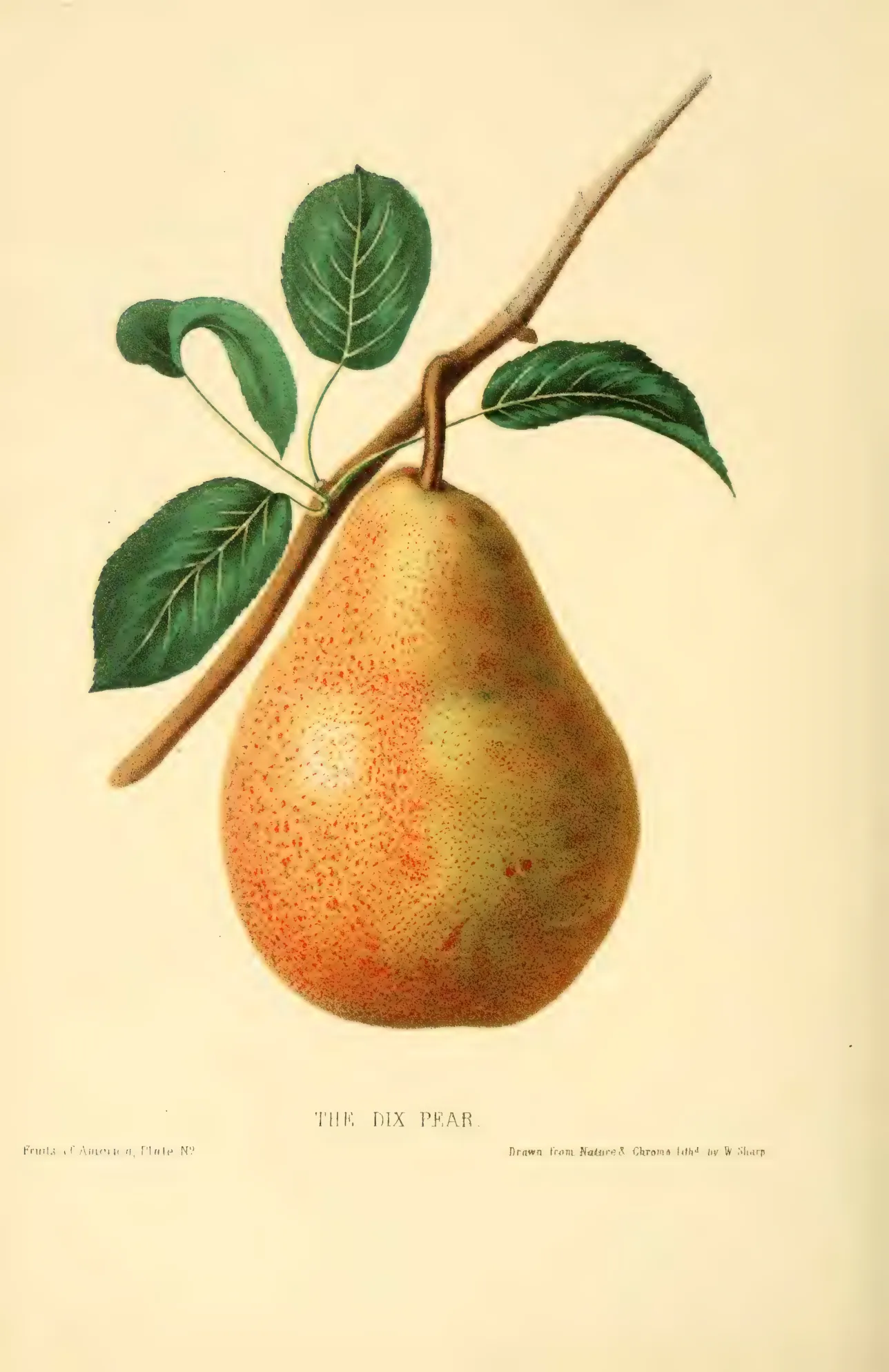
Dix
Origin / History
Dix is an American seedling pear from Boston, Massachusetts. It sprang from seed near the house in the garden of Madame Dix and was named in compliment to her. Hovey (1852) dates its origin "about thirty-five years ago." The young tree grew so rapidly that by 1829 it stood twenty-three feet high, with a stem ten inches in diameter. In Hovey's day it still stood in the same spot and had become a very large tree. Hovey says it first began to bear in 1825 but did not produce a full crop until 1829, and has borne abundant crops of fine fruit ever since; Downing gives 1826 as the year it first bore.
Dix was brought into notice in 1829 and described in the New England Farmer, vol. viii, p. 161, in 1830. Hedrick also cites Prince's Pomological Manual (1831) and Downing's Fruits and Fruit Trees of America (1869). On its introduction it was pronounced "one of the very best autumn pears, which might, with the greatest safety, be introduced into our gardens." Hovey adds that "twenty years' experience have fully confirmed the correctness of that opinion."
Hovey writes that "few, if any, of our native pears hold a higher rank than the Dix." He credits this standing to "the large size, beautiful appearance, and exquisite flavor of its fruit, added to the vigor and hardiness of the tree, its productiveness, constant bearing, and period of maturity," which together make "a combination of qualities which but few varieties possess." He also records that cultivators often rejected Dix when selecting fine pears because it is so late in coming into bearing. Downing calls it "unquestionably, a fruit of the highest excellence," which "deserves the attention of all planters."
Tree
Vigorous and hardy; Downing calls it one of the hardiest of pear trees. Habit erect and upright; in time it forms a large and fine head. Annual shoots rather long and slender, horizontal at first but erect at the ends. As the branches age they assume a rather straggling habit (Hovey). Shoots occasionally thorny (Hovey), often thorny (Thomas).
Hovey calls Dix one of the most marked varieties in the nursery, its wood "almost as yellow, smooth, and slender, as a willow." Young wood clear light yellow to pale yellow, smooth and glossy, with very minute dots, slender and rather long-jointed. Downing gives the young branches as dull olive yellow brown, upright and slender. Old wood pale olive yellow. Buds medium size, roundish ovate, slightly diverging, with very prominent shoulders; flower buds medium size (Hovey).
Leaves small, ovate, light green, broadest in the middle, tapering to each end. Hovey describes them as little recurved on the midrib, slightly wavy, and somewhat reflexed at the edges; Thomas calls them flat. Surface smooth and glossy; very finely serrated. Petioles long, about two inches, slender. Flowers medium size, petals narrow (Hovey).
Very late in coming into bearing: a tardy bearer, unproductive while young, not bearing until the tree has attained considerable size. Hovey gives the average period before fruiting as eight or ten years, occasionally four or five, "but oftener twelve and upwards." He adds that once in fruit it is productive and a constant bearer, and that the pears "ripen off as freely as the Baldwin apple." Does not succeed on the quince unless double-worked (Hovey).
Fruit
Size: Large; about four inches long and three and a half inches in diameter (Hovey).
Form: Oblong, oblong pyriform, or long pyriform. Hovey gives oblong inclining to pyramidal, regular, largest in the middle, tapering to an obtuse point at the stem. Thomas gives the body as round-ovate, tapering slightly to the often oblique, slightly flattened, obtuse crown.
Stem: Short to medium length, about an inch (Hovey) to an inch and a quarter (Thomas) long. Rather stout to stout, thicker at each end. Curved (Hovey). Set obliquely or rather obliquely.
Cavity: Little or no depression, or slightly sunk; Budd and Hansen give a slight depression at the top of the neck. Hovey describes a shallow cavity formed by swellings and projections of the fruit, highest on one side; Elliott likewise notes the stem raised on one side.
Calyx: Small, "small for so large a fruit" (Downing); Hovey calls the eye medium size. Open and slightly sunk; segments of the calyx short, stiff, projecting (Hovey).
Basin: Small, narrow, shallow to very shallow, scarcely at all sunk; plaited or furrowed (Hovey).
Skin: Slightly rough to rough. Green, yellowish green, or greenish yellow, becoming pale yellow (Hovey) to fine deep yellow at maturity; Hedrick says the exposed fruit becomes deep yellow when ripe. Broadly tinged with pale red in the sun and mottled with dots of a deeper shade (Hovey). Sprinkled with russet around the stalk; often russeted around the crown (Hovey).
Dots: Numerous, distinct, russet. Hovey describes large distinct russet specks, regularly and thickly covering the skin.
Flesh and flavor: Yellowish white; coarse, not very fine-grained, or rather granular. Melting and juicy. Rich, sugary, sweet, slightly vinous, perfumed, delicious, of a fine flavor. Elliott calls the flesh "a little harsh," and Thomas "often excellent, sometimes rather acid." Downing rates it "very good to best," Hovey praises its "exquisite flavor," and Hedrick notes it is "by some thought to be superior to the St. Germain."
Core and seeds: Core rather large (Hovey), marked with a dark gritty circle extending toward the stem (Elliott). Seeds small (Hovey).
Season
Autumn: October and November, or middle and late autumn. Hovey gives ripe in November, keeping four or five weeks.
Uses
Recommended at its introduction as an autumn pear for gardens. Elliott considers the tree well suited to extensive orcharding.
Subtypes / Variants
Not described in source.
Other
The fruit often cracks (Thomas). Budd and Hansen say it cracks except in drier inland climates with less moisture of air.
Book Sources
Described in 6 period pomological works
Nursery Catalog Sources
Found in 4 catalogs (1845–1864) from Massachusetts
- Winship's Nursery (Brighton Nurseries , operated by the Winship family), Brighton (Boston) , Massachusetts — 1845
- Hovey & Co. , Cambridge , Massachusetts — 1849
- Joseph Breck & Co. , Boston , Massachusetts — 1855
- St. Helena Nursery , Howell Prairie, Marion County, OR (Marion Co., Ogn.) — 1864
View original book sources (6)
— C.M. Hovey, The Fruits of America (1852)THE DIX PEAR.
Dix. New England Farmer, vol. viii. p. 161, 1830.
Few, if any, of our native pears hold a higher rank than the Dix. The large size, beautiful appearance, and exquisite flavor of its fruit, added to the vigor and hardiness of the tree, its productiveness, constant bearing, and period of maturity, give it a combination of qualities which but few varieties possess. When originally brought into notice, in 1829, it was pronounced "one of the very best autumn pears, which might, with the greatest safety, be introduced into our gardens;" and twenty years' experience have fully confirmed the correctness of that opinion.
The Dix originated in Boston, in the garden of Madame Dix, in compliment to whom it was named, about thirty-five years ago. The tree sprung from seed near the house, and grew so rapidly, that, in 1829, it had attained the height of twenty-three feet, with a stem ten inches in diameter; it still stands in the same spot, and has now become a very large tree. It first began to bear in 1825, but did not produce a full crop till 1829, since which time it has continued to bear abundant crops of fine fruit.
The Dix is very late in coming into bearing, and, on this account, cultivators have often rejected it in making a selection of fine pears. The average period of its fruiting is eight or ten years, occasionally in four or five, but oftener twelve and upwards. It has, however, the good quality of constant bearing after it has attained a fruiting state, and the pears ripen off as freely as the Baldwin apple. It does not succeed upon the quince unless double-worked.
The Dix is one of the most marked varieties in the nursery. The wood is almost as yellow, smooth, and slender, as a willow; but the tree has an erect and upright habit, and in time forms a large and fine head.
Tree.—Vigorous, upright, with rather long and slender annual shoots, occasionally thorny, horizontal at first, but erect at the ends; as the branches become older they assume a rather straggling habit.
Wood.—Clear light yellow, smooth and glossy, with very minute dots, slender and rather long-jointed; old wood, pale olive yellow; buds, medium size, roundish ovate, slightly diverging, with very prominent shoulders: Flower-buds, medium size.
Leaves.—Small, ovate, light green, broadest in the middle, tapering to each end, little recurved on the midrib, slightly wavy, and somewhat reflexed at the edges, with a smooth and glossy surface, and very finely serrated; petioles long, about two inches in length, slender.
Flowers.—Medium size, petals narrow.
Fruit.—Large, about four inches long and three and a half in diameter: Form, oblong, inclining to pyramidal, regular, largest in the middle, tapering to an obtuse point at the stem: Skin, slightly rough, greenish yellow, becoming pale yellow when mature, broadly tinged with pale red in the sun, and mottled with dots of a deeper shade, often russeted around the crown, and regularly and thickly covered with large distinct russet specks: Stem, medium length, about an inch long, rather stout, curved, and inserted in a shallow cavity, formed by swellings and projections of the fruit, highest on one side: Eye, medium size, open and slightly sunk in a very shallow, plaited or furrowed basin; segments of the calyx short, stiff, projecting: Flesh, yellowish white, coarse, melting, and juicy: Flavor, rich, sugary, slightly vinous, perfumed and delicious: Core, rather large: Seeds, small.
Ripe in November, and keeps four or five weeks.
— F.R. Elliott, The Western Fruit Book (1865)Dix.
American. Origin, Boston, Mass. Tree, hardy, vigorous, young shoots, pale yellow, upright, slender, unproductive while young, well suited to extensive orcharding. Fruit, large, oblong pyriform; skin, little rough, yellow, with russet dots, and around the stem: stem, set obliquely, raised one side, short, stout, thickest at each end; calyx, small; basin, shallow; core, marked with a dark gritty circle, extending toward the stem; flesh, yellowish white, melting, a little harsh, juicy, sweet. October and November.
— A.J. Downing, The Fruits and Fruit Trees of America (1900)Dix.
Dix. Lewis, erroneously, of the French.
The Dix is, unquestionably, a fruit of the highest excellence, and deserves the attention of all planters. It is one of the hardiest of pear-trees, but the tree does not come into bearing until it has attained considerable size. The young branches are dull olive yellow brown, upright, and slender. The original tree stands in the garden of Madam Dix, Boston. It bore for the first time in 1826.
Fruit large, oblong, or long pyriform. Skin roughish, fine deep yellow at maturity, marked with distinct russet dots, and sprinkled with russet around the stalk. Calyx small for so large a fruit. Basin narrow, and scarcely at all sunk. Stalk rather stout, short, thicker at each end, set rather obliquely, but with little or no depression. Flesh not very fine-grained, but juicy, rich, sugary, melting, and delicious, with a slight perfume. Very good to best. October and November.
— John J. Thomas, The American Fruit Culturist (1903)Dix. Large, long pyriform, body round-ovate, tapering slightly to the often oblique and slightly flattened and obtuse crown; yellowish green, becoming deep yellow; dots numerous, distinct; stalk an inch and a quarter long, stout at each end, slightly sunk; basin small; flesh rather granular, rich, juicy, sweet, often excellent, sometimes rather acid. The fruit often cracks. Middle and late autumn. A tardy bearer. Shoots yellow, rather slender, often thorny; leaves flat. A native of Boston, Mass. Fig. 700.
— J.L. Budd & N.E. Hansen, American Horticultural Manual, Part II: Systematic Pomology (1914)Dix. — Large, oblong, or long pyriform; color deep yellow at maturity, with russet dots and russet around the stem; skin somewhat rough; stem short, stout, thickened at each end, and set obliquely with slight depression at top of neck; basin narrow and very shallow. Flesh a trifle coarse, but juicy, rich, sugary, melting, delicious, very good to best. Fruit often cracks except in drier inland climates with less moisture of air. Massachusetts.
— U.P. Hedrick, The Pears of New York (1921)Dix.
- Prince Pom. Man. 1:142. 1831. 2. Downing Fr. Trees Am. 737, fig. 1869.
Originated in the garden of Madame Dix, Boston, Mass.; it bore first in 1826. Fruit large, oblong or long-pyriform; skin rough, green, the exposed fruit becoming deep yellow when ripe, marked with distinct russet dots and sprinkled with russet around the stalk; flesh melting, rich, juicy, of a fine flavor and by some thought to be superior to the St. Germain; very good to best; Oct. and Nov.