Doctor
Apple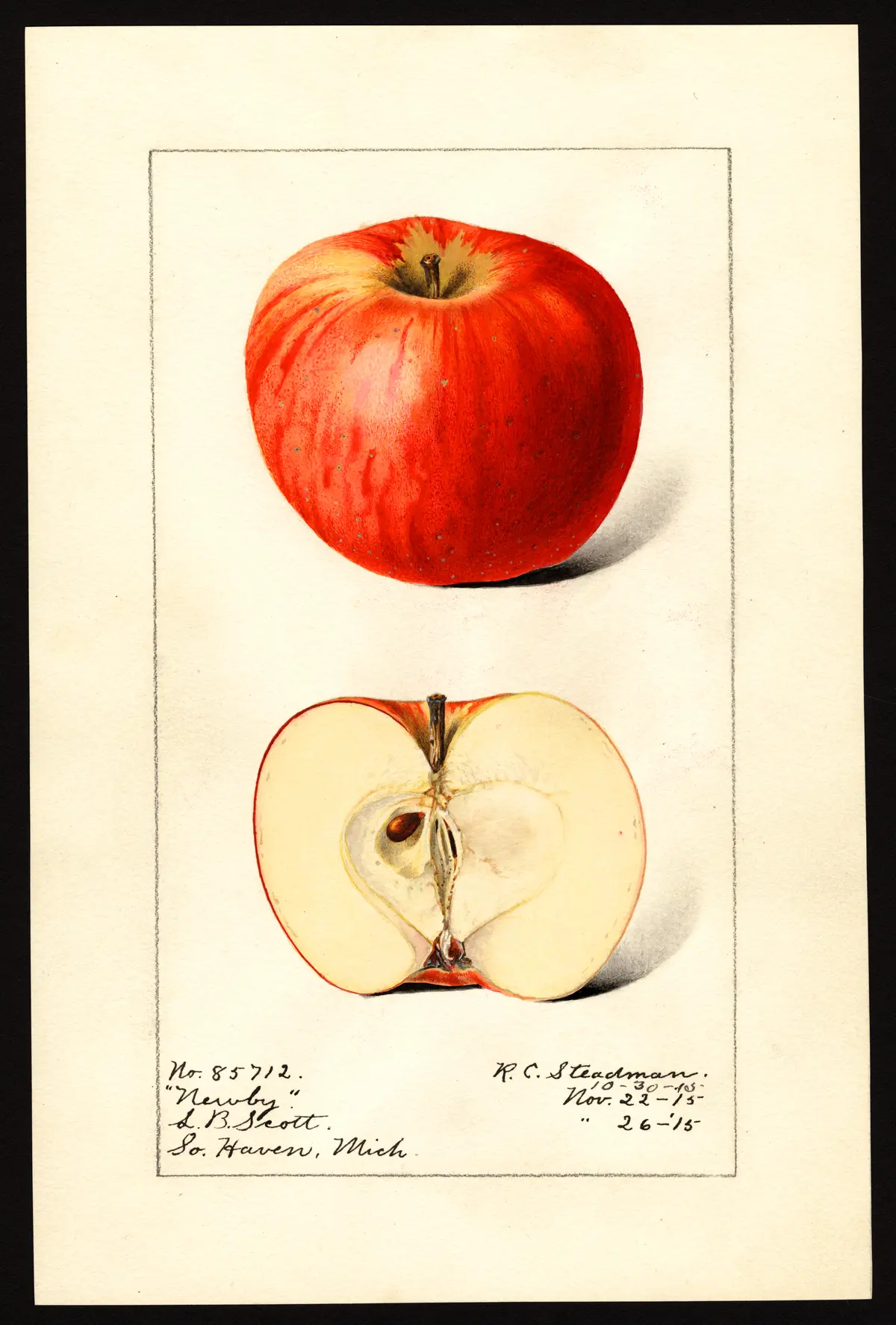
USDA Pomological Watercolor Collection
Doctor
Origin/History
Doctor is an old American variety originating at Germantown, Pennsylvania, near Philadelphia, about 1800. It derives its name from a physician in Germantown by whom it was first brought into notice. The variety has been grown to a considerable extent in Pennsylvania, southern Ohio, Indiana, and other portions of the Central West, succeeding well in Pennsylvania and Ohio but being less esteemed farther north. It gained only slight recognition in New York and is not recommended for planting there. It has been reintroduced in Indiana under the name Newby, and has also been disseminated under the names Coon Red, or Coon. Coxe first described it in 1817.
Tree
Sources differ on tree vigor: Downing describes the tree as "rather an indifferent grower and bearer," while Beach calls it "moderately vigorous" and Hedrick describes it as "vigorous" (and elsewhere "but moderately vigorous, and not above the average in other characters, thus bringing the variety down to mediocrity"). Beach reports it has the reputation of being generally a regular and abundant bearer, and is not slow in coming into bearing. Elliott notes that in southern Ohio and Indiana it produces abundantly of second-rate fruit.
Form very open and spreading. Twigs long to medium, straight, moderately stout; internodes medium or above. Bark clear reddish-brown with some olive-green, streaked with scarf-skin, but slightly pubescent. Lenticels scattering, medium or below medium size, roundish or oblong, raised. Buds medium size, broad, plump, obtuse, free or nearly so, somewhat pubescent. Leaves medium size, broad.
Fruit
Size
Medium to large; pretty uniform in size and shape. Coxe describes it as "very large, fair, and beautiful." Elliott gives medium to large; Thomas medium in size, or large; Downing medium.
Form
Oblate, symmetrical, angular. Coxe describes the form as "rather flat"; Elliott as flat; Downing as roundish oblate; Thomas as regular, oblate.
Stem
Stem short, or short to medium. Coxe notes the stem is "very short, and both ends deeply indented." Thomas notes "stalk and calyx deep set."
Cavity
Acute, deep, wavy, not russeted, sometimes lipped. Elliott also describes the cavity as deep.
Calyx
Large, somewhat open; lobes long, acute. Elliott describes the calyx as closed. Calyx tube rather large, rather short urn-shape to truncate funnel-form. Stamens basal to above median (Beach); stamens basal (Hedrick).
Basin
Variable, somewhat obtuse to abrupt, often wide, deep, ridged and wrinkled. Elliott describes the basin as open.
Skin
Smooth, waxen yellow, overspread with a bright light red blush, indistinctly marked with narrow carmine splashes. Coxe describes the skin as smooth, with a yellow ground, clouded and streaked with shades of red, with a few small dark spots or clouds. Elliott: yellow striped and washed with several shades of red and occasional spots of russet. Downing: yellow, striped and washed with two or three shades of red, with a few darker spots. Thomas: yellow, clouded and streaked with red. Dots green or grayish (Beach); green or gray (Hedrick). Prevailing effect attractive red and yellow.
Flesh/Flavor
Flesh a little tinged with yellow (Beach) / yellow (Hedrick), firm, moderately coarse (Beach) / coarse (Hedrick), crisp, rather tender (Beach) / tender (Hedrick), juicy, mild subacid, slightly aromatic (Beach) / aromatic (Hedrick); good to nearly very good (Beach), good to very good (Hedrick). Coxe describes the flesh as "tender, juicy, and highly flavoured, remarkably breaking." Elliott: tender, juicy. Downing: tender, juicy, breaking, slightly aromatic, subacid; Good. Thomas: breaking, tender, aromatic, brisk, fine flavor.
In texture, flavor and general quality Beach considers it inferior to Baldwin, while Hedrick states it is of about the same quality as that of the Baldwin.
Core/Seeds
Core medium to small (Beach) / small (Hedrick), abaxile; cells usually symmetrical, open or sometimes closed; core lines meeting or somewhat clasping. Carpels smooth, broadly elliptical, quite concave. Seeds medium in size, wide, obtuse. Elliott: core small; seeds oblong pyriform.
Season
Sources give varying seasons. Coxe: ripens in October and keeps for several months. Elliott: October to January. Downing: October, January. Thomas: late autumn and early winter. Beach: December to April or later. Hedrick: December to April.
Uses
Among the most admired apples of the season as a table fruit (Coxe). Of value chiefly for market, although acceptable for either dessert or culinary uses (Beach).
Subtypes/Variants
Not described in source.
Other
Fruit attractive because of its good color, desirable size and uniformity in size and shape.
Book Sources
Described in 6 period pomological works
- Coxe, A View of the Cultivation of Fruit Trees (1817) — listed as Doctor, or Dewit Apple
- Beach, The Apples of New York Vol. 1 (1905)
- Downing, Fruits and Fruit Trees of America (1900)
- Elliott, The Western Fruit Book (1865)
- Hedrick, Cyclopedia of Hardy Fruits (1922)
- Thomas, The American Fruit Culturist (1903)
USDA Nomenclature (1905)
From W.H. Ragan, Nomenclature of the Apple, USDA Bulletin No. 56
Newby is here added as a synonym of Doctor.
Nursery Catalog Sources
Found in 4 catalogs (1900–1913) from Illinois
- Central Experimental Farm , Dominion Department of Agriculture, Agassiz, British Columbia (under test; Bulletin No. 3, Second Series) — 1900
- Benjamin Buckman (personal inventory) , Farmingdale , Illinois — 1901
- Benjamin Buckman (personal inventory) , Farmingdale , Illinois — 1901 — listed as Newby
- Benjamin Buckman (personal inventory) , Farmingdale , Illinois — 1913 — listed as Newby
View original book sources (6)
— William Coxe, A View of the Cultivation of Fruit Trees (1817)NO. 31. DOCTOR, OR DEWIT APPLE.
This is a very large, fair, and beautiful apple—the form is rather flat; the skin is smooth, with a yellow ground, clouded and streaked with shades of red, with a few small dark spots or clouds—the stem is very short, and both ends deeply indented—the flesh is tender, juicy, and highly flavoured, remarkably breaking—it ripens in October, and keeps for several months: it is among the most admired apples of the season as a table fruit. It derives its name from a physician in Germantown, near Philadelphia, by whom it was first brought into notice.
— F.R. Elliott, The Western Fruit Book (1865)Doctor. Red Doctor, | De Witt. Native of Pennsylvania. Much grown in Southern Ohio and Indiana, producing abundantly of second-rate fruit. Fruit, medium to large, flat, yellow striped and washed with several shades of red and occasional spots of russet ; calyx, closed ; basin, open ; cavity, deep ; core, small ; seeds, oblong pyriform ; flesh, tender, juicy. October to January.
— A.J. Downing, The Fruits and Fruit Trees of America (1900)Doctor.
Red Doctor. De Witt.
A Pennsylvania Apple; the tree is rather an indifferent grower and bearer.
Fruit medium, roundish oblate, yellow, striped and washed with two or three shades of red, with a few darker spots. Flesh tender, juicy, breaking, slightly aromatic, subacid. Good. October, January.
— John J. Thomas, The American Fruit Culturist (1903)Doctor. (De Witt.) Medium in size, or large; regular, oblate; yellow, clouded and streaked with red; stalk and calyx deep set; flesh breaking, tender, aromatic, brisk, fine flavor. Late autumn and early winter. Succeeds well in Pennsylvania and Ohio; less esteemed farther north. Origin, Pennsylvania.
— S.A. Beach, The Apples of New York, Vol. 1 (1905)DOCTOR.
REFERENCES. 1. Coxe, 1817:119. fig. 2. Wilson, 1828:136. 3. Cat. Hort. Soc. London, 1831. 4. Downing, 1845:107. 5. Thomas, 1849:147. 6. Emmons, Nat. Hist. N. Y., 3:62. 1851. 7. Hooper, 1857:29. 8. Elliott, 1858:130. 9. Warder, 1867:717. 10. Livingston, Amer. Gard., 21:204. 1900. 11. Munson, Me. Sta. An. Rpt., 18:89. 1902. 12. Powell and Fulton, U. S. B. P. I. Bul., 48:40. 1903. 13. Beach and Clark, N. Y. Sta. Bul., 248:115. 1904.
SYNONYMS. COON (13). COON RED (13). DEWIT APPLE (1). DE WITT (3, 4, 5, 8). DOCTOR DEWITT (9). Newby (12). Red Doctor (4, 8).
Fruit attractive because of its good color, desirable size and uniformity in size and shape. In texture, flavor and general quality it is inferior to Baldwin. It is of value chiefly for market, although acceptable for either dessert or culinary uses. The tree is vigorous, or moderately so, and has the reputation of being generally a regular and abundant bearer. It is not slow in coming into bearing. Not recommended for planting in New York.
Historical. An old variety which originated at Germantown, Pa. Named in honor of a physician who brought it into notice (1, 4). It has been grown to a considerable extent in Pennsylvania, Ohio and other portions of the Central West, but it has gained only slight recognition in New York. It has been reintroduced in Indiana under the name Newby. It has also been disseminated under the name Coon Red, or Coon.
TREE.
Tree moderately vigorous. Form very open and spreading. Twigs long to medium, straight, moderately stout; internodes medium or above. Bark clear reddish-brown with some olive-green, streaked with scarf-skin, but slightly pubescent. Lenticels scattering, medium or below medium size, roundish or oblong, raised. Buds medium size, broad, plump, obtuse, free or nearly so, somewhat pubescent. Leaves medium size, broad.
FRUIT.
Fruit medium to large; pretty uniform in size and shape. Form oblate, symmetrical, angular. Stem short or medium. Cavity acute, deep, wavy, not russeted, sometimes lipped. Calyx large, somewhat open; lobes long, acute. Basin variable, somewhat obtuse to abrupt, often wide, deep, ridged and wrinkled. Skin smooth, waxen yellow, overspread with a bright light red blush, indistinctly marked with narrow carmine splashes. Dots green or grayish. Prevailing effect attractive red and yellow. Calyx tube rather large, rather short urn-shape to truncate funnel-form. Stamens basal to above median. Core medium to small, abaxile; cells usually symmetrical, open or sometimes closed; core lines meeting or somewhat clasping. Carpels smooth, broadly elliptical, quite concave. Seeds medium in size, wide, obtuse. Flesh a little tinged with yellow, firm, moderately coarse, crisp, rather tender, juicy, mild subacid, slightly aromatic, good to nearly very good. Season December to April or later.
— U.P. Hedrick, Cyclopedia of Hardy Fruits (1922)DOCTOR. The fruit of this variety is well-colored, satisfactory in size and shape, and of about the same quality as that of the Baldwin. The tree is but moderately vigorous, and not above the average in other characters, thus bringing the variety down to mediocrity. Doctor originated in Germantown, Pennsylvania, about 1800.
Tree vigorous, open and spreading. Leaves broad. Fruit medium to large, uniform in size and shape, oblate, symmetrical, angular; stem short; cavity acute, deep, wavy, sometimes lipped; calyx large, open; lobes long, acute; basin variable, obtuse to abrupt, often wide, deep, ridged and wrinkled; skin smooth, waxen yellow, with a bright red blush, indistinctly marked with narrow carmine splashes; dots green or gray; prevailing effect red and yellow; calyx-tube large, short, urn-shape to truncate funnel-form; stamens basal; core small, abaxile; cells usually symmetrical, open or sometimes closed; core-lines meeting or somewhat clasping; carpels smooth, broadly elliptical, quite concave; seeds medium in size, wide, obtuse; flesh yellow, firm, coarse, crisp, tender, juicy, mild subacid, aromatic; good to very good; December to April.