Doctor Walker
Apple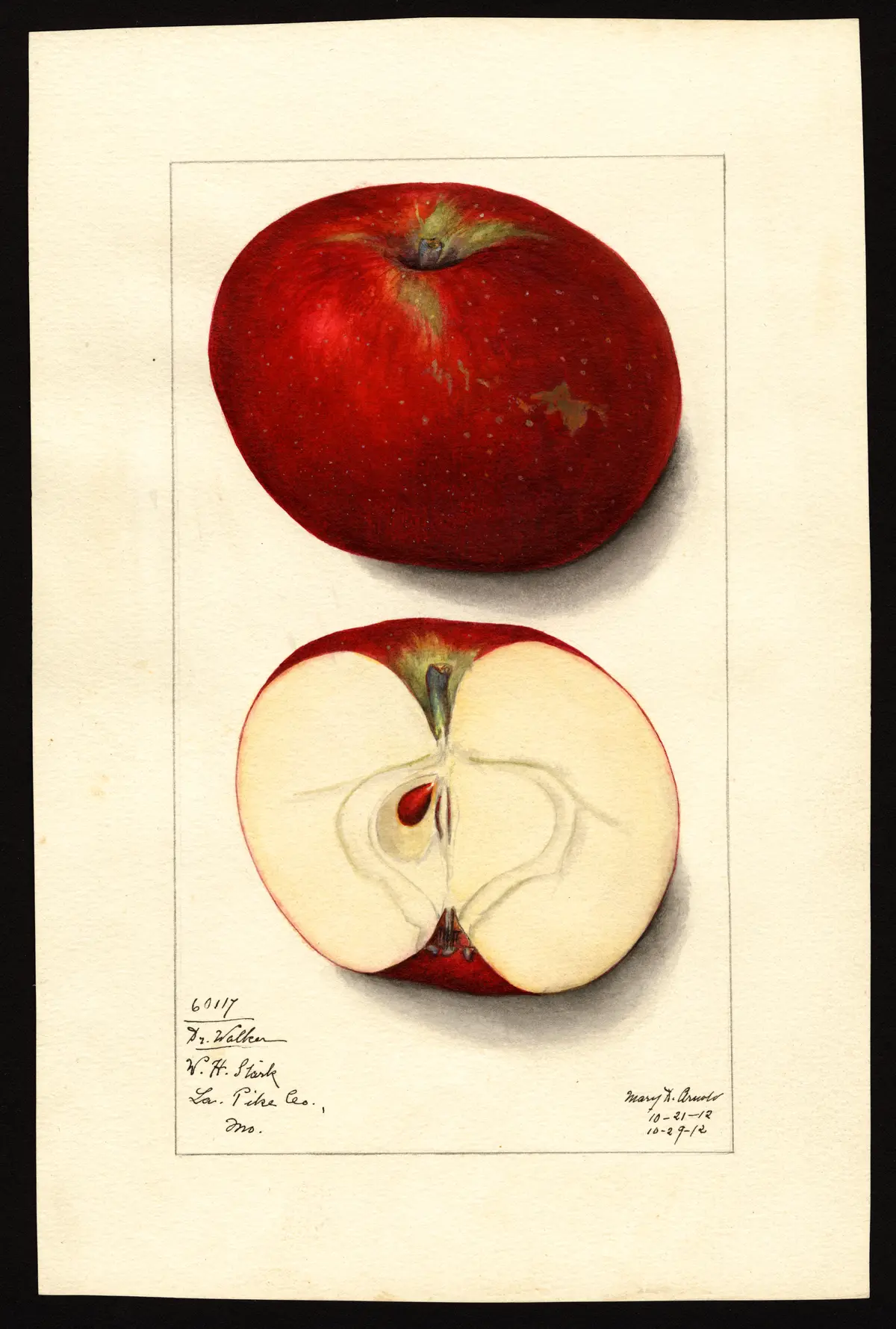
USDA Pomological Watercolor Collection
Doctor Walker
Origin / History
Seedling of Rawles' Genet (Downing; Beach writes "Rails"). Originated on the farm of John Litsey, near Springfield, Ky. In that locality it is said to be superior in quality to its parent, and "an acquisition for its locality", being hardy, productive and blooming late in the season. Downing lists it under the name Litsey. Beach finds the fruit, as grown in New York, only moderately attractive, dull in color and scarcely medium in size; the tree does not come into bearing very early, but is quite productive, and the fruit keeps very late. Beach does not recommend it for planting in New York.
Tree
Tree hardy, vigorous or moderately vigorous; branches short, moderately stout. Form upright spreading and rather open. Twigs below medium or short, straight, rather stout, with large terminal buds; internodes below medium or short. Bark clear dark olive-green somewhat tinged with reddish-brown, little or no scarf-skin, decidedly pubescent. Lenticels numerous, medium to small, roundish to oblong, not raised. Buds often large, broad, plump, obtuse, free, pubescent. Blooms late. Downing calls it an early and good bearer annually; Beach says it does not come into bearing very early, but is quite productive.
Fruit
Size: Medium or below; scarcely medium as grown in New York (Beach).
Form: Oblate or roundish, inclining to conic, sometimes roundish oblate; sometimes a little oblique (Downing).
Stem: Short to medium; small (Downing).
Cavity: Medium in size; acute to acuminate, rather deep, moderately broad, somewhat furrowed, sometimes russeted (Beach).
Calyx: Medium to large, closed or partly open (Downing gives it closed); lobes often leafy, long, acuminate. Calyx tube cone-shape (Beach).
Basin: Abrupt, medium to rather large in width, medium to moderately deep, somewhat furrowed, wrinkled or slightly corrugated.
Skin: Tough, smooth, somewhat glossy; pale yellow, pale green or yellowish, shaded, striped and splashed with light and dark red nearly over the whole (Downing), or deeply blushed or mottled with purplish-red with distinct narrow dull carmine stripes (Beach). Dull in color as grown in New York (Beach).
Dots: Moderately sprinkled, light (Downing); numerous, conspicuous, pale yellow or grayish (Beach).
Flesh and flavor: Flesh whitish, half fine (Downing) or rather fine (Beach), firm, crisp, tender, juicy. Flavor mild subacid, "pleasant", becoming nearly sweet, somewhat aromatic. Downing calls it "quite rich"; Beach rates it "good".
Core and seeds: Core small to medium, rather small (Downing), closed or partly open; core lines meeting or slightly clasping. Carpels roundish inclined to obcordate, emarginate, slightly tufted. Seeds medium or above, dark, wide, obtuse, slightly tufted.
Season
January to May; Downing gives February to May. Keeps well; Beach says the fruit keeps very late.
Uses
Not described in source.
Subtypes / Variants
Not described in source.
Other
Not described in source.
Book Sources
Described in 2 period pomological works
View original book sources (2)
— A.J. Downing, The Fruits and Fruit Trees of America (1900)Litsey.
This is a seedling of Rawles' Genet, and originated on the farm of John Litsey, near Springfield, Ky. It is said to be superior in quality to its parent, and an acquisition for its locality. Tree hardy, vigorous, an early and good bearer annually. It blooms late, and keeps well.
Fruit medium, oblate, inclining to conical, sometimes a little oblique; skin pale yellow, shaded, striped and splashed with light and dark red nearly over the whole, and moderately sprinkled with light dots; stalk short, small; cavity medium; calyx closed; basin rather large, moderately deep, slightly corrugated; flesh whitish, half fine, tender, juicy, quite rich, with a pleasant, mild subacid flavor; core rather small. February to May.
— S.A. Beach, The Apples of New York, Vol. 1 (1905)DOCTOR WALKER.
REFERENCES. 1. Downing, 1881:83. app. 2. Bailey, An. Hort., 1892:237. 3. Thomas, 1897:633. SYNONYM. Litsey (1).
As grown here the fruit is only moderately attractive, being dull in color and scarcely medium in size. The tree does not come into bearing very early, but is quite productive, and the fruit keeps very late. It is not recommended for planting in New York.
Historical. A seedling of Rails which originated on the farm of John Litsey near Springfield, Ky., in which locality it is said to be superior to its parent, being hardy, productive and blooming late in the season (1).
TREE.
Tree vigorous or moderately vigorous; branches short, moderately stout. Form upright spreading and rather open. Twigs below medium or short, straight, rather stout with large terminal buds; internodes below medium or short. Bark clear dark olive-green somewhat tinged with reddish-brown, little or no scarf-skin, decidedly pubescent. Lenticels numerous, medium to small, roundish to oblong, not raised. Buds often large, broad, plump, obtuse, free, pubescent.
FRUIT.
Fruit medium or below. Form roundish inclined to conic, sometimes roundish oblate. Stem short to medium. Cavity acute to acuminate, rather deep, moderately broad, somewhat furrowed, sometimes russeted. Calyx medium to large, closed or partly open; lobes often leafy, long, acuminate. Basin abrupt, medium in width and depth, somewhat furrowed, wrinkled. Skin tough, smooth, somewhat glossy, pale green or yellowish, deeply blushed or mottled with purplish-red, with distinct narrow dull carmine stripes. Dots numerous, conspicuous, pale yellow or grayish. Calyx tube cone-shape. Core medium to small, closed or partly open; core lines meeting or slightly clasping. Carpels roundish inclined to obcordate, emarginate, slightly tufted. Seeds medium or above, dark, wide, obtuse, slightly tufted. Flesh whitish, firm, rather fine, crisp, tender, juicy, mild subacid, becoming nearly sweet, somewhat aromatic, good. Season January to May.