Duhamel Du Monceau
Pear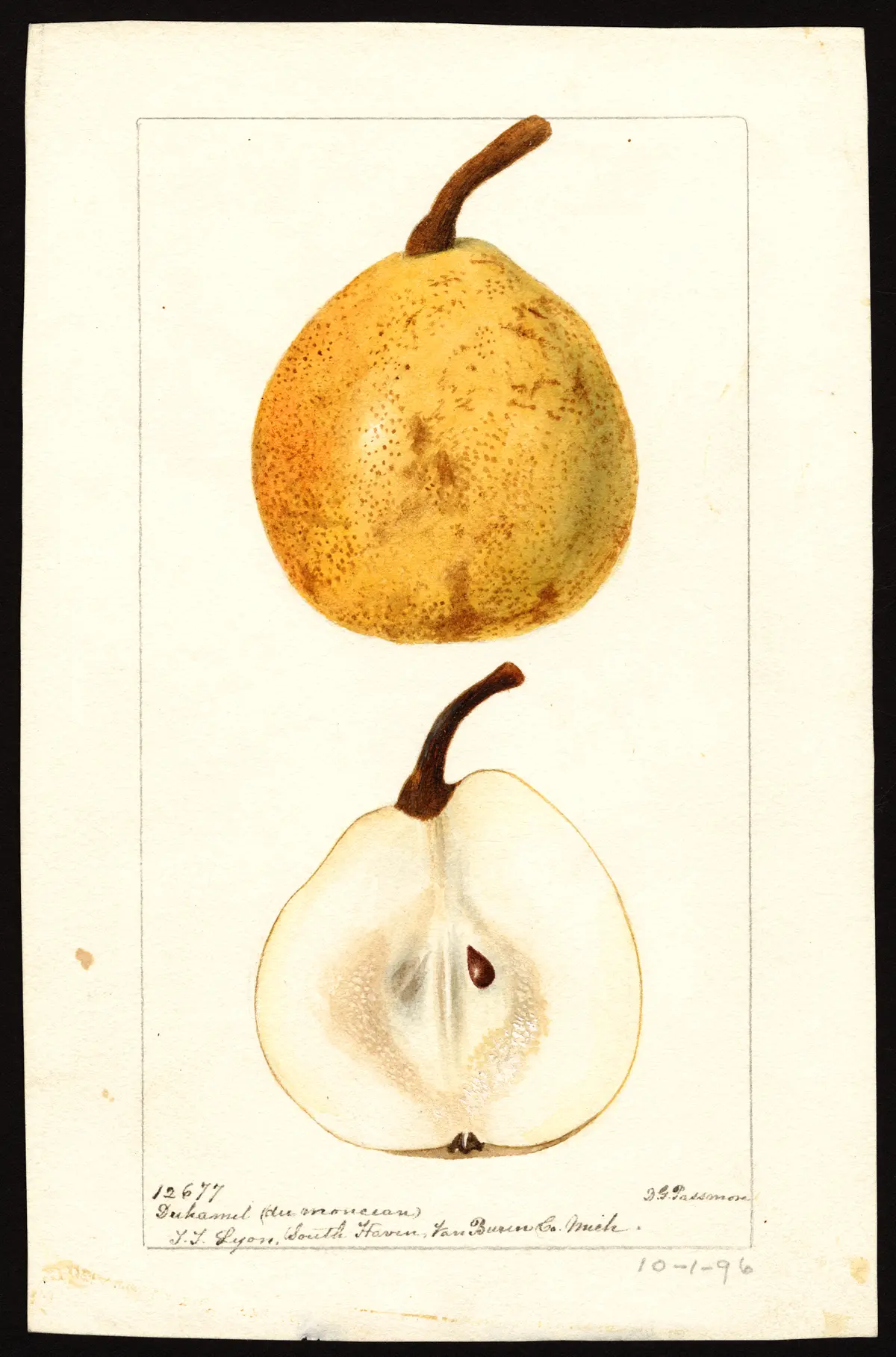
USDA Pomological Watercolor Collection
Duhamel Du Monceau
Origin / History
Duhamel Du Monceau was obtained from seed by André Leroy, the eminent author and pomologist at Angers, France. In naming the variety, M. Leroy stated that his purpose was to do honor to the memory of the illustrious professor who filled an important place in pomology, and who, in giving us the Traité des arbres fruitiers published in 1768, rendered and still renders valuable services to horticulturists. The original tree began to fruit in 1862 and was cataloged by Leroy in 1865. The variety seems to have been described first in America by Downing in 1876. After a probationary period of a half century in America, Duhamel Du Monceau had not found favor with commercial orchardists, but pear fanciers valued it for its delectable late-keeping fruits. Nurserymen find the trees rather difficult to grow. Thomas (1903) and Budd-Hansen (1914) simply identify the variety as French.
Tree
Tree vigorous, upright, dense, hardy; Hedrick (1922) adds slow-growing. Downing (1900) describes the tree as vigorous, spreading, and a good bearer; the Central Experimental Farm (1900) at Agassiz BC, where it was planted Spring 1894, recorded the tree as a strong grower. Budd-Hansen (1914) note it is a good tree and good bearer in the lake region. Trunk stocky. Branches thick, zigzag, dull brownish-red, covered with ash-gray scarf-skin, marked with numerous large lenticels. Branchlets very thick, short, with short internodes, brownish-red, tinged with green, dull, smooth, glabrous, with many conspicuous, raised lenticels. Leaf-buds long, obtuse, appressed; leaf-scars prominent. Leaves 3 in. long, 1½ in. wide, long, folded lengthwise with the margins curled under, leathery; apex taper-pointed; margin entire or coarsely crenate; petiole 2 in. long, slender. Flower-buds large, long, conical, plump, free, singly on short spurs. Blossoms open late; flowers 1 in. across, well distributed, averaging 7 buds in a cluster; pedicels 1⅛ in. long, slender, pubescent, pale green.
Fruit
Size
Sources differ on size. Downing (1900) and the Central Experimental Farm (1900) describe the fruit as medium; Budd-Hansen (1914) also call it medium. Thomas (1903) calls it large. Hedrick (1921) describes the fruit as above medium in size, 3½ in. long, 2½ in. wide, uniform in size; Hedrick (1922) gives the same dimensions (3½ inches long, 2½ inches wide). Hedrick (1921, 1922) also characterizes the fruits more broadly as "unattractive little fruits" which would have small value were it not for their delicious quality and late keeping.
Form
Roundish-pyriform, or at times oblong-pyriform (Hedrick 1921, 1922); symmetrical, with equal sides. Downing (1900) describes the fruit as roundish pyriform. Thomas (1903) describes it as long pyriform. Budd-Hansen (1914) describe it as obovate, obtuse pyriform. The Central Experimental Farm (1900) calls it roundish. The fruits are of the type of those of Winter Nelis, differing in shape somewhat, but even better in quality and keep longer (Hedrick).
Stem
Stem 1 in. long, slightly curved, thick (Hedrick 1921); inch long, curved, thick (Hedrick 1922). Budd-Hansen (1914) give stem one and one-quarter inches long, stout, fleshy at point of insertion. Downing (1900) describes the stalk as long, inclined.
Cavity
Hedrick (1921, 1922) report cavity lacking, the stem being attached to the smooth, flat surface. Downing (1900) describes a slight depression, sometimes by a lip. Budd-Hansen (1914) describe a very slight cavity into which the stem is set, fleshy at the point of insertion.
Calyx
Calyx open; lobes separated at the base, short, obtuse or acute (Hedrick 1921, 1922). Downing (1900) describes the calyx as open, or half closed.
Basin
Basin shallow, obtuse, gently furrowed, small (Hedrick 1921, 1922). Downing (1900) describes the basin as shallow, a little uneven. Budd-Hansen (1914) describe it as narrow, shallow, often corrugated.
Skin
Skin thin, tender, roughened by the russet skin, dull (Hedrick 1921, 1922). Color greenish-yellow overspread with solid russet, or splashed, spotted and sprinkled with russet, the cheek often solid russet (Hedrick 1921); greenish-yellow nearly overspread with solid russet, or at times only splashed, spotted and sprinkled with russet (Hedrick 1922). Downing (1900) describes the skin as pale whitish yellow, a shade of brown in the sun, partially netted and patched with russet, and sprinkled with many russet and brown dots. Thomas (1903) describes it as light yellow, partly russeted. Budd-Hansen (1914) describe the color as yellow, with many russet specks and patches of gray or cinnamon russet. The Central Experimental Farm (1900) describes the skin as a little pale greenish yellow, with a reddish cheek and sprinkled with russet dots.
Dots
Dots many, small, russet, obscure because of the russet color, slightly raised (Hedrick 1921); many, small, russet, obscure, slightly raised (Hedrick 1922).
Flesh / Flavor
Flesh yellowish-white, granular especially around the core, melting, buttery, very juicy, vinous; quality very good (Hedrick 1921). Hedrick (1922) gives flesh yellowish-white, granular around the core, melting, buttery, very juicy, vinous; quality very good. Downing (1900) describes the flesh as whitish, half fine, buttery, juicy, melting, sweet, slightly vinous, and very good. Thomas (1903) describes the flesh as melting, juicy, excellent. Budd-Hansen (1914) describe the flesh as yellow, melting, juicy, very good. The Central Experimental Farm (1900) describes the flesh as whitish, fine grained, sweet, juicy, with a pleasant flavour, quality good. The fruits are further distinguished by a musky taste and perfume, which make them especially agreeable to those who like rich, sweet, perfumed pears (Hedrick 1921, 1922).
Core / Seeds
Core variable in size, closed, with clasping core-lines; calyx-tube short, wide, conical; seeds elongated-oval, wide, plump, acute (Hedrick 1921, 1922).
Season
Fruit ripe October to November (Hedrick 1921, 1922). Downing (1900) gives November. The Central Experimental Farm (1900) gives Season October. Thomas (1903) gives early winter. Budd-Hansen (1914) give early winter. Hedrick (1921, 1922) further notes the fruits come into edible condition late — about the latest of all pears (1922) — and keep longer than Winter Nelis.
Uses
Valued by pear fanciers for their delectable late-keeping fruits and especially agreeable to those who like rich, sweet, perfumed pears (Hedrick 1921, 1922). Has not found favor with commercial orchardists. Nurserymen find the trees rather difficult to grow (Hedrick 1921).
Subtypes / Variants
Not described in source.
Other
Hedrick (1921, 1922) compares the variety directly to Winter Nelis: the fruits are of that type, differing in shape somewhat, but are even better in quality and keep longer; and the trees are better than most of their orchard associates, and far superior to the unmanageable trees of Winter Nelis with which this variety must compete.
Book Sources
Described in 5 period pomological works
Nursery Catalog Sources
Found in 7 catalogs (1900–1917) from Washington
- Central Experimental Farm , Dominion Department of Agriculture, Agassiz, British Columbia (under test; Bulletin No. 3, Second Series) — 1900
- Island Nurseries & Fruit Farm , Vashon (Vashon Island) , Washington — 1910
- Island Nurseries & Fruit Farm , Vashon (Vashon Island) , Washington — 1911
- Island Nurseries & Fruit Farm , Vashon (Vashon Island) , Washington — 1914
- Island Nurseries & Fruit Farm , Vashon (Vashon Island) , Washington — 1915
- Island Nurseries & Fruit Farm , Vashon (Vashon Island) , Washington — 1916
- Island Nurseries & Fruit Farm , Vashon (Vashon Island) , Washington — 1917
View original book sources (6)
— A.J. Downing, The Fruits and Fruit Trees of America (1900)Duhamel du Monceau.
Raised by Andre Leroy, Angers, France, and dedicated to Duhamel du Monceau; tree vigorous, spreading, and a good bearer.
Fruit medium, roundish pyriform; skin pale whitish yellow, a shade of brown in the sun, partially netted and patched with russet, and sprinkled with many russet and brown dots; stalk long, inclined, set in a slight depression, sometimes by a lip; calyx open, or half closed; basin shallow, a little uneven; flesh whitish, half fine, buttery, juicy, melting, sweet, slightly vinous, and very good. November.
— U.P. Hedrick, The Pears of New York (1921)DUHAMEL DU MONCEAU
- Leroy Dict. Pom. 3:114, fig. 1869. 2. Downing Fr. Trees Am. 2nd App. 146, fig. 1876. 3. W. N. Y. Hort. Soc. Rpt. 118. 1881. Duhamel's Butterbirne. 4. Mathieu Nom. Pom. 207. 1889. Duhamel. 5. Budd-Hansen Am. Hort. Man. 2:241. 1903.
The unattractive little fruits of this pear would have small value were it not for the fact that they are delicious in quality and come into edible condition late. The fruits are of the type of those of Winter Nelis, differing in shape somewhat, but are even better in quality and keep longer. The fruits are further distinguished by a musky taste and perfume, which make them especially agreeable to those who like rich, sweet, perfumed pears. The trees, while in no characters remarkable, are better than most of their orchard associates, and far superior to the unmanageable trees of Winter Nelis with which this variety must compete. After a probationary period of a half century in America, Duhamel du Monceau has not found favor with commercial orchardists, but pear fanciers value it for its delectable late-keeping fruits. Nurserymen find the trees rather difficult to grow.
Duhamel du Monceau was obtained from seed by André Leroy, the eminent author and pomologist at Angers, France. In naming the variety, M. Leroy said that his purpose was to do honor to the memory of the illustrious professor who filled an important place in pomology, and who, in giving us the Traité des arbres fruitiers published in 1768, rendered and still renders valuable services to horticulturists. The original tree began to fruit in 1862 and was cataloged by Leroy in 1865. The variety seems to have been described first in America by Downing in 1876.
Tree vigorous, upright, dense, hardy; trunk stocky; branches thick, zigzag, dull brownish-red, covered with ash-gray scarf-skin, marked with numerous large lenticels; branchlets very thick, short, with short internodes, brownish-red, tinged with green, dull, smooth, glabrous, with many conspicuous, raised lenticels. Leaf-buds long, obtuse, appressed; leaf-scars prominent. Leaves 3 in. long, 1½ in. wide, long, folded lengthwise with the margins curled under, leathery; apex taper-pointed; margin entire or coarsely crenate; petiole 2 in. long, slender. Flower-buds large, long, conical, plump, free, singly on short spurs; blossoms open late; flowers 1 in. across, well distributed, averaging 7 buds in a cluster; pedicels 1⅛ in. long, slender, pubescent, pale green.
Fruit ripe October to November; above medium in size, 3½ in. long, 2½ in. wide, uniform in size, roundish-pyriform or at times oblong-pyriform, symmetrical, with equal sides; stem 1 in. long, slightly curved, thick; cavity lacking, the stem being attached to the smooth, flat surface; calyx open; lobes separated at the base, short, obtuse or acute; basin shallow, obtuse, gently furrowed, small; skin thin, tender, roughened by the russet skin, dull; color greenish-yellow overspread with solid russet, or splashed, spotted and sprinkled with russet, the cheek often solid russet; dots many, small, russet, obscure because of the russet color, slightly raised; flesh yellowish-white, granular especially around the core, melting, buttery, very juicy, vinous; quality very good. Core variable in size, closed, with clasping core-lines; calyx-tube short, wide, conical; seeds elongated-oval, wide, plump, acute.
— Central Experimental Farm, Central Experimental Farm, Agassiz BC — Catalogue of Fruit Trees under Test (Bulletin No. 3, 1900) (1900)Planted Spring 1894. Tree a strong grower. Fruit of medium size, roundish. Skin a little pale greenish yellow, with a reddish cheek and sprinkled with russet dots. Flesh whitish, fine grained, sweet, juicy, with a pleasant flavour, quality good. Season October.
— John J. Thomas, The American Fruit Culturist (1903)Duhamel du Monceau. Large, long pyriform, light yellow, partly russeted; flesh melting, juicy, excellent. Early winter. French.
— J.L. Budd & N.E. Hansen, American Horticultural Manual, Part II: Systematic Pomology (1914)Duhamel (Duhamel du Monceau). — Medium, obovate, obtuse pyriform; color yellow, with many russet specks and patches of gray or cinnamon russet; stem one and one-quarter inches long, stout, fleshy at point of insertion in very slight cavity; basin narrow, shallow, often corrugated. Flesh yellow, melting, juicy, very good. Season, early winter. A good tree and good bearer in lake region. France.
— U.P. Hedrick, Cyclopedia of Hardy Fruits (1922)DUHAMEL DU MONCEAU.
Duhamel.
The unattractive little fruits of this pear would have small value were it not for the fact that they are delicious in quality, and come into edible condition about the latest of all pears. The fruits are similar to those of Winter Nelis, differing in shape somewhat, but are even better in quality and keep longer. They are distinguished by a musky taste and perfume, which is especially agreeable to those who like rich, sweet, perfumed pears. The trees are better than most of their orchard associates, and far superior to the unmanageable Winter Nelis with which this variety must compete. After a probationary period of a half century in America, Duhamel du Monceau has not found favor with commercial orchardists, but pear fanciers value it for its delectable latekeeping fruits. Duhamel du Monceau was obtained from seed by Andre Leroy, Angers, France.
Tree vigorous, upright, dense, slow-growing, hardy; branches thick, zigzag, dull brownish-red, marked with numerous, large lenticels. Leaves inches long, 1½ inches wide, long, folded lengthwise with the margins curled under, leathery; apex taper-pointed; margin entire or very coarsely crenate; petiole inches long, slender. Blossoms open late, inch across, well distributed, averaging buds in a cluster. Fruit ripe October-November; 3½ inches long, 2½ inches wide, roundish-pyriform or at times oblong-pyriform, symmetrical, with equal sides; stem inch long, curved, thick; cavity lacking, the stem being attached to the smooth, flat surface; calyx open; lobes separated at the base, short, obtuse or acute; basin shallow, obtuse, gently furrowed, small; skin thin, tender, roughened by the russet skin, dull; color greenish-yellow nearly overspread with solid, russet or at times only splashed, spotted and sprinkled with russet; dots many, small, russet, obscure, slightly raised; flesh yellowish-white, granular around the core, melting, buttery, very juicy, vinous; quality very good; core variable in size, closed, with clasping core-lines; calyx-tube short, wide, conical; seeds elongated-oval, wide, plump, acute.