Émile d'Heyst
Pear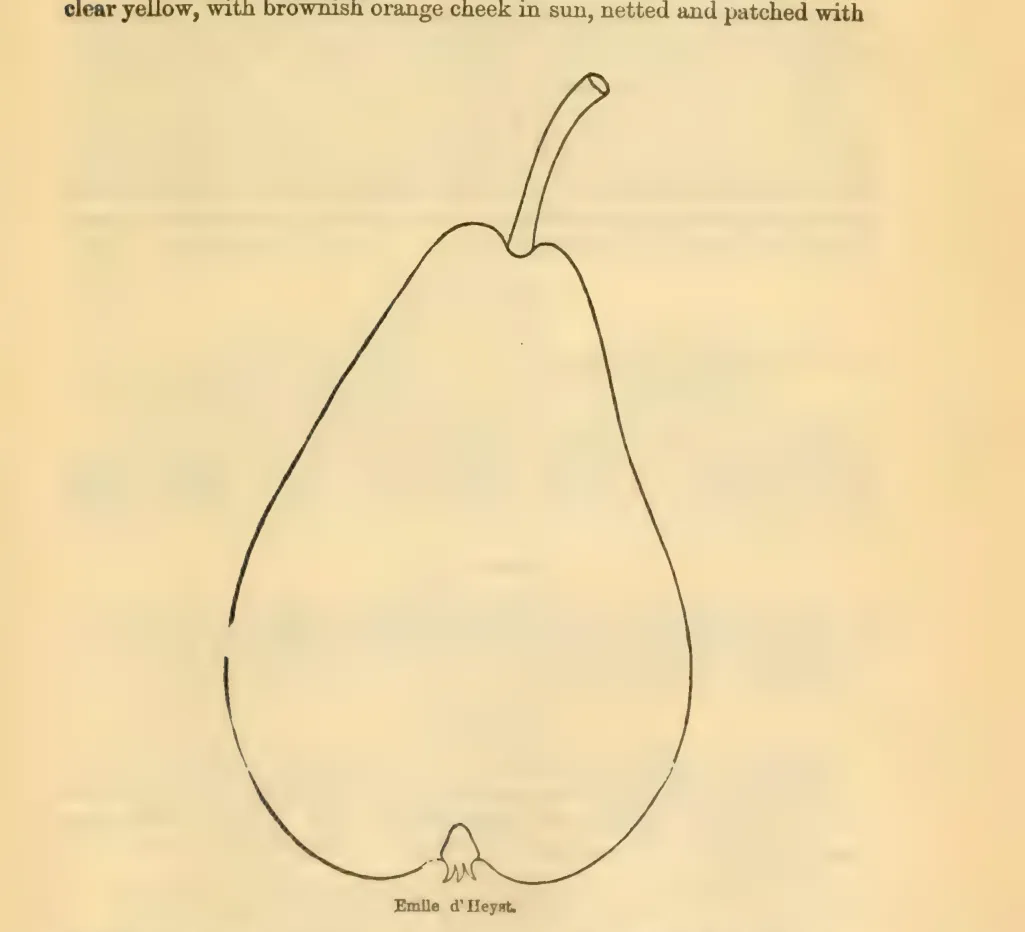
Origin & History
A seedling raised by Major Esperen of Mechlin, Belgium, which fruited in 1847 (Hedrick). The fruit was dedicated by Esperen to the son of his friend L. E. Berckmans — according to Downing, of Georgia; according to Elliott, of New Jersey.
Tree
Hardy and productive, so much so as to require thinning to obtain full-sized fruit (Downing). Holds its foliage quite late in autumn, and holds its fruit well (Downing). Downing describes the tree as vigorous and spreading, while Elliott characterizes it as of moderate vigor, a healthy and good grower, but straggling and not easily brought to a pyramidal form. Thomas likewise describes the shoots as long, diverging and straggling. Elliott notes that it seems well suited to the American climate and grows well on Quince. Young wood is described as olive color by Downing, fawn or light-brown and rather slender by Elliott, and brownish-yellow by Thomas.
Fruit
Size: Large (Downing, Thomas), or medium and often larger (Hedrick), or large to above medium (Elliott).
Form: Oblong obovate pyriform, angular and irregular (Downing). Hedrick describes it as ovate, rather long, irregular, generally with sides unequal, bossed. Elliott calls it long calabasse form. Thomas describes it as long pyriform, like the Winkfield.
Stem: Medium to long, inclined, curved (Downing). Elliott and Thomas agree the stem is variable, but rather long, sometimes fleshy. Elliott adds that it is inserted in an uneven cavity.
Cavity: Slight, often with a lip or fleshy ridge at base of stem (Downing). Elliott describes the cavity as uneven.
Calyx: Small, closed, with short segments (Downing). Elliott and Thomas agree the calyx is small.
Basin: Downing describes it as medium and somewhat furrowed. Elliott calls it deep and narrow, surrounded by uneven protuberances. Thomas agrees: narrow, deep, and knobby.
Skin: Clear yellow, with brownish orange cheek in the sun, netted and patched with russet, and thickly sprinkled with large russet dots (Downing). Light green, washed and waved with fawn and russet, becoming bright yellow at the time of maturity (Elliott). Thomas similarly notes light green with some brown russet. Hedrick describes the surface as bronzed, dotted with fine specks.
Flesh & Flavor: Yellowish white, fine-grained, juicy, melting, sweet, slightly vinous and aromatic, rich and excellent; rated very good to best (Downing). Greenish, fine and dense, melting, scented, free from grit; juice very abundant, refreshing, sugary, slightly acid but very agreeably perfumed; rated first quality (Hedrick). Buttery, melting, very juicy, exceedingly fine, sugary and well perfumed (Elliott). Buttery and melting, fine, perfumed (Thomas).
Core & Seeds: Not described in sources.
Season
October (Hedrick). Ripening well through November (Elliott, Thomas). November and December (Downing).
Uses
Not described in sources.
Subtypes & Variants
Not described in sources.
Book Sources
Described in 4 period pomological works
Nursery Catalog Sources
Found in 6 catalogs (1897–1917) from England
- Kelway & Son , Langport, Somerset , England — 1897
- George Bunyard & Co. , Royal Nurseries, Maidstone, Kent , England — 1900
- James Veitch & Sons , Ltd., Royal Exotic Nursery, Chelsea, London (also Coombe Wood, Langley, and Feltham) , England — 1911
- Thomas Rivers & Son , Sawbridgeworth, Hertfordshire , England — 1913
- George Bunyard & Co. , Royal Nurseries, Maidstone, Kent , England — 1914
- George Bunyard & Co. , Royal Nurseries, Maidstone, Kent , England — 1917
View original book sources (4)
— A.J. Downing, The Fruits and Fruit Trees of America (1900)Emile d'Heyst.
This fruit was dedicated by Major Esperen to the son of his friend L. E. Berckmans, of Georgia. It is of Belgian origin, and is one of the very best. The tree is hardy and productive, so much so as to require thinning to obtain full-sized fruit. It holds its foliage quite late in autumn, and holds its fruit well. Tree vigorous, spreading. Young wood olive color.
Fruit large, oblong obovate pyriform, angular and irregular. Skin clear yellow, with brownish orange cheek in sun, netted and patched with russet, and thickly sprinkled with large russet dots. Stalk medium to long, inclined, curved. Cavity slight, often with a lip or fleshy ridge at base of stem. Calyx small, closed. Segments short. Basin medium, somewhat furrowed. Flesh yellowish white, fine-grained, juicy, melting, sweet, slightly vinous and aromatic, rich and excellent. Very good to best. November, December.
— U.P. Hedrick, The Pears of New York (1921)Émile d'Heyst.
- Leroy Dict. Pom. 2:131, fig. 1869. 2. Bunyard Handb. Hardy Fr. 173. 1920.
A seedling raised by Major Esperen, Mechlin, Bel., which fruited in 1847. Fruit medium and often larger, ovate, rather long, irregular, generally with sides unequal, bossed, bronzed, dotted with fine specks; flesh greenish, fine and dense, melting, scented, free from grit; juice very abundant, refreshing, sugary, slightly acid but very agreeably perfumed; first; Oct.
— F.R. Elliott, The Western Fruit Book (1865)Emile d'Heyst.
This fruit is dedicated by Major Esperen to the son of his friend, L. E. Berckmans, of New Jersey.
A Belgian fruit. Tree of moderate vigor; a healthy and good grower, but straggling and not easily brought to a pyramidal form. It seems well suited to this climate and grows well on Quince. Young wood, fawn or light-brown, rather slender. Fruit, large, or above medium size, long calabasse form; color, light green, washed and waved with fawn and russet, becomes bright yellow at the time of maturity; stem, variable, but rather long, sometimes fleshy, inserted in an uneven cavity; calyx, small, set in a deep, narrow basin, surrounded by uneven protuberances: flesh, buttery, melting, very juicy, exceedingly fine, sugary and well perfumed. Ripening well through November. (L. E. Berckmans.)
— John J. Thomas, The American Fruit Culturist (1903)Emile d'Heyst. Large, long pyriform (like the Winkfield) ; light green with some brown russet; stem variable, rather long, sometimes fleshy; calyx small, basin narrow, deep, and knobby; buttery and melting, fine, perfumed. November. Shoots long, brownish-yellow, diverging and straggling. Fig. 645.