ENSEE
Apple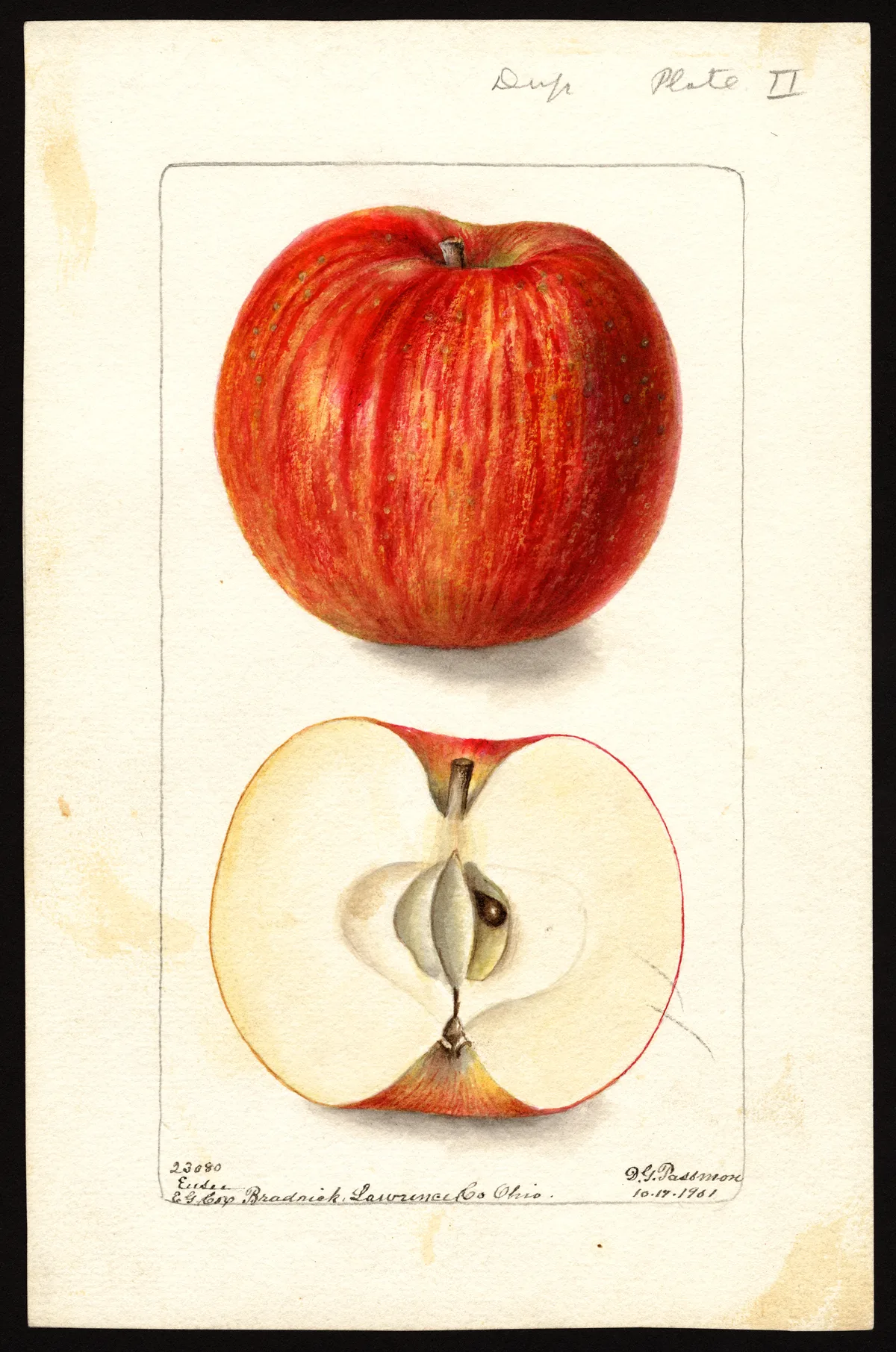
USDA Pomological Watercolor Collection
ENSEE
Origin and History
ENSEE was introduced around 1900 by U. T. Cox of Rockwood, Ohio. Upon introduction, it created considerable attention in horticultural publications and societies, generating significant interest among fruit growers. The variety was promoted on the basis of its fruit's good keeping qualities and the trees' early bearing habit and productivity. However, after twenty years of cultivation and trial (approximately by 1920), ENSEE fell largely out of favor. By the time of this account, it was almost wholly discarded except in Ohio, with only two or three nurseries in the country offering trees and little commercial demand.
Tree
ENSEE trees bear early and are productive. The tree characteristics are described as somewhat inferior to those of Rome apples, which accounts for the decline in the variety's popularity despite its fruit's merits.
Fruit
The apples are similar to Rome apples, differing chiefly in being slightly darker in color. The fruit exhibits good keeping qualities.
Season
Not described in source.
Uses
Not described in source.
Subtypes/Variants
Not described in source.
Other
The variety appears to have been displaced in commercial cultivation by Rome apples, which offered superior tree characteristics despite similar fruit quality.
Book Sources
Described in 1 period pomological work
Nursery Catalog Sources
Found in 6 catalogs (1906–1918) from Illinois, Missouri
- Stark Bros. Nurseries & Orchards Co. , Louisiana , Missouri — 1906
- Stark Bros. Nurseries & Orchards Co. , Louisiana , Missouri — 1910
- Stark Bros. Nurseries & Orchards Co. , Louisiana , Missouri — 1911
- Stark Bros. Nurseries & Orchards Co. , Louisiana , Missouri — 1912
- Benjamin Buckman (personal inventory) , Farmingdale , Illinois — 1913
- Stark Bros. Nurseries & Orchards Co. , Louisiana , Missouri — 1918
View original book sources (1)
— U.P. Hedrick, Cyclopedia of Hardy Fruits (1922)ENSEE. About 1900, Ensee, introduced by U. T. Cox, Rockwood, Ohio, created something of a sensation in the horticultural press and in horticultural societies. It seemed especially worthy of trial because of the good keeping qualities of the fruit, and the early bearing and productiveness of the trees. After twenty years of probation, however, it is now almost wholly discarded except in Ohio, but two or three nurserymen in the country offer it, and there is but little demand for the trees. On the grounds of the New York Agricultural Experiment Station, the apples are similar to those of Rome, differing chiefly in being a little darker in color. The tree-characters of Rome seem to be somewhat better than those of Ensee, which fact, no doubt, accounts for the falling off in the demand for the newer variety.