Ferdinand
Apple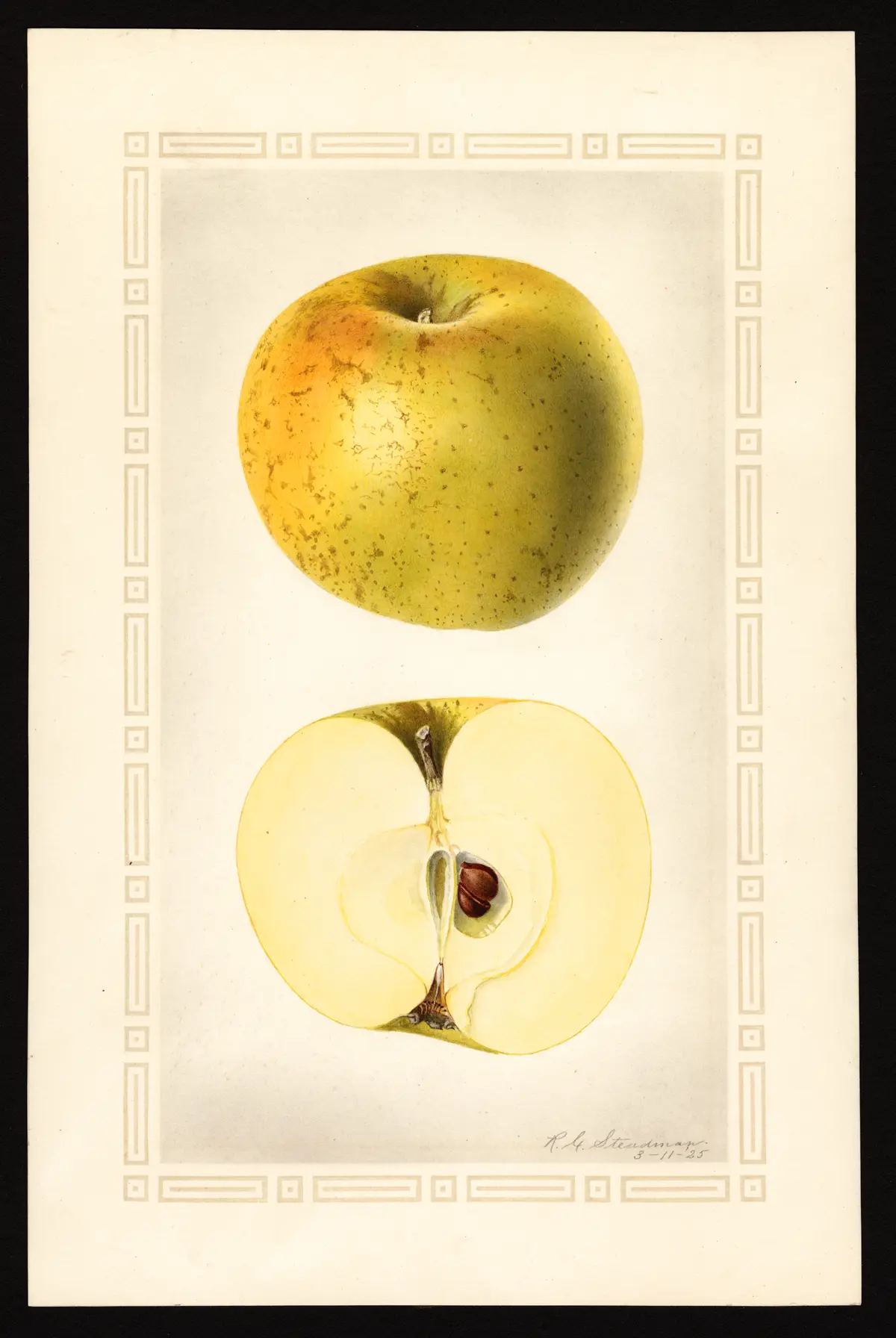
USDA Pomological Watercolor Collection
Ferdinand
Origin/History
Ferdinand originated with Mr. Adam Minnick near Pomaria, South Carolina, and is described as a seedling of Pomaria, S.C. It bore its first fruit in 1848. Warder noted he procured his trees from Virginia, where he stated it originated, though the broader consensus places its origin in South Carolina. In its native locality it is considered a late autumn variety. In 1873 it was given a place in the American Pomological Society's Catalogue of recommended apples, but was dropped from that list in 1899. Early references include Summer in Horticulturist (1849, with figure), Elliott (1858), Warder (1867), Downing (1872), Leroy (1873), Thomas (1885), and Taylor in the American Pomological Society Report (1895).
Tree
Tree vigorous and upright (Warder, Downing); moderately vigorous and upright (Elliott). A strong upright grower in the nursery. In the orchard at the New York State Station it is a rather slow grower with short, moderately stout branches. Form spreading and open, flat at the top. Rather slow in coming into bearing and at best only moderately productive, but bears some fruit nearly every year.
Twigs upright, small to medium, straight, stout; internodes vary from long to short. Bark olive-green tinged with brownish-red, in part mottled with scarf-skin, somewhat pubescent near tips. Lenticels scattering, medium to large, oblong to roundish, raised. Buds medium to large, broad, obtuse, appressed, slightly pubescent.
Fruit
Size: Large; above medium to nearly large.
Form: Flattened-conic, irregular (Warder); oblate (Downing, Thomas); oblate irregular (Elliott); flat (Lowther). Flattened at the base, roundish conic to oblate conic, often somewhat ribbed, somewhat irregular (Beach).
Stem: Short, stout/thick, often with a fleshy protuberance.
Cavity: Medium (Warder); acute, moderately shallow to rather deep, rather narrow, often obscurely furrowed or compressed, often overspread with russet, sometimes lipped (Beach).
Calyx: Medium and open (Warder); large and closed (Downing); open (Elliott); above medium to small, partly open or closed, with acuminate lobes (Beach). Calyx tube wide, cone-shape or sometimes rather funnel-form. Stamens median.
Basin: Shallow (Warder, Elliott); often oblique, usually narrow and shallow but varies to moderately wide and deep (Beach).
Skin: Smooth, pale green or yellow (Warder); deep orange yellow, moderately sprinkled with large brown dots (Downing); pale greenish-yellow (Elliott); greenish-yellow (Thomas); yellow (Lowther). Beach describes the skin as rather thin, moderately tender, deep yellow or greenish with an orange blush which sometimes deepens to red, sometimes partly covered with russet. Dots numerous, sometimes whitish, but usually rough russet, variable in size and irregular in form. Prevailing effect greenish-yellow.
Flesh/Flavor: Flesh yellow or tinged with yellow, tender, firm, rather fine, crisp, moderately juicy. Flavor sub-acid (Warder); mild subacid (Downing); aromatic with a rich agreeable flavor similar to that of some russet apples, sprightly becoming mild subacid (Beach). Quality good to very good. A fine dessert fruit.
Core/Seeds: Core small to above medium, abaxile; cells fairly symmetrical, closed or somewhat open; core lines meeting or clasping. Carpels roundish, emarginate, slightly tufted. Seeds numerous, above medium to below, flat, obtuse, dark.
Season
November to March (Warder, Downing, Elliott); December to May (Beach); winter (Thomas, Lowther). A good keeper.
Uses
A fine dessert fruit. Not recommended for commercial planting, but because it is excellent in quality and a good keeper it may be worthy of a place in home orchards in the lower Hudson valley and on Long Island. Lowther classifies use as "Cn". Reported (per Lowther) as adapted to or grown in more than one of the three divisions of the American Pomological Society, with notation "4*" in the Southern Division.
Subtypes/Variants
Not described in source.
Other
Not described in source.
Book Sources
Described in 6 period pomological works
Nursery Catalog Sources
Found in 3 catalogs (1900–1913) from Illinois
- Central Experimental Farm , Dominion Department of Agriculture, Agassiz, British Columbia (under test; Bulletin No. 3, Second Series) — 1900
- Benjamin Buckman (personal inventory) , Farmingdale , Illinois — 1901
- Benjamin Buckman (personal inventory) , Farmingdale , Illinois — 1913
View original book sources (6)
— John A. Warder, American Pomology: Apples (1867)Ferdinand.
I procured my trees from Virginia, where it originated. Tree vigorous, upright.
Fruit large, flattened-conic, irregular; Surface smooth, pale green or yellow.
Basin shallow; Eye medium, open.
Cavity medium; Stem stout.
Flesh yellow, tender; Flavor sub-acid; Quality good; Season, "November to March," according to Mr. Summer, South Carolina.
— A.J. Downing, The Fruits and Fruit Trees of America (1900)Ferdinand.
A seedling of Pomaria, S. C. Tree vigorous, upright.
Fruit large, oblate, deep orange yellow, moderately sprinkled with large brown dots. Stalk short. Calyx large, closed. Flesh yellow, moderately juicy, tender, mild subacid. Good to very good. November to March.
— S.A. Beach, The Apples of New York, Vol. 1 (1905)FERDINAND.
REFERENCES. 1. Summer, Horticulturist, 4:275. 1849. fig. 2. Elliott, 1858:133. 3. Warder, 1867:533. 4. Downing, 1872:175. 5. Leroy, 1873:300. 6. Am. Pom. Soc. Cat., 1873. 7. Thomas, 1885:510. 8. Taylor, Am. Pom. Soc. Rpt., 1895:193.
Fruit of good form and size and rather attractive in color for a yellow apple. It is a fine dessert fruit and a good keeper. As grown at this Station it is rather slow in coming into bearing and at best is only moderately productive but it bears some fruit nearly every year. It is not recommended for commercial planting. Because it is excellent in quality and a good keeper it may be worthy of a place in the home orchards in the lower Hudson valley and on Long Island.
Historical. Ferdinand originated with Mr. Adam Minnick near Pomaria, S. C. It bore its first fruit in 1848. In that locality it is a late autumn variety. In 1873 it was given a place in the American Pomological Society's Catalogue of recommended apples but was dropped from that list in 1899.
TREE.
Tree a strong upright grower in the nursery. In the orchard at this Station it is a rather slow grower with short, moderately stout branches. Form spreading and open, flat at the top. Twigs upright, small to medium, straight, stout; internodes vary from long to short. Bark olive-green tinged with brownish-red, in part mottled with scarf-skin, somewhat pubescent near tips. Lenticels scattering, medium to large, oblong to roundish, raised. Buds medium to large, broad, obtuse, appressed, slightly pubescent.
FRUIT.
Fruit above medium to nearly large. Form flattened at the base, roundish conic to oblate conic, often somewhat ribbed, somewhat irregular. Stem short, often with a fleshy protuberance. Cavity acute, moderately shallow to rather deep, rather narrow, often obscurely furrowed or compressed, often overspread with russet, sometimes lipped. Calyx above medium to small, partly open or closed; lobes acuminate. Basin often oblique, usually narrow and shallow but varies to moderately wide and deep.
Skin rather thin, moderately tender, deep yellow or greenish with an orange blush which sometimes deepens to red, sometimes partly covered with russet. Dots numerous, sometimes whitish, but usually rough russet, variable in size and irregular in form. Prevailing effect greenish-yellow.
Calyx tube wide, cone-shape or sometimes rather funnel-form. Stamens median.
Core small to above medium, abaxile; cells fairly symmetrical, closed or somewhat open; core lines meeting or clasping. Carpels roundish, emarginate, slightly tufted. Seeds numerous, above medium to below, flat, obtuse, dark.
Flesh tinged with yellow, firm, rather fine, crisp, tender, moderately juicy, aromatic with a rich agreeable flavor similar to that of some russet apples, sprightly becoming mild subacid, good to very good.
Season December to May.
— Granville Lowther (ed.), Encyclopedia of Practical Horticulture (1914)Ferdinand. Size: large. Form: flat. Color: yellow. Quality/Use: "Cn". Season: winter. N. Div.: blank. C. Div.: blank. S. Div.: 4* (asterisk indicates the variety is reported as adapted to or grown in more than one of the three divisions of the American Pomological Society).
— F.R. Elliott, The Western Fruit Book (1865)Ferdinand.
Native South Carolina. Tree, moderately vigorous, upright. Fruit, large, oblate irregular, pale greenish yellow ; stem, thick : calyx, open ; basin, shallow; flesh, yellowish, tender. November to March. New. (Wm. Sumner in Hort.)
— John J. Thomas, The American Fruit Culturist (1903)Ferdinand. Large, oblate, irregular, greenish-yellow. Winter. S. C.