Fink
Apple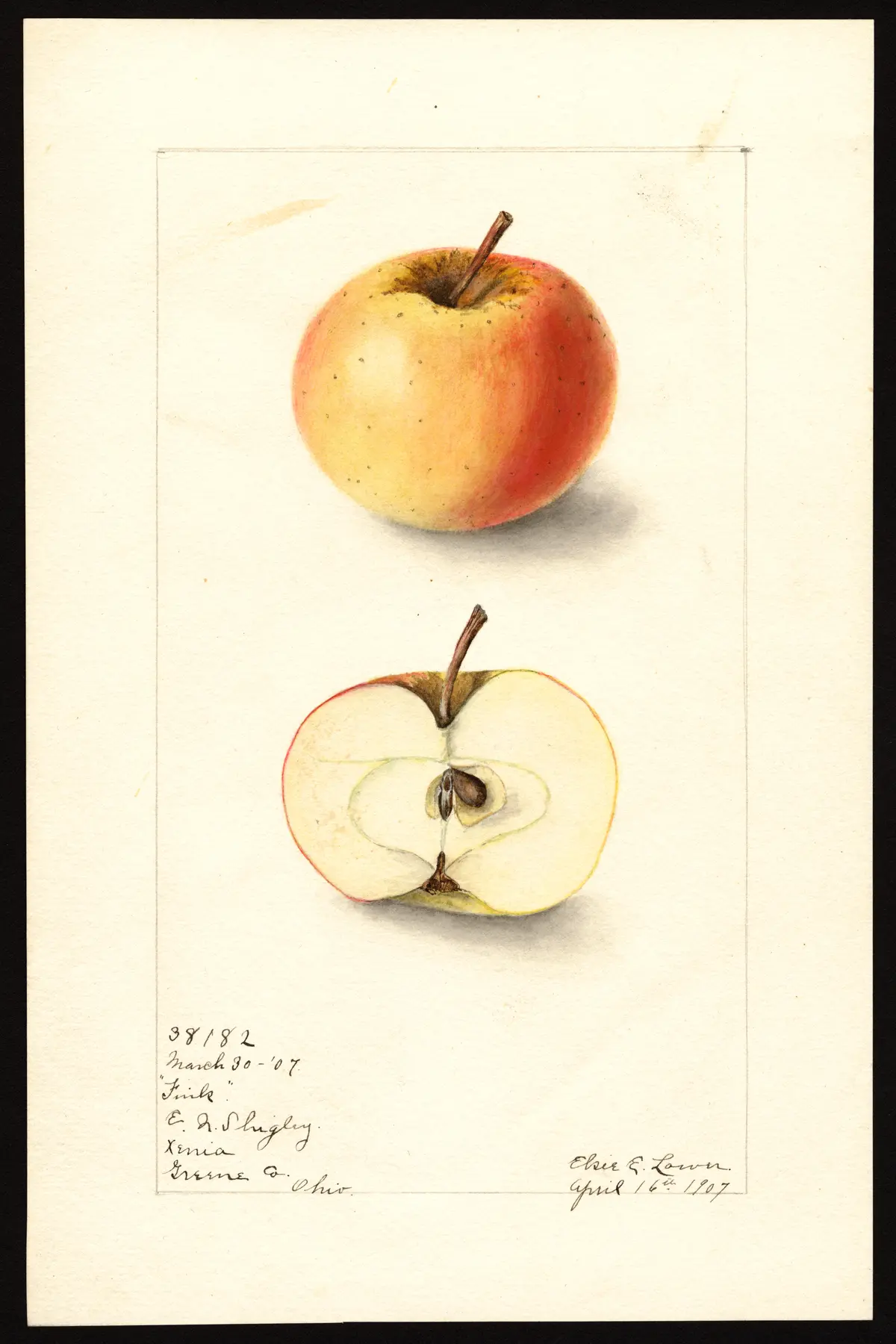
USDA Pomological Watercolor Collection
Fink
Origin/History
Fink originated as a seedling on the farm of Joseph Fink in Somerset, Ohio. It was brought before the notice of the Ohio Pomological Society many years before 1867 by Mr. Clarke of Somerset, Ohio, and was described as Fink's Seedling in the Ohio Cultivator in May 1847. Mr. Elliott considered it the same as Tewksbury Winter Blush and introduced Fink's Seedling as a synonym of that variety. Others thought it a different fruit, among whom was M. B. Bateham, Esq., the practical Pomologist and Secretary of the Ohio Pomological Society, who propagated and planted the trees extensively. At the Society's meeting of 1854, the merits and claims of this variety were freely discussed, and the Society named it the Fink, after admitting that it was an original seedling, as stated by Mr. Fink, in whose seedling orchard it had originated.
Tree
Strong, vigorous, upright grower. A profuse and heavy annual bearer.
Fruit
Size: Small (Warder, Downing, Budd & Hansen); medium (Lowther, Thomas).
Form: Roundish-oblate and regular (Warder, Budd & Hansen); oblate (Downing, Thomas); flat (Lowther).
Stem: One inch long, moderately stout (Budd & Hansen).
Cavity: Medium, very regular, russeted (Budd & Hansen).
Calyx: Medium, open; tube long, funnel-shaped (Budd & Hansen).
Basin: Shallow, broad, corrugated (Budd & Hansen).
Skin/Surface: Very smooth, polished. Color described as greenish-yellow blushed with brownish-red (Warder); whitish yellow with a crimson cheek in the sun (Downing); pale greenish yellow with crimson or brownish red blush (Budd & Hansen); yellow-red (Lowther); red and yellow (Thomas).
Dots: Few, light (Budd & Hansen).
Flesh/Flavor: Whitish; breaking, juicy, mild sub-acid (Warder); fine-grained, compact, moderately pleasant, aromatic, subacid (Downing); fine-grained, firm, juicy, mild, aromatic, subacid (Budd & Hansen). Quality good to very good.
Core/Seeds: Not described in source.
Season
Winter; late winter. A remarkable long keeper — remaining sound until the second season or even later, and has been shown in May after having been kept over two winters. The fruit of two years' growth has often been shown at the same time.
Uses
Market (Lowther).
Subtypes/Variants
Not described in source.
Other
Lowther's tabular classification records: N. Div.: blank; C. Div.: 2F; S. Div.: blank.
Book Sources
Described in 5 period pomological works
Nursery Catalog Sources
Found in 5 catalogs (1894–1913) from Alabama, Illinois
- The Vineland Nurseries (Kelsey & Co. , Proprietors), St. Joseph, Missouri (Office: 13th and Atchison Sts., 2 Blocks East of the Citizens St. Car Line) — 1894 — listed as Tewksbury Winter Blush
- Alabama Nursery Co. , Huntsville , Alabama — 1900 — listed as Tewksbury Winter Blush
- Central Experimental Farm , Dominion Department of Agriculture, Agassiz, British Columbia (under test; Bulletin No. 3, Second Series) — 1900
- Benjamin Buckman (personal inventory) , Farmingdale , Illinois — 1901
- Benjamin Buckman (personal inventory) , Farmingdale , Illinois — 1913
View original book sources (5)
— John A. Warder, American Pomology: Apples (1867)Fink. FINK'S SEEDLING.
This long keeper was brought before the notice of the Ohio Pomological Society many years ago by Mr. Clarke, of Somerset, Ohio. Mr. Elliott considered it the same as Tewksbury Winter Blush, and introduces Fink's Seedling as a synonym of that variety. Others think it a different fruit, among whom is that practical Pomologist, the Secretary of that association, M. B. Bateham, Esq., who has propagated and planted the trees extensively. It was described as Fink's Seedling in the Ohio Cultivator, May, 1847. At the meeting of 1854, the merits and claims of this variety were freely discussed, and the Society named it the Fink, after admitting that it was an original seedling, as stated by Mr. Fink, in whose seedling orchard it had originated.
Tree of strong upright growth, a profuse and annual bearer.
Fruit small, regular, roundish-oblate; Surface very smooth, polished, greenish-yellow, blushed with brownish-red; Flesh whitish, breaking, juicy, mild sub-acid; remarkable for its keeping qualities, remaining sound until the second season, and has been shown in May after having been kept over two winters.
— A.J. Downing, The Fruits and Fruit Trees of America (1900)Fink.
Fink's Seedling.
Origin, farm of Joseph Fink, Somerset, O. Tree a strong, vigorous, upright grower and a profuse bearer.
Fruit small, oblate, whitish yellow, with a crimson cheek in the sun. Flesh whitish, fine-grained, compact, moderately pleasant, aromatic, subacid. Good to very good. A long keeper, often the fruit of two years' growth being shown at the same time.
— Granville Lowther (ed.), Encyclopedia of Practical Horticulture (1914)Fink. Size: medium. Form: flat. Color: yellow-red. Quality: good. Use: market. Season: winter. N. Div.: blank. C. Div.: 2F. S. Div.: blank.
— John J. Thomas, The American Fruit Culturist (1903)Fink. Medium, oblate, red and yellow. Late winter.
— J.L. Budd & N.E. Hansen, American Horticultural Manual, Part II: Systematic Pomology (1914)Fink.—Origin, on farm of Joseph Fink, Somerset, Ohio; tree of strong, upright growth, a heavy annual bearer.
Fruit small, roundish oblate, regular; surface very smooth, polished, pale greenish yellow with crimson or brownish red blush; dots few, light; cavity medium, very regular, russeted; stem one inch long, moderately stout; basin shallow, broad, corrugated; calyx medium, open; tube long, funnel-shaped; flesh whitish, fine-grained, firm, juicy, mild, aromatic, subacid, good to very good. A remarkably late keeper, remaining sound until the second season or even later.