Fishkill
Apple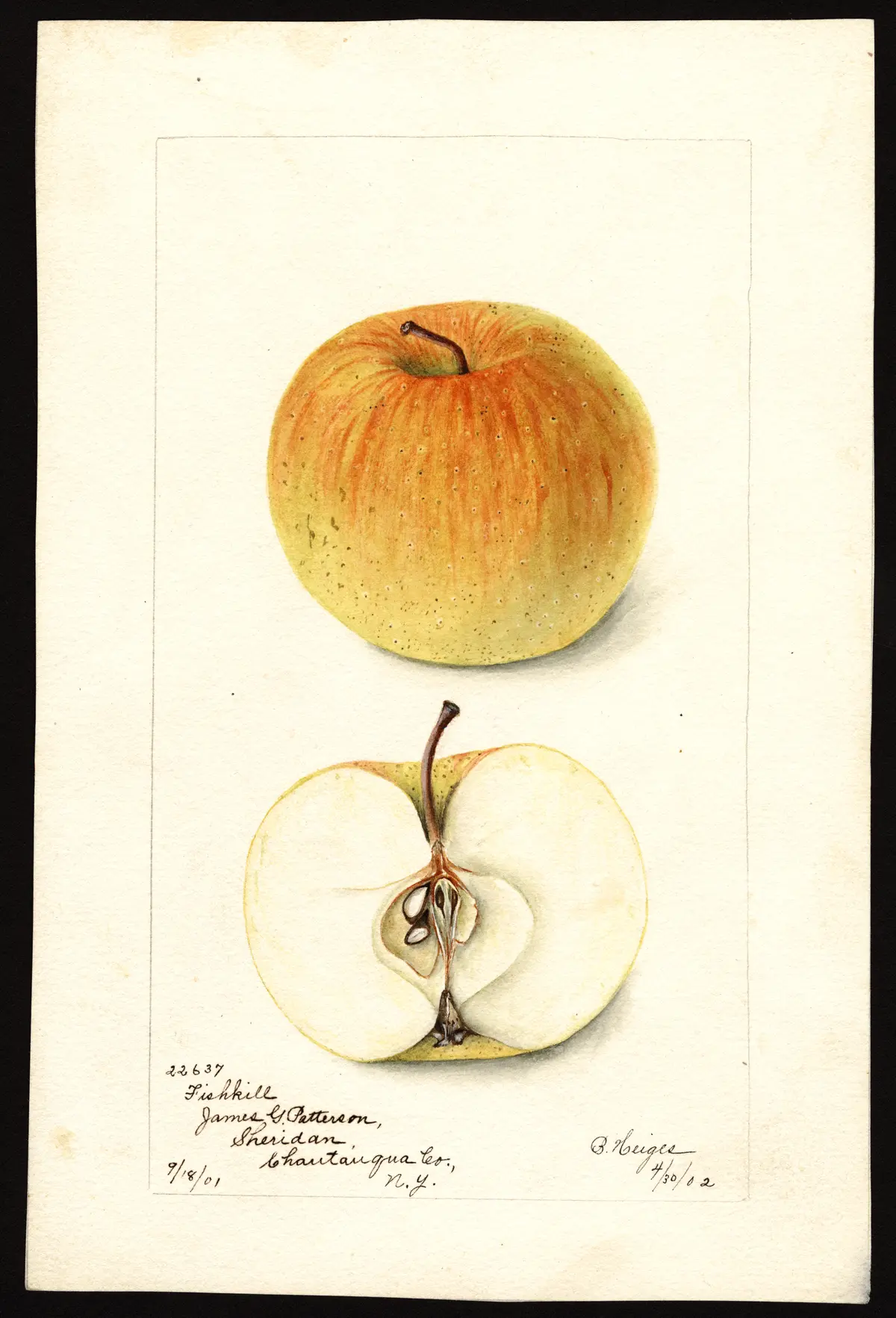
USDA Pomological Watercolor Collection
Fishkill Apple
Origin/History
Origin: Fishkill, New York. The variety is documented in Downing (1869), New York Station annual reports, and Vermont Station trials. Downing remarked that the fruit is apt to decay on the tree, though this characteristic was not confirmed in New York State trials.
Tree
Tree vigorous with long, slender, curved branches; laterals willowy, long, slender. Form upright spreading or roundish, rather dense. Comes into bearing rather early and is almost an annual bearer, yielding fair to good crops of uniformly large fruit.
Twigs: Short to medium, straight, moderately slender, rather geniculate; internodes medium to long.
Bark: Brown tinged with clear reddish brown, mottled with scarfskin; slightly pubescent.
Lenticels: Numerous, small or below medium, generally elongated and narrow, usually not raised.
Buds: Small to above medium, plump, obtuse to somewhat acute, usually free or nearly so.
Fruit
Size and Form: Very large to large, uniform in size and shape. Form nearly round varying to somewhat oblate or oblate conic, regular, obscurely ribbed.
Stem: Medium to long, thick to slender.
Cavity: Varying from somewhat obtuse to slightly acuminate, moderately deep to deep, rather broad, usually symmetrical, sometimes lipped, sometimes lightly russeted.
Calyx: Rather small, closed or slightly open. Calyx tube rather long, wide, varying from elongated conical to funnel-shape. Stamens median to marginal.
Basin: Shallow, usually moderately wide, obtuse, angularly furrowed and wrinkled, with some tendency to develop mammiform protuberances.
Skin: A little rough, thick, tough, dull yellow washed with dull or brownish red; in highly colored specimens deepening to a bright red blush, mottled, striped and splashed with deep carmine, often overspread with thin whitish bloom. Dots numerous, conspicuous, medium size, russet. Prevailing effect attractive although rather dull red.
Flesh: Whitish or tinged with yellow, firm, coarse, moderately crisp, moderately tender, juicy. Flavor mild subacid, fair to good in flavor and quality.
Core and Seeds: Core below medium to rather large, abaxile; cells usually symmetrical, open; core lines clasping. Carpels roundish to broadly obcordate, somewhat emarginate, slightly tufted. Seeds light brown, below medium to rather large, narrow, rather long, plump, varying from obtuse to acuminate.
Season
November to February.
Uses
Fruit large and rather attractive in appearance, but not of sufficient quality to displace standard sorts of its season for either culinary or dessert uses. Should the variety possess superior hardiness, it may be worthy of trial in regions where hardiness is a prime requisite.
Book Sources
Described in 1 period pomological work
Nursery Catalog Sources
Found in 1 catalog (1913) from Illinois
- Benjamin Buckman (personal inventory) , Farmingdale , Illinois — 1913
View original book sources (1)
— S.A. Beach, The Apples of New York, Vol. 2 (1905)FISHKILL
REFERENCES. 1. Downing, 1869:176. 2. N. Y. Sta. An. Rpt., 11:222. 1892. 3. Waugh, Vt. Sta. An. Rpt., 14:294. 1901.
SYNONYMS. FISHKILL (2, 3). FISHKILL BEAUTY (1). Fishkill Beauty (2).
Fruit large, rather attractive in appearance, but not good enough in quality to displace standard sorts of its season either for culinary or dessert uses. Downing remarks that it is apt to decay on the tree (1), but this has not proved true in our experience with the variety. The tree comes into bearing rather early and is almost an annual bearer, yielding fair to good crops of uniformly large fruit. Should it possess superior hardiness it may be worthy of trial in those regions where this character is a prime requisite.
Historical. Origin Fishkill, N. Y.
TREE.
Tree vigorous with long, slender, curved branches; laterals willowy, long, slender. Form upright spreading or roundish, rather dense. Twigs short to medium, straight, moderately slender, rather geniculate; internodes medium to long. Bark brown tinged with clear reddish brown, mottled with scarfskin; slightly pubescent. Lenticels numerous, small or below medium, generally elongated and narrow, usually not raised. Buds small to above medium, plump, obtuse to somewhat acute, usually free or nearly so.
FRUIT.
Fruit very large to large, uniform in size and shape. Form nearly round varying to somewhat oblate or oblate conic, regular, obscurely ribbed. Stem medium to long, thick to slender. Cavity varying from somewhat obtuse to slightly acuminate, moderately deep to deep, rather broad, usually symmetrical, sometimes lipped, sometimes lightly russeted. Calyx rather small, closed or slightly open. Basin shallow, usually moderately wide, obtuse, angularly furrowed and wrinkled, with some tendency to develop mammiform protuberances. Skin a little rough, thick, tough, dull yellow washed with dull or brownish red, in highly colored specimens deepening to a bright red blush, mottled, striped and splashed with deep carmine, often overspread with thin whitish bloom. Dots numerous, conspicuous, medium size, russet. Prevailing effect attractive although rather dull red. Calyx tube rather long, wide, varying from elongated conical to funnel-shape. Stamens median to marginal. Core below medium to rather large, abaxile; cells usually symmetrical, open; core lines clasping. Carpels roundish to broadly obcordate, somewhat emarginate, slightly tufted. Seeds light brown, below medium to rather large, narrow, rather long, plump, varying from obtuse to acuminate. Flesh whitish or tinged with yellow, firm, coarse, moderately crisp, moderately tender, juicy, mild subacid, fair to good in flavor and quality.
Season November to February.