Flake's Fall
Apple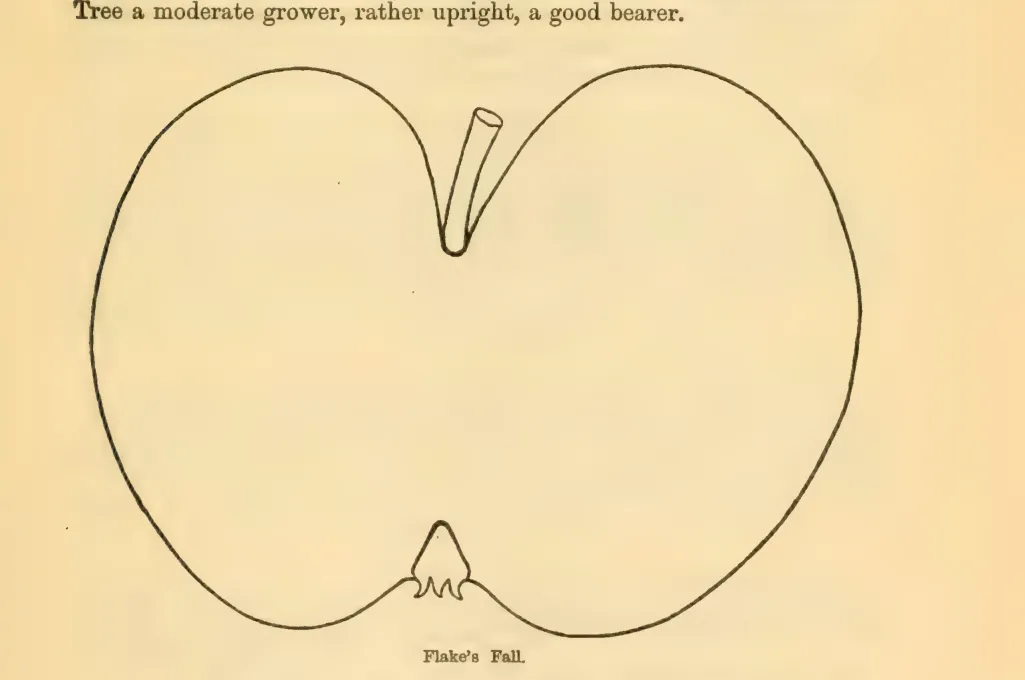
Flake's Fall
Origin / History
Originated with the late Col. Flake, of Mercer, Pa., where Downing says it is esteemed a valuable and profitable apple, either for market or the table.
Tree
Moderate grower, rather upright, a good bearer.
Fruit
Size: Large.
Form: Oblate, slightly conic.
Stem: Very short, rather stout.
Cavity: Large, deep, russeted, the splashes and nettings extending outside it.
Calyx: Open, or partially closed. Segments large, to a point, rather separated.
Basin: Medium, uneven.
Skin: Yellowish, overspread, shaded, striped, and splashed with light and dark crimson, becoming very dark in the sun.
Dots: Thickly sprinkled, light and russet, some with dark center.
Flesh and flavor: Flesh white, tender, moderately juicy. Mild subacid, peculiarly aromatic. Downing rates it "very good."
Core and seeds: Core small.
Season
October, November.
Uses
Market and table.
Subtypes / Variants
Not described in source.
Other
Not described in source.
Book Sources
Described in 2 period pomological works
View original book sources (2)
— A.J. Downing, The Fruits and Fruit Trees of America (1900)Flake's Fall.
Originated with the late Col. Flake, of Mercer, Pa., where it is esteemed a valuable and profitable apple, either for market or the table. Tree a moderate grower, rather upright, a good bearer.
Flake's Fall
Fruit large, form oblate, slightly conic. Color yellowish, overspread, shaded, striped, and splashed with light and dark crimson, becoming very dark in the sun, thickly sprinkled with light and russet dots, some with dark centre. Stalk very short, and rather stout. Cavity large, deep, russeted, the splashes and nettings extending outside. Calyx open, or partially closed. Segments large, to a point, and rather separated. Basin medium, uneven. Flesh white, tender, moderately juicy, mild subacid, peculiarly aromatic. Core small. Very good. October, November.
— John J. Thomas, The American Fruit Culturist (1903)Flake's Fall. Large, striped; mild sub-acid, aromatic. Market. October. Pa.