Fort Miami
Apple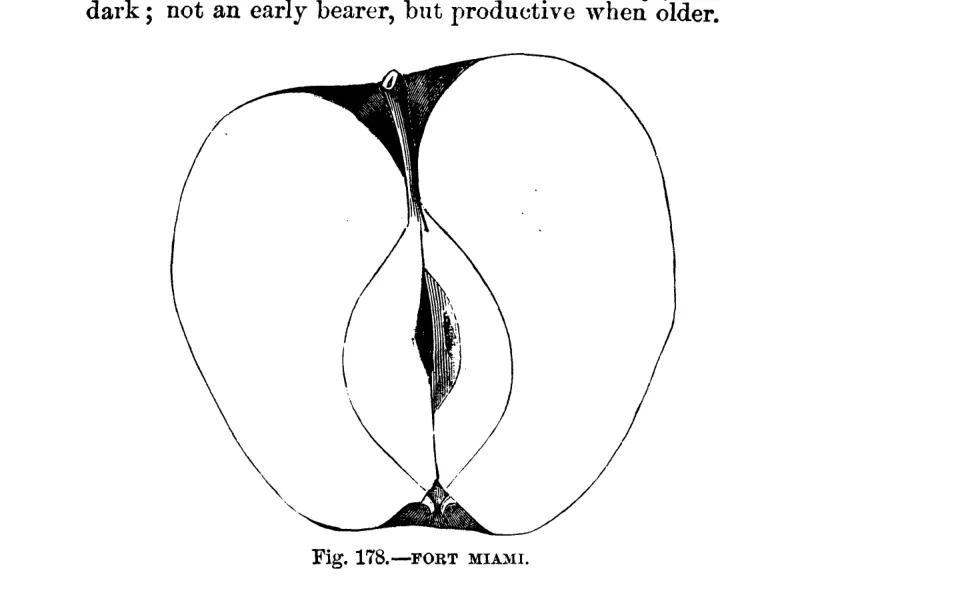
Origin & History
Originated near Fort Miami, in Ohio. A seedling russet of the Maumee region, brought to the notice of the Ohio State Horticultural Society by its Vice-President, J. Austin Scott, of Toledo (Warder). In April 1846, F.R. Elliott made his outline and descriptions from specimens sent by A. Spafford, Esq., of Perrysburgh, Ohio, since which he was unable to obtain any of the fruit. Warder classifies Fort Miami among the Conical Apples, Angular, Sour, Russet group.
Tree
Upright and spreading, with healthy, thrifty growth. Shoots dark in color, nearly upright, spreading. Not an early bearer, but productive when older — Elliott notes the original tree was said to be very productive.
Fruit
Size: Medium (Warder, Downing) to large (Elliott, Thomas).
Form: Roundish oblong-conic, truncated, angular, often unequal (Warder). Downing agrees on roundish oblong conic, truncated. Elliott describes it as roundish oblong, flattened at both ends, widest at base, uneven, somewhat ribbed. Thomas concurs: roundish-oblong, ribbed.
Skin: Sources differ on the ground color. Warder describes it as rich yellow russet, often bronzed, with scattered dots and netted russeting. Downing gives pale yellow with a brownish tinge, considerably russeted in the sun. Elliott describes it as brownish red, more or less russeted. Thomas simply notes brownish and russeted.
Stem: Medium (Warder, Elliott). Elliott specifies three-fourths of an inch long. Downing describes it as rather short.
Cavity: Acute and deep. Warder adds wavy and green. Downing describes it as medium, acute, deep. Elliott gives deep, open, uneven.
Calyx: Sources disagree. Warder describes the eye as small and closed. Downing describes the calyx as open. Elliott gives medium size, closed.
Basin: Medium or shallow, folded (Warder). Downing describes it as abrupt, corrugated. Elliott gives medium depth, furrowed.
Flesh & Flavor: Greenish-yellow, firm (Warder). Downing describes the flesh as yellowish, fine, crisp, juicy, rather rich subacid, aromatic, rating it "Very good." Elliott describes yellowish white flesh, crisp, breaking, with an "exceedingly high, spicy, sub-acid flavor." Thomas concurs: sub-acid, spicy. Warder characterizes the flavor as acid, rich, rating the quality "nearly best."
Core & Seeds: Core oval, clasping the eye, regular, closed; seeds often imperfect (Warder). Not described by other sources.
Season
Winter. Warder gives February to April; Downing gives March to May; Elliott gives February to May.
Uses
Dessert (Warder). Not described by other sources.
Subtypes & Variants
Elliott records the synonym "Scandiana Mala."
Other
Not described in source.
Book Sources
Described in 4 period pomological works
Nursery Catalog Sources
Found in 2 catalogs (1901–1913) from Illinois
- Benjamin Buckman (personal inventory) , Farmingdale , Illinois — 1901
- Benjamin Buckman (personal inventory) , Farmingdale , Illinois — 1913
View original book sources (4)
— John A. Warder, American Pomology: Apples (1867)CLASS II.—CONICAL APPLES. ORDER II.—ANGULAR. SECTION 2.—SOUR. SUB-SECTION 3.—RUSSET.
Fort Miami.
This is another of the seedling russets of the Maumee, brought to the notice of the State Society by its Vice-President, J. Austin Scott, of Toledo. Mr. Elliott describes it from notes taken in 1846, when he received specimens from A. Spafford, Esq., Perrysburgh, Ohio.
Tree upright and spreading, healthy, thrifty; Shoots dark; not an early bearer, but productive when older.
Fig. 178.—FORT MIAMI.
Fruit medium, roundish or oblong-conic, truncated, angular, often unequal; Surface rich yellow russet, often bronzed; Dots scattered, netted russeting.
Basin medium or shallow, folded; Eye small, closed.
Cavity acute, wavy, green; Stem medium.
Core oval, clasping the eye, regular, closed; Seeds often imperfect; Flesh greenish-yellow, firm; Flavor acid, rich; quality nearly best; Use, dessert; Season, February to April.
— A.J. Downing, The Fruits and Fruit Trees of America (1900)Fort Miami. Origin near Fort Miami, Ohio. Tree thrifty, healthy, productive, but not an early bearer. Fruit medium, roundish oblong conic, truncated, pale yellow with a brownish tinge, considerably russeted in the sun. Stalk rather short. Cavity medium, acute, deep. Calyx open. Basin abrupt, corrugated. Flesh yellowish, fine, crisp, juicy, rather rich subacid, aromatic. Very good. March to May.
— F.R. Elliott, The Western Fruit Book (1865)Fort Miami.
Scandiana Mala.
American. Originated near Fort Miami, in Ohio. In April, 1846, we made our outline and descriptions from specimens sent us by A. Spafford, Esq., Perrysburgh, Ohio., since which we have been unable to obtain any of the fruit. Trees, thrifty, healthy growth ; shoots, dark color, nearly upright, spreading ; not an early bearer, but the original tree said to be very productive.
Fruit, medium to large ; form, roundish oblong, flattened at both ends, widest at base, uneven, somewhat ribbed; color, brownish red, more or less russeted ; stem, medium size, three-fourth inch long ; cavity, deep, open, uneven ; calyx, medium size, closed ; basin, medium depth, furrowed ; flesh, yellowish white, crisp, breaking, exceedingly high, spicy, sub-acid flavor. February to May.
— John J. Thomas, The American Fruit Culturist (1903)Fort Miami. Medium or large, roundish-oblong, ribbed, brownish and russeted; sub-acid, spicy. Winter. Ohio.