Foundling
Apple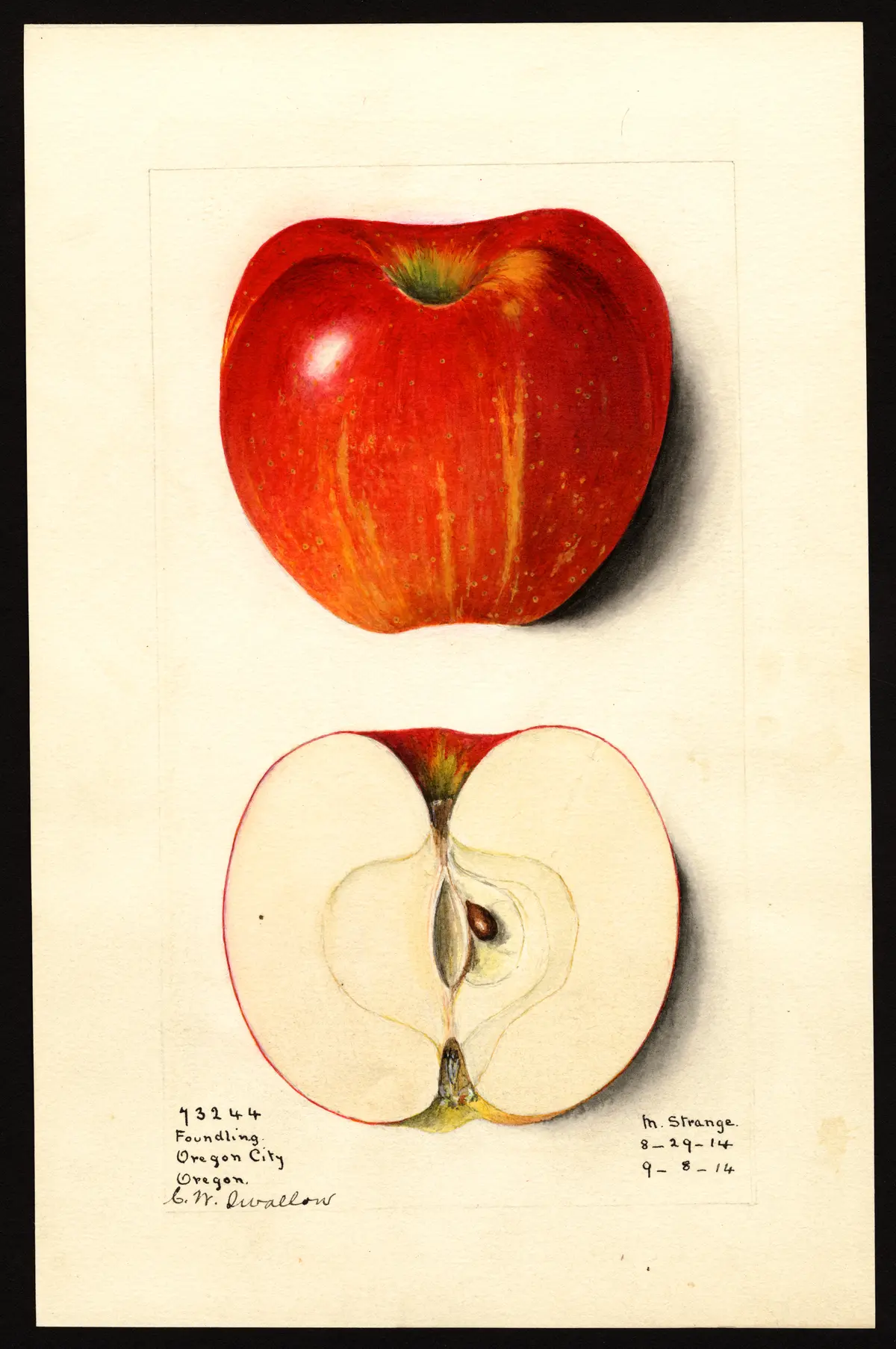
USDA Pomological Watercolor Collection
Foundling
Origin / History
Native of Massachusetts; originated in Groton, Massachusetts (Downing; Budd & Hansen). Thomas notes simply "Massachusetts." Warder cites specimens obtained from Mr. Warren.
Tree
Moderately vigorous, spreading, productive (Downing; Warder; Budd & Hansen).
Fruit
Size: Sources vary slightly. Warder: medium to large. Downing: above medium. Elliott: large. Thomas: rather large. Budd & Hansen: above medium to large. Lowther: medium.
Form: Roundish, flattened at the ends, angular or uneven (Warder); roundish oblate, inclining to conic (Downing); roundish flattened, narrowing to the eye (Elliott); oblate-conic, ribbed (Thomas); roundish, slightly flattened at the ends, obscurely conical, somewhat ribbed, angular and uneven (Budd & Hansen); roundish (oblate) (Lowther).
Stem / Stalk: Short, slender (Downing; Elliott; Thomas; Budd & Hansen); Warder notes short or medium.
Cavity: Deep, acute, wavy, green (Warder); large, somewhat furrowed (Downing); deep (Elliott); large (Thomas); large, deep, acute, somewhat furrowed and wavy, green (Budd & Hansen).
Calyx / Eye: Eye small, closed (Warder); calyx closed (Downing; Elliott); calyx small, closed (Budd & Hansen).
Basin: Wide, abrupt, folded (Warder); small, furrowed (Downing; Thomas; Budd & Hansen); furrowed (Elliott).
Skin / Surface: Yellowish-green, mixed red, splashed deep red; dots minute, indented (Warder). Yellowish green, striped and shaded with deep rich red (Downing). Yellowish green, with broken stripes, pale red, greenish specks (Elliott). Striped red on yellowish green (Thomas). Yellowish green, shaded, mixed and splashed with rich deep red; dots minute, indented (Budd & Hansen). Color summarized as yellow-red (Lowther).
Flesh / Flavor: White, tender, fine-grained, juicy; flavor sub-acid, aromatic (Warder). Yellow, tender, juicy, with a pleasant, rich vinous aroma; very good (Downing). Yellowish, crisp, tender, sprightly, sub-acid (Elliott). Yellow, tender, with a rich, sub-acid flavor (Thomas). Yellow, tender, fine-grained, juicy, pleasant, rich aromatic subacid, very good (Budd & Hansen). Quality good (Warder; Lowther).
Core / Seeds: Core large, wide, open, clasping; seeds numerous (many), small, pointed (Warder; Budd & Hansen). Elliott: core medium; seeds small.
Season
August and September (Downing; Elliott; Budd & Hansen). September (Warder). Late summer (Thomas). Autumn (Lowther).
Uses
Table (Warder); family (Lowther).
Subtypes / Variants
Not described in source.
Other
Lowther's geographic reporting: Northern Division — no reports; Central Division — 6 reporting stations; Southern Division — no reports.
Book Sources
Described in 6 period pomological works
Nursery Catalog Sources
Found in 2 catalogs (1901–1913) from Illinois
- Benjamin Buckman (personal inventory) , Farmingdale , Illinois — 1901
- Benjamin Buckman (personal inventory) , Farmingdale , Illinois — 1913
View original book sources (6)
— John A. Warder, American Pomology: Apples (1867)Foundling.
"From Massachusetts. Tree moderately vigorous, spreading, productive." — [Downing.]
Fruit medium to large, round, flattened at the ends, angular or uneven; Surface yellowish-green, mixed red, splashed deep red; Dots minute, indented.
Basin wide, abrupt, folded; Eye small, closed.
Cavity deep, acute, wavy, green; Stem short or medium.
Core large, wide, open, clasping; Seeds numerous, small, pointed; Flesh white, tender, fine-grained, juicy; Flavor sub-acid, aromatic; Quality good; Use, table; Season, September.
Specimens obtained from Mr. Warren.
— A.J. Downing, The Fruits and Fruit Trees of America (1900)FOUNDLING.
Shirley. Groton.
Origin, Groton, Mass. Tree moderately vigorous, spreading, productive.
Fruit above medium, roundish oblate, inclining to conic. Color yellowish green, striped and shaded with deep rich red. Stalk short, slender, in a large, somewhat furrowed cavity. Calyx closed. Basin small, furrowed. Flesh yellow, tender, juicy, with a pleasant, rich vinous aroma. Very good. August, September.
— Granville Lowther (ed.), Encyclopedia of Practical Horticulture (1914)Foundling. Size: medium. Form: roundish (oblate). Color: yellow-red. Quality: good. Use: family. Season: autumn. Northern Division: no reports. Central Division: 6 reporting stations. Southern Division: no reports.
— F.R. Elliott, The Western Fruit Book (1865)Foundling. Funtling, | Shirley, | Groton. Native of Mass. Fruit, large, roundish flattened, narrowing to the eye, yellowish green, with broken stripes, pale red, greenish specks ; stem, short, slender ; cavity, deep ; calyx, closed ; basin, furrowed ; core, medium ; seeds, small ; flesh, yellowish, crisp, tender, sprightly, sub-acid. August and September.
— John J. Thomas, The American Fruit Culturist (1903)Foundling. Rather large, oblate-conic, ribbed; striped red on yellowish green; stalk short, slender, cavity large, basin small, furrowed; flesh yellow, tender, with a rich, sub-acid flavor. Late summer. Massachusetts.
— J.L. Budd & N.E. Hansen, American Horticultural Manual, Part II: Systematic Pomology (1914)Foundling. — Origin, Groton, Massachusetts; tree moderately vigorous, spreading, productive.
Fruit above medium to large, roundish, slightly flattened at the ends, obscurely conical, somewhat ribbed, angular and uneven; surface yellowish green, shaded, mixed and splashed with rich deep red; dots minute, indented; cavity large, deep, acute, somewhat furrowed and wavy, green; stem short, slender; basin small, abrupt, furrowed; calyx small, closed. Core large, wide, open, clasping; seeds many, small, pointed; flesh yellow, tender, fine-grained, juicy, pleasant, rich aromatic subacid, very good. August, September.