Fulton
Pear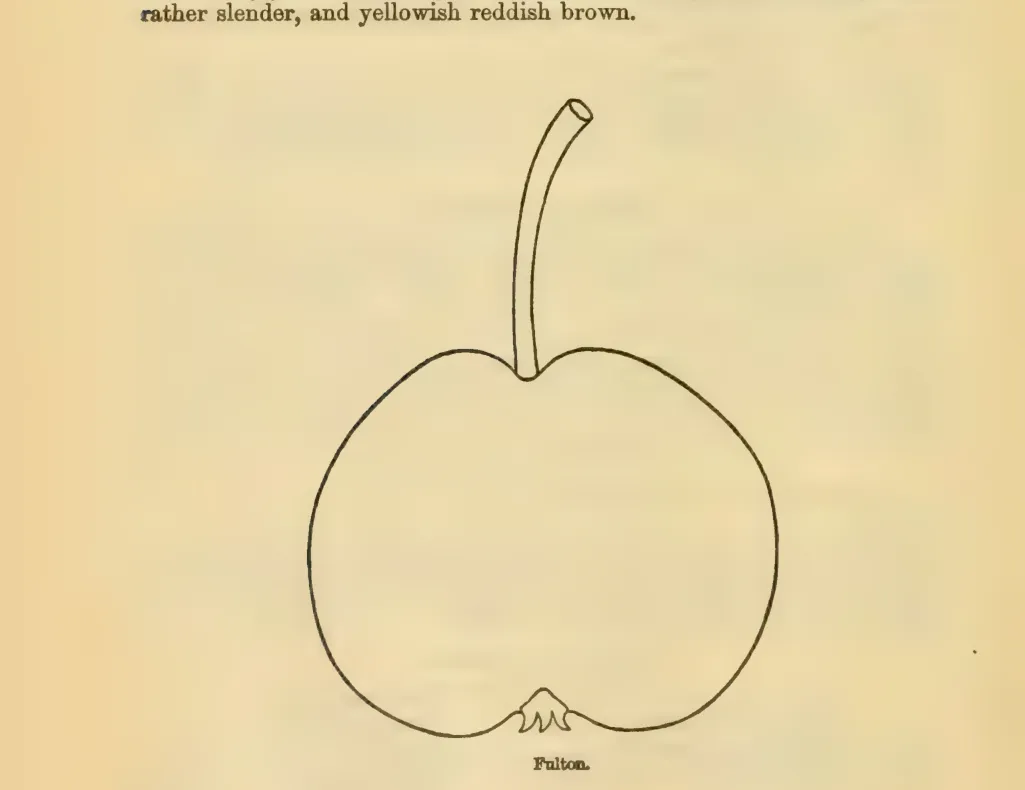
Fulton
Origin / History
Fulton is an American pear, a native of Maine. Most authors place its origin at Topsham, Me., and Downing calls it a seedling from the farm of Mrs. Fulton of Topsham. Hedrick says it originated on the farm of a Mr. Fulton in Brunswick, Me.
Hovey traces its history through a letter from John Abbott of Brunswick, Me., written in answer to inquiries from Samuel Downer of Dorchester: "a family by the name of Fulton, about fifty years ago, removed from the county of Plymouth, Mass., to Topsham, in this neighborhood, and commenced a new farm. In a year or two after they commenced their farm, Mr. Fulton and his wife, as the woman informed me, returned to Massachusetts, to visit her friends, where she collected a considerable quantity of pear seeds, which she planted on her return home. I have counted on this farm, by this woman's planting, forty trees; but they are all ordinary — some of them very ordinary — except this." Abbott adds that he had resided in Brunswick twenty-six years and had known the pear nearly as long.
Hovey calls Fulton one of the earliest native pears brought to the attention of cultivators. It first fruited in the vicinity of Boston in 1828, when there were "not more than eight or ten American varieties of any acknowledged excellence." Samuel Downer first made known its merits. Hovey credits Downer's "excellent knowledge of fruits" and writes that "the encomiums which he bestowed upon it have been fully deserved." Hovey cites the variety from the New England Farmer, vol. vii, p. 386. Hedrick's references begin with Prince's Pomological Manual of 1832, and he records that it was exhibited before the Massachusetts Horticultural Society in 1829.
Hovey (1852) wrote that after a quarter of a century, and after the introduction of many other native and foreign sorts, it "still maintains its good character, and is eagerly sought after by every cultivator of fine pears." He praises it for "a combination of good qualities": a rich-looking fruit, an abundant bearer, a hardy and vigorous tree, and a pear that ripens its fruit well and in long succession. Thomas calls it "Valuable."
Tree
Hardy to very hardy: Hovey calls it hardy, and the later authors call it very hardy. Moderately vigorous (Hovey, Downing); Hovey also calls it a vigorous tree and a good grower. Habit upright, the lateral branches forming a gentle curve upwards, making a handsome head (Hovey). Does not succeed well upon the quince (Hovey).
Young shoots slender to rather slender, reddish brown, or yellowish reddish brown (Downing). Hovey describes the wood as brownish yellow, dotted with whitish specks, rather slender and very short-jointed, the young growth slightly downy; old wood grayish olive. Buds medium size, short, diverging; flower buds medium size (Hovey).
Leaves small, ovate, narrowing to each end, thick, light yellowish green, changing to red in autumn. They are a little wavy, slightly recurved on the midrib, and finely and sharply serrated. Petioles rather short, about one inch long, moderately stout (Hovey).
Flowers medium size; petals roundish ovate; claw long (Hovey).
An abundant bearer, bearing every year; productive. Elliott calls it well suited for standard orcharding at the West.
Fruit
Size: Small to medium. Hovey and Hedrick give medium, Hovey measuring it about two and a half inches long and two and a half inches in diameter. The other authors place it below medium, rather small or nearly medium, and Elliott calls it small.
Form: Roundish to nearly round, slightly uneven, flattened at the crown, and rounding off to the stem. Elliott calls it obovate, and Hedrick globular-turbinate.
Stem: Slender, about one to two inches long; Thomas gives an inch and a quarter. Hovey calls it of medium length, about one inch, smooth, and rather deeply inserted.
Cavity: Small, round, narrow to rather narrow.
Calyx: Eye medium size, open, moderately sunk (Hovey). Segments long, deep cut, stiff, projecting; Elliott calls them nearly erect.
Basin: Small (Hovey). Downing and Thomas call it an uneven hollow or basin; Elliott calls it round and regular.
Skin: At first entirely gray russet, becoming at maturity a dark cinnamon russet. Hovey describes it as fair, of a clear bright cinnamon russet, showing in some places a deep yellow ground. Hedrick gives dark yellow, russeted. Hovey calls the skin slightly rough; Thomas calls the whole surface a smooth russet. A rich-looking fruit (Hovey).
Dots: Not described in source.
Flesh and flavor: Flesh white, fine (Hovey), half buttery, melting, moderately juicy to juicy, with a sprightly, agreeable flavor. Hovey calls the flavor "rich and excellent, though not highly perfumed," and writes that though "not so highly perfumed as some others," it "has a fine melting flesh and delicious flavor." Thomas also calls it rich.
Hedrick says that if picked and matured in the house the flesh is buttery, melting, and full of rich juice. If allowed to remain on the tree it "becomes breaking, dry and without flavor."
Quality runs from "second" (Hedrick) to "nearly or quite first-rate" (Thomas). Downing calls it "Very good."
Core and seeds: Hovey calls the core large. Elliott says it is encircled by a coarse line but is itself small and compact. Hovey gives the seeds as medium size, short, and pale brown; Elliott calls them blackish.
Season
The season runs from the last of September through November. Most authors give October and November, or middle and late autumn. Hovey gives ripe the last of September, keeping three or four weeks.
The fruit ripens gradually and in long succession. Hovey writes that every pear that falls from the tree or is gathered, if taken to the fruit room, mellows and becomes excellent, and that Mr. Manning of Salem first noticed this "some years ago." Hedrick dates Manning's discovery to 1840. He states that the fruits, after attaining half their size, are in good eating condition after lying a day or two.
Abbott supplied himself with the pear for three or four weeks by having the fruit gathered and brought to him before it softened.
Uses
Abbott called it "the only good pear for the market in the neighborhood" of Brunswick.
Subtypes / Variants
Not described in source.
Other
Not described in source.
Book Sources
Described in 5 period pomological works
Nursery Catalog Sources
Found in 2 catalogs (1845–1849) from Massachusetts
- Winship's Nursery (Brighton Nurseries , operated by the Winship family), Brighton (Boston) , Massachusetts — 1845
- Hovey & Co. , Cambridge , Massachusetts — 1849
View original book sources (5)
— C.M. Hovey, The Fruits of America (1852)THE FULTON PEAR.
Fulton. New England Farmer, vol. vii. p. 386.
The Fulton is one of the earliest of our native pears which were brought to the attention of cultivators. At the time it first fruited in the vicinity of Boston, in 1828, there were not more than eight or ten American varieties of any acknowledged excellence. Samuel Downer, Esq., of Dorchester, first made known its merits, and it is doing no more than justice to his excellent knowledge of fruits, to say that the encomiums which he bestowed upon it have been fully deserved, and that at the present time, after the lapse of a quarter of a century, and after the introduction of so many others, both native and foreign, it still maintains its good character, and is eagerly sought after by every cultivator of fine pears. It possesses a combination of good qualities. It is a rich looking fruit, having a fine cinnamon russet skin when fully mature; it is an abundant bearer; a hardy and vigorous tree; ripens its fruit well and in long succession, and though not so highly perfumed as some others, has a fine melting flesh and delicious flavor.
The Fulton originated in Topsham, Me., and we cannot better state its history and introduction than in giving an extract of a letter from Mr. John Abbott, of Brunswick, Me., in answer to the inquiries of Mr. Downer, in tracing out its origin: —
"With respect to its history, I have to inform you that a family by the name of Fulton, about fifty years ago, removed from the county of Plymouth, Mass., to Topsham, in this neighborhood, and commenced a new farm. In a year or two after they commenced their farm, Mr. Fulton and his wife, as the woman informed me, returned to Massachusetts, to visit her friends, where she collected a considerable quantity of pear seeds, which she planted on her return home. I have counted on this farm, by this woman's planting, forty trees; but they are all ordinary — some of them very ordinary — except this. I have resided in Brunswick twenty-six years, and have nearly as long been acquainted with this pear. As this is the only good pear for the market in the neighborhood, I supply myself with it for three or four weeks by having them gathered and brought me before they soften."
One peculiarity of the Fulton is the gradual ripening of the fruit. Every pear that falls from the tree, or that is gathered, if taken to the fruit room, mellows and becomes excellent. Mr. Manning, of Salem, first noticed this, some years ago. The tree is a good grower, and forms a handsome head. It does not succeed well upon the quince.
Tree. — Moderately vigorous, of upright habit, the lateral branches forming a gentle curve upwards.
Wood. — Brownish yellow, dotted with whitish specks, rather slender and very short-jointed, the young growth slightly downy; old wood, grayish olive; buds, medium size, short, diverging: Flower-buds, medium size.
Leaves. — Small, ovate, narrowing to each end, thick, light yellowish green, changing to red in the autumn, little wavy, slightly recurved on the midrib, and finely and sharply serrated; petioles, rather short, about one inch long, moderately stout.
Flowers. — Medium size; petals, roundish ovate; claw, long.
Fruit. — Medium size, about two and a half inches long, and two and a half in diameter: Form, nearly round, slightly uneven, flattened at the crown, and rounding off to the stem: Skin, fair, slightly rough, of a clear bright cinnamon russet, showing in some places a deep yellow ground: Stem, medium length, about one inch long, smooth, and rather deeply inserted in a small round cavity: Eye, medium size, open, and moderately sunk in a small basin; segments of the calyx, long, stiff, projecting: Flesh, white, fine, melting and juicy: Flavor, rich and excellent, though not highly perfumed: Core, large: Seeds, medium size, short, pale brown.
Ripe the last of September, and keeps three or four weeks.
— F.R. Elliott, The Western Fruit Book (1865)FULTON.
American. Native of Maine. Tree, very hardy, yearly and abundant bearer, well suited for standard orcharding at the West; young shoots, slender, reddish brown.
Fruit, small, obovate; color, at first gray russet, becoming dark cinnamon russet; calyx, open, segments nearly erect; basin, round, regular; stem, one to two inches long; cavity, narrow; core, encircled by a coarse line, but of itself small, compact; seeds, blackish; flesh, half buttery, moderately juicy, sprightly. October, November.
— A.J. Downing, The Fruits and Fruit Trees of America (1900)Fulton.
This American Pear is a native of Maine, and is a seedling from the farm of Mrs. Fulton, of Topsham, in that State. It is very hardy, and bears every year abundantly. Tree moderately vigorous. Young shoots rather slender, and yellowish reddish brown.
Fruit below medium size, roundish, flattened. Skin at first entirely gray russet in color, but at maturity of a dark cinnamon russet. Stalk one to two inches long, slender, planted in a narrow cavity. Calyx with long segments sunk in an uneven hollow. Flesh half buttery moderately juicy, with a sprightly, agreeable flavor. Very good. October and November.
— John J. Thomas, The American Fruit Culturist (1903)Fig. 722. Fulton. Rather small or nearly medium; roundish, crown flattened; whole surface a smooth gray russet, becoming a dark cinnamon russet; stalk an inch and a quarter long, slender, cavity round, rather narrow; calyx long, deep cut, basin uneven; flesh half buttery, melting, rich, sprightly, agreeable, nearly or quite first-rate. Ripens middle and late autumn. Shoots rather slender, reddish brown. Tree very hardy and productive. Valuable. Origin, Topsham, Me.
— U.P. Hedrick, The Pears of New York (1921)Fulton,
- Prince Pom. Man. 2:214. 1832. 2. Downing Fr. Trees Am. 768, fig. 1869.
Originated on the farm of a Mr. Fulton in Brunswick, Me. Exhibited before the Massachusetts Horticultural Society in 1829. Fruit medium, globular-turbinate, dark yellow, russeted; flesh, if picked and matured in the house, buttery, melting, full of rich juice. If allowed to remain on the tree it becomes breaking, dry and without flavor. A peculiarity of this pear first discovered by Manning in 1840 is that the fruits after they have attained half their size, are in good eating condition after lying a day or two; second; Oct.