Garden
Apple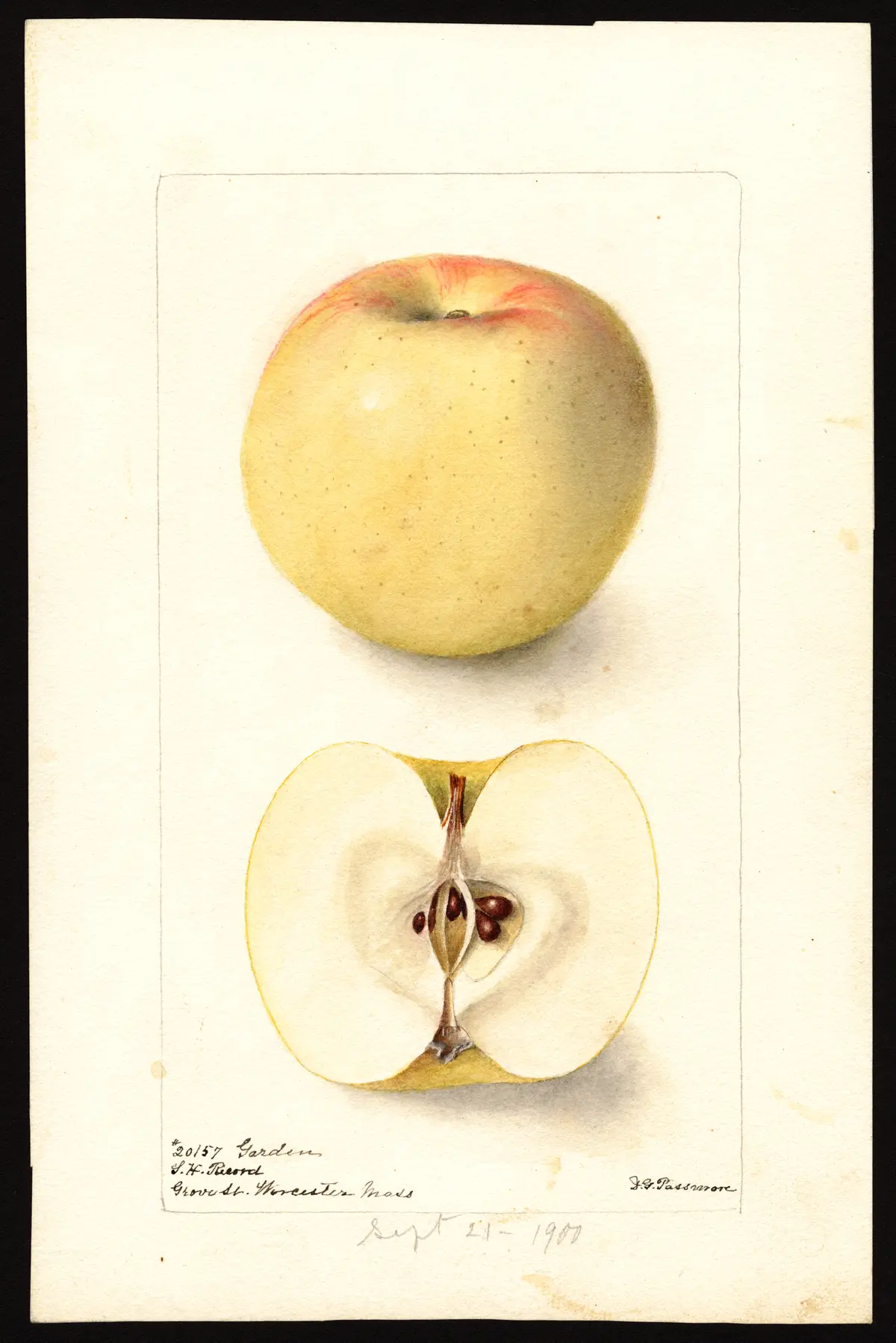
USDA Pomological Watercolor Collection
Origin/History
The primary Downing entry attributes this variety to Hezekiah Ellis of Spottsylvania County, Virginia. Hansen (1902) identifies a variety called Garden as Russian in origin, noting it is identical with Kustoe (No. 215) as fruited in the Iowa Experiment Station orchard. Downing also separately describes a distinct variety called "Comstock's Garden" as origin uncertain.
Downing notes that Warder (American Pomology, p. 435) describes a Garden Apple and simultaneously lists "Garden Royal" as a synonym, which Downing characterizes as erroneous, as Garden Royal is a distinct fruit under that name. Warder's description differs markedly from Downing's primary entry in size, ground color, and season, suggesting possible confusion between two distinct varieties bearing the name "Garden." The descriptions across these sources present substantial conflicts in size, season, origin, and use that are documented throughout the sections below.
Tree
Comstock's Garden (Downing): moderately vigorous, productive.
Not described in source for the primary Virginia-origin entry, the Warder entry, or the Hansen and Thomas entries.
Fruit
Size
Sources disagree. Downing (primary Virginia entry), Hansen, and Thomas describe the fruit as small. Warder (cited in Downing) describes the fruit as pretty large. Comstock's Garden (Downing) describes medium size.
Form
Downing (primary): oblate. Hansen: oblate, truncate, regular. Warder (per Downing): roundish flat, regular. Comstock's Garden (Downing): roundish oblate.
Stem
Sources disagree substantially. Downing (primary): stalk long, slender. Hansen: stem very peculiar, very short, thick and fleshy, like a shoe peg stuck into the apple. Warder (per Downing): stem short to medium, sometimes knobby. Comstock's Garden (Downing): stalk short and slender.
Cavity
Downing (primary): medium, thinly russetted. Hansen: wide, very shallow, often flat. Warder (per Downing): deep, acute, regular, green. Comstock's Garden (Downing): not described in source.
Calyx
Downing (primary): closed; segments rather long, partially recurved. Hansen: closed. Warder (per Downing): closed. Comstock's Garden (Downing): nearly closed.
Basin
Downing (primary): abrupt, slightly corrugated. Hansen: wide, shallow, regular. Warder (per Downing): wide, regular, small. Comstock's Garden (Downing): medium, slightly furrowed.
Skin
Downing (primary): yellow ground, shaded, splashed, and striped with two shades of red nearly over the whole surface; moderately sprinkled with light and gray dots. Hansen: yellow ground, covered with stripes and broad splashes of dark red on the sunny side; dots white, minute, numerous. Warder (per Downing): smooth, yellowish green ground, slightly shaded red, with scattered stripes of carmine; dots minute, black. Comstock's Garden (Downing): whitish ground, nearly covered with narrow stripes of light and dark red, thickly sprinkled with conspicuous light dots. Thomas: striped.
Flesh and Flavor
Downing (primary): flesh white, a little stained next the skin, crisp, juicy, mild subacid; quality good to very good. Hansen: flesh white, juicy, fine-grained, sweet, good; a pleasant flavored little eating apple for home use. Warder (per Downing): flesh pale yellow or whitish, tender, fine-grained, juicy, subacid, aromatic, saccharine, agreeable. Comstock's Garden (Downing): flesh white tinged with red, not very tender; valuable as a cooking fruit. Thomas: sub-acid, good.
Core and Seeds
Warder (per Downing): core wide, closed or open, regular, clasping the eye. Hansen: core closed.
Season
Sources disagree substantially, likely reflecting multiple distinct varieties sharing the name. Downing (primary): November–December. Thomas: November. Warder (per Downing): August to October. Comstock's Garden (Downing): September–October. Hansen: August–September.
Uses
Hansen: a pleasant flavored little eating apple for home use. Comstock's Garden (Downing): valuable as a cooking fruit. Downing (primary) and Thomas do not specify use beyond quality rating.
Subtypes/Variants
Downing separately describes "Comstock's Garden" as a distinct variety — medium-sized, whitish skin with red stripes and conspicuous light dots, September–October season, primarily a cooking fruit — with origin uncertain. This entry is sufficiently distinct from the primary Virginia-origin Garden that Downing treats them as separate entries.
Hansen identifies the variety with Kustoe (No. 215) as fruited in the Iowa Experiment Station orchard.
Warder's description (cited within Downing) differs so substantially from Downing's primary entry — in size (pretty large vs. small), season (August–October vs. November–December), ground color (yellowish green vs. yellow), and stem length (short to medium vs. long) — that Downing presents it as a potentially distinct or confused identification, and explicitly rejects Warder's "Garden Royal" synonym as erroneous.
Book Sources
Described in 3 period pomological works
USDA Nomenclature (1905)
From W.H. Ragan, Nomenclature of the Apple, USDA Bulletin No. 56
Hansen says this is identical with Kustoe.
View original book sources (3)
— A.J. Downing, The Fruits and Fruit Trees of America (1900)Garden.
Originated with Hezekiah Ellis, in Spottsylvania Co., Va.
Fruit small, oblate, yellow, shaded, splashed, and striped with two shades of red nearly over the whole surface, moderately sprinkled with light and gray dots. Stalk long, slender. Cavity medium, thinly russetted. Calyx closed. Segments rather long, partially recurved. Basin abrupt, slightly corrugated. Flesh white, a little stained next the skin, crisp, juicy, mild subacid. Good to very good. November, December.
Warder, in his American Pomology, page 435, describes a Garden Apple, and gives at the same time Garden Royal as a synonym, which latter must be erroneous, as there is a distinct fruit under that name. Warder's description is as follows:
Fruit pretty large, roundish flat, regular. Surface smooth, yellowish green, slightly shaded red, scattered stripes carmine, dots minute black. Basin wide, regular, small, closed. Cavity deep, acute, regular, green. Stem short to medium, sometimes knobby. Core wide, closed or open, regular, clasping the eye. Flesh pale yellow or whitish, tender, fine-grained, juicy, subacid, aromatic, saccharine, agreeable. August to October.
Garden.
Comstock's Garden.
Origin uncertain. Tree moderately vigorous, productive.
Fruit medium size, roundish oblate. Skin whitish, nearly covered with narrow stripes of light and dark red, and thickly sprinkled with conspicuous light dots. Stalk short and slender. Calyx nearly closed. Basin medium, slightly furrowed. Flesh white tinged with red, not very tender, but valuable as a cooking fruit. September, October.
— N.E. Hansen, A Study of Northwestern Apples (1902)Garden (No. 214)—Origin, Russia; this is identical with Kustoe No. 215 as fruited in the Iowa Experiment Station orchard—Fruit small, regular, oblate, truncate; surface yellow, covered with stripes and broad splashes of dark red on sunny side; dots white, minute, numerous; cavity wide, very shallow, often flat; stem very peculiar, very short, thick and fleshy, like a shoe peg stuck into the apple; basin wide, shallow, regular; calyx closed. Core closed; flesh white, juicy, fine grained, sweet, good. August, September. A pleasant flavored little eating apple for home use.
— John J. Thomas, The American Fruit Culturist (1903)Garden. Small, striped; sub-acid, good. November.