Grundy
Apple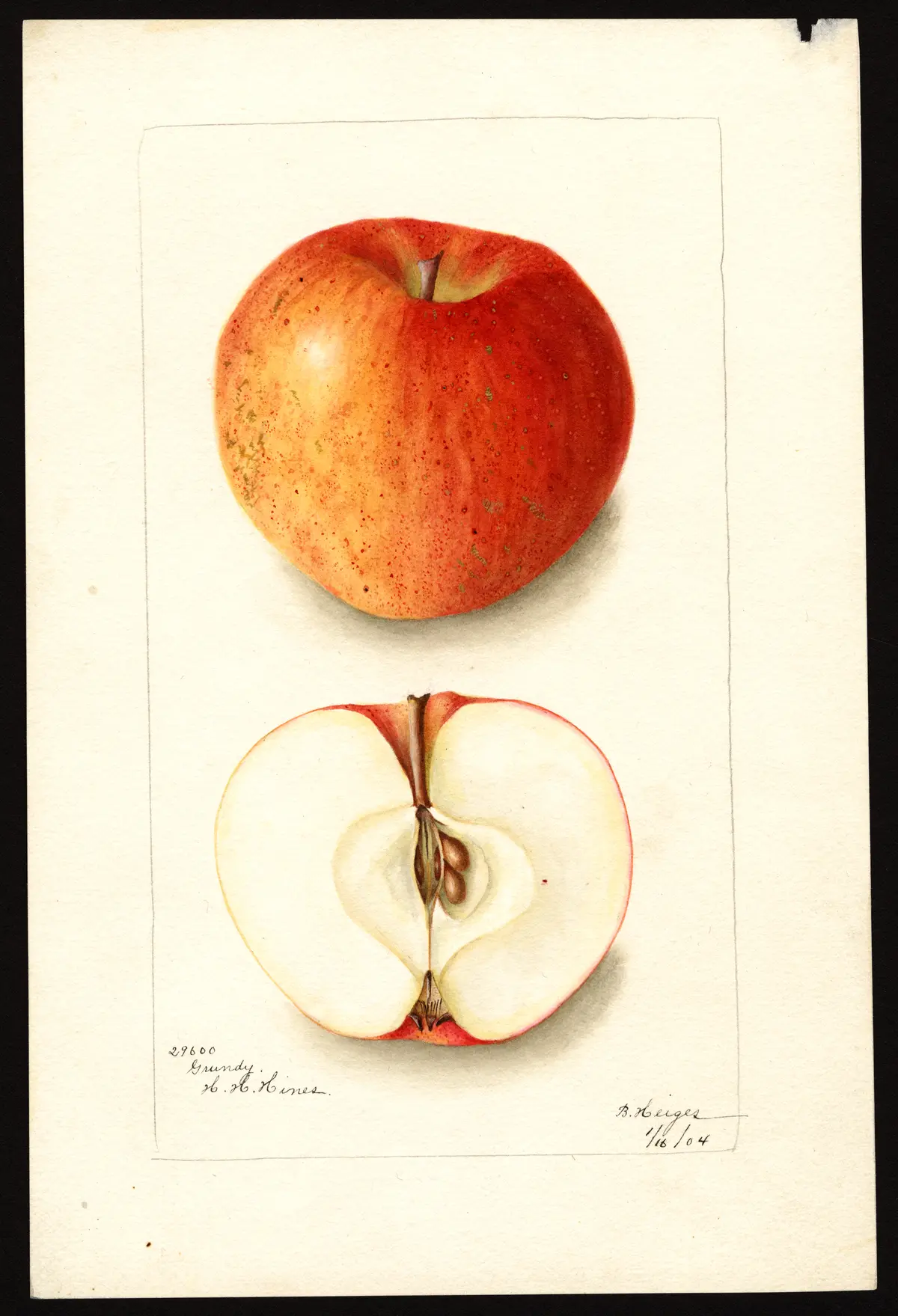
USDA Pomological Watercolor Collection
Grundy
Origin / History
Originated in Grundy County, northern Iowa, by J. S. B. Thompson (Hansen; Budd and Hansen), who list it under the name Thompson Seedling No. 38. Beach says it came from seed taken from New York to Grundy County, Iowa, by Mrs. J. S. B. Thompson in 1861. Beach adds that it "has received favorable notice as a hardy variety in that region, but has not been sufficiently tested in this state [New York] to determine its value here."
Tree
Vigorous and spreading. Productive; Hansen calls it an abundant and prolific bearer.
Fruit
Size: Large.
Form: Regular, roundish, flattened at the ends (Hansen); roundish oblong, truncated (Budd and Hansen, 1914).
Stem: Short, completely filling the lower part of the cavity (funnel, in Budd and Hansen).
Cavity: Regular, narrow, acuminate (Hansen) or funnel-shaped (Budd and Hansen), with a radiating patch of russet, described as large by Hansen.
Calyx: Wide open. Tube conical; stamens basal (Budd and Hansen, 1914).
Basin: Deep, abrupt, slightly wavy.
Skin: Yellow, mostly covered with dark marbled and mixed red, with grayish net-veinings.
Dots: White, minute, inconspicuous (Hansen) or obscure (Budd and Hansen).
Flesh and flavor: Flesh white, tender, juicy, subacid. Quality "very good."
Core and seeds: Core closed. Seeds short, plump (Hansen); few (Budd and Hansen, 1914).
Season
September and October.
Uses
Not described in source.
Subtypes / Variants
Not described in source.
Other
Not described in source.
Book Sources
Described in 3 period pomological works
View original book sources (3)
— N.E. Hansen, A Study of Northwestern Apples (1902)Grundy (Thompson Seedling No. 38)—Originated in Grundy County, northern Iowa, by J. S. B. Thompson; tree vigorous and spreading; an abundant and prolific bearer—Fruit large, regular, roundish, flattened at the ends; surface yellow, mostly covered with dark marbled and mixed red, with grayish net-veinings; dots white, minute, inconspicuous; cavity regular, narrow, acuminate, with large, radiating patch of russet; stem short, completely filling lower part of cavity; basin deep, abrupt, slightly wavy; calyx wide open. Core closed; seeds short, plump; flesh white, tender, juicy, subacid, very good. September and October.
— S.A. Beach, The Apples of New York, Vol. 2 (1905)GRUNDY.
REFERENCES. 1. Hansen, S. D. Sta. Bul. 76:56. 1902. 2. Budd-Hansen, 1903:95. 3. Jewell Nursery Co. Cat., 1903:7. 4. Ragan, U. S. B. P. I. Bul. 56:133. 1905.
SYNONYMS. Grundy (1, 2, 3, 4). Thompson Seedling No. 38 (1, 2, 3, 4).
Fruit large, regular, subacid, yellow marbled with red. Season September and October. Tree vigorous, spreading, productive. Originated from seed taken from New York to Grundy county, Iowa, by Mrs. J. S. B. Thompson in 1861. It has received favorable notice as a hardy variety in that region, but has not been sufficiently tested in this state to determine its value here (2).
— J.L. Budd & N.E. Hansen, American Horticultural Manual, Part II: Systematic Pomology (1914)Grundy (Thompson Seedling, No. 38).—Originated by J. S. B. Thompson, Grundy Co., Iowa; tree productive.
Fruit large, roundish oblong, truncated; surface yellow, mostly covered with dark marbled and mixed red, with grayish net-veining; dots white, minute, obscure; cavity regular, narrow, funnel-shaped, with radiating patch of russet; stem short, completely filling lower part of funnel; basin deep, abrupt, slightly wavy; calyx wide open. Core closed; tube conical; stamens basal; seeds few; flesh white, tender, juicy, subacid, very good. September, October.