Hagloe Crab
Crab Apple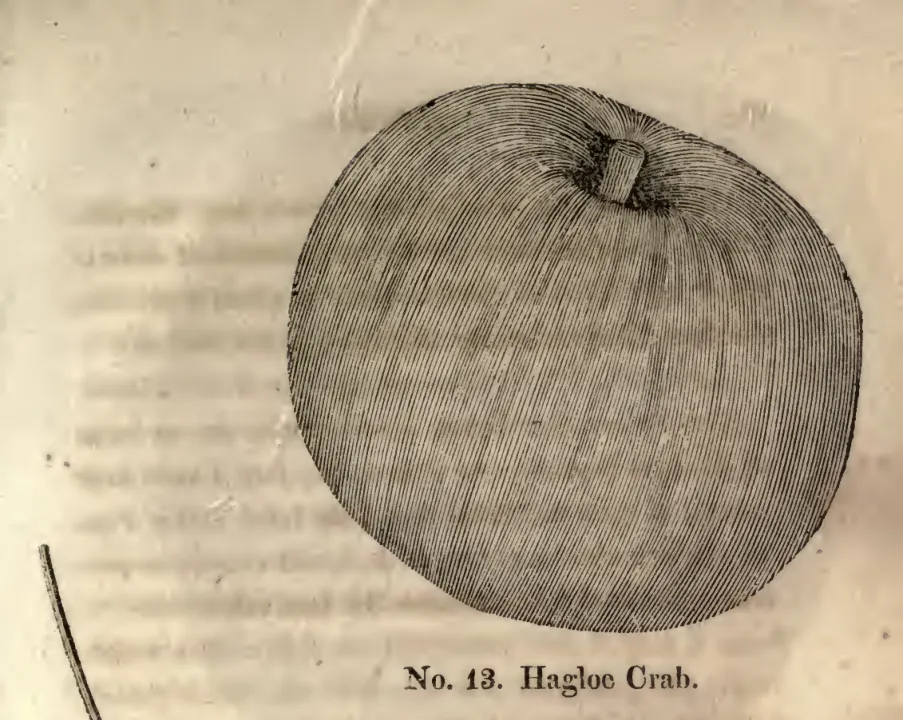
Hagloe Crab
Origin / History
A celebrated old English cider fruit. The parent tree was standing in 1783 in the orchard of Mr. Bellamy of Herefordshire, England (Coxe). Its reputation as a cider apple stands very high in Herefordshire; as reported by Mr. Marshal and cited by Coxe, the cider it produces has been supposed to exceed, for richness, flavour, and price, any fruit liquor which nature and art have produced. Sixty guineas have been offered for a hogshead of a hundred and ten gallons; also bottle for bottle of wine and spirituous liquors have been offered for it (Coxe).
Tree
Growth very uncommon; thick, strong shoots. Buds particularly large, especially at the extremity of the branches. Color of the wood dark. Size of the tree small. Bears abundantly and early (Coxe).
Fruit
Size: Sources conflict. Coxe describes the size as about middling and notes great beauty and large size as market virtues; Downing describes the fruit as small.
Form: Sources conflict. Coxe describes the form as round, flat at the ends. Downing describes it as ill-shaped, something between an apple and a crab, more long than broad, wide at the base and narrow at the crown, the crown a little sunk.
Stem: Stalk large (Coxe).
Cavity: Not described in source.
Calyx / Eye: Eye flat (Downing).
Basin: Crown (apex) a little sunk (Downing).
Skin: Sources partially conflict on color. Coxe describes the fruit when fully ripe as having a yellow ground streaked with bright red. Downing describes it as pale yellow, a little marbled in different directions with a russet gray, and having a few red specks or streaks on the sunny side.
Flesh / Flavor: Flesh remarkably soft and woolly, but not dry; color of the flesh pale. Taste acid, but highly flavoured. The smell of the apple is faint. The quantity of juice is smaller, in proportion to the fibrous matter, than in most other apples, requiring near one third more of the Hagloes for a barrel of cider than of common fruit; yet the juice, though uncommonly sheer, is singularly rich (Coxe).
Core / Seeds: Not described in source.
Season
Ripens in August and September. Keeps a long time without rotting (Coxe).
Uses
Principally prized as a cider fruit of the highest quality; when properly manufactured, the cider is very rich, and the color of the cider dark despite the pale flesh (Coxe). Also noted as an uncommonly fine cooking apple, and from its great beauty, large size, and abundant bearing, a valuable market fruit (Coxe).
Subtypes / Variants
Not described in source.
Other
Not described in source.
Book Sources
Described in 2 period pomological works
View original book sources (2)
— William Coxe, A View of the Cultivation of Fruit Trees (1817)NO. 13. HAGLOE CRAB.
The character of this apple as a cider fruit, stands very high in Herefordshire, England, where the parent tree was standing in 1783, in the orchard of Mr. Bellamy of that county: the cider, as stated by Mr. Marshal, has been supposed to exceed, for richness, flavour, and price, any fruit liquor which nature and art have produced. Sixty guineas have been offered for a hogshead of a hundred and ten gallons; also bottle for bottle of wine and spirituous liquors, have been offered for it. The fruit, when fully ripe, has a yellow ground streaked with bright red—the size about middling, the form round, flat at the ends; the stalk large—the flesh remarkably soft and woolly, but not dry—the taste acid, but highly flavoured, the quantity of juice smaller, in proportion to the fibrous matter, than in most other apples, requiring near one third more of the Hagloes for a barrel of cider, than of common fruit: the juice, though uncommonly sheer, is singularly rich, and though the smell of the apple is faint, the flavour of the cider is high; and when properly manufactured, is very rich. The colour of the flesh is pale, but that of the cider dark—it ripens in August and September; keeps a long time without rotting—it bears abundantly and early: the growth of the tree is very uncommon; thick strong shoots; buds, particularly at the extremity of the branches, very large; the colour of the wood dark—the size of the tree small: the Hagloe is an uncommonly fine cooking apple; and from its great beauty and large size, added to its abundant bearing, is a valuable market fruit.
— A.J. Downing, The Fruits and Fruit Trees of America (1900)Hagloe Crab.
This is a celebrated old English cider fruit.
Fruit small, ill-shaped, something between an apple and a crab, more long than broad, wide at the base and narrow at the crown, which is a little sunk, and the eye flat, pale yellow, a little marbled in different directions, with a russet gray, and having a few red specks or streaks on the sunny side.