Hampton's Virgalieu
Pear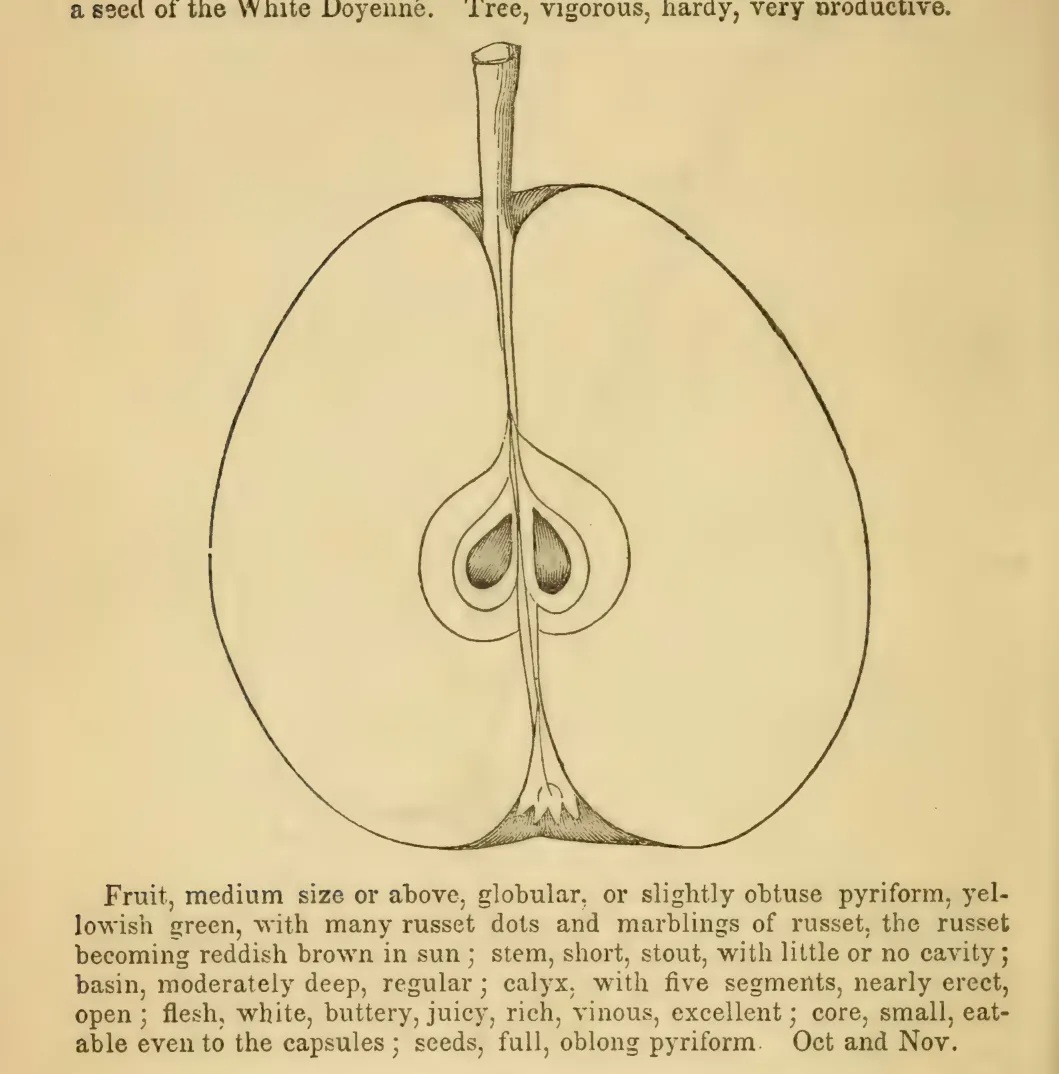
Hampton's Virgalieu
Origin/History
Originated with W. C. Hampton, of Mount Victory, Hardin County, Ohio, from a seed of the White Doyenne. Listed in Elliott (1865), Downing (1869/1900), and Hedrick (1921).
Tree
Vigorous, hardy, and productive (Elliott; Hedrick). Downing does not describe the tree.
Fruit
Size and Form: Medium in size (all sources); Elliott notes "or above" on size. Downing describes the form as roundish pyriform; Elliott and Hedrick describe it as globular, or slightly obtuse pyriform.
Surface: Downing notes the surface as uneven. Skin color is green, slightly yellow at maturity (Downing), or yellowish-green at maturity (Elliott; Hedrick). Downing describes patches, nettings, and dots of russet, and notes that the fruit sometimes develops a warm cheek in sun. Elliott and Hedrick describe many russet dots and marblings of russet, the latter becoming reddish-brown in the sun.
Stem: Short and stout (Elliott). Little or no cavity at the stem (Elliott).
Cavity: Little or no cavity (Elliott).
Calyx: Five segments, nearly erect, open (Elliott).
Basin: Moderately deep, regular (Elliott).
Skin: See Surface above.
Flesh and Flavor: Flesh color is described as yellowish by Downing, but as white by both Elliott and Hedrick. On texture: Downing describes the flesh as slightly gritty and melting; Elliott and Hedrick describe it as buttery. All sources agree the flesh is juicy and vinous. Elliott and Hedrick add rich; Hedrick and Downing add brisk. Quality rated very good (Downing; Hedrick) or excellent (Elliott).
Core and Seeds: Core small (Elliott; Hedrick); Elliott notes it is eatable even to the capsules. Seeds full, oblong pyriform (Elliott).
Season
October (Downing). October and November (Elliott; Hedrick).
Uses
Not described in source.
Subtypes/Variants
Not described in source.
Other
Not described in source.
Book Sources
Described in 3 period pomological works
View original book sources (3)
— A.J. Downing, The Fruits and Fruit Trees of America (1900)Hampton's Virgalieu.
A seedling of W. C. Hampton, Ohio.
Fruit medium, roundish pyriform. Surface uneven, green, slightly yellow at maturity, sometimes with a warm cheek in sun, patches, nettings, and dots of russet. Flesh yellowish, slightly gritty, juicy, melting, brisk, vinous. Very good. October.
— U.P. Hedrick, The Pears of New York (1921)Hampton Virgalieu.
- Elliott Fr. Book 388, fig. 1859.
- Downing Fr. Trees Am. 778. 1869.
Originated with W. C. Hampton, Mount Victory, Ohio, from a seed of the White Doyenne. Tree vigorous, hardy and productive. Fruit medium, globular, or slightly obtuse-pyriform, yellowish-green at maturity, with many russet dots and marblings of russet, the latter becoming reddish-brown in the sun; flesh white, buttery, juicy, rich, vinous, brisk; core small; very good; Oct. and Nov.
— F.R. Elliott, The Western Fruit Book (1865)Hampton Virgalieu.
Originated with W. C. Hampton, of Mount Victory, Hardin Co., O., from a seed of the White Doyenne. Tree, vigorous, hardy, very productive. Fruit, medium size or above, globular, or slightly obtuse pyriform, yellowish green, with many russet dots and marblings of russet, the russet becoming reddish brown in sun ; stem, short, stout, with little or no cavity ; basin, moderately deep, regular ; calyx, with five segments, nearly erect, open ; flesh, white, buttery, juicy, rich, vinous, excellent ; core, small, eatable even to the capsules ; seeds, full, oblong pyriform Oct and Nov.