Harvest Redstreak
Apple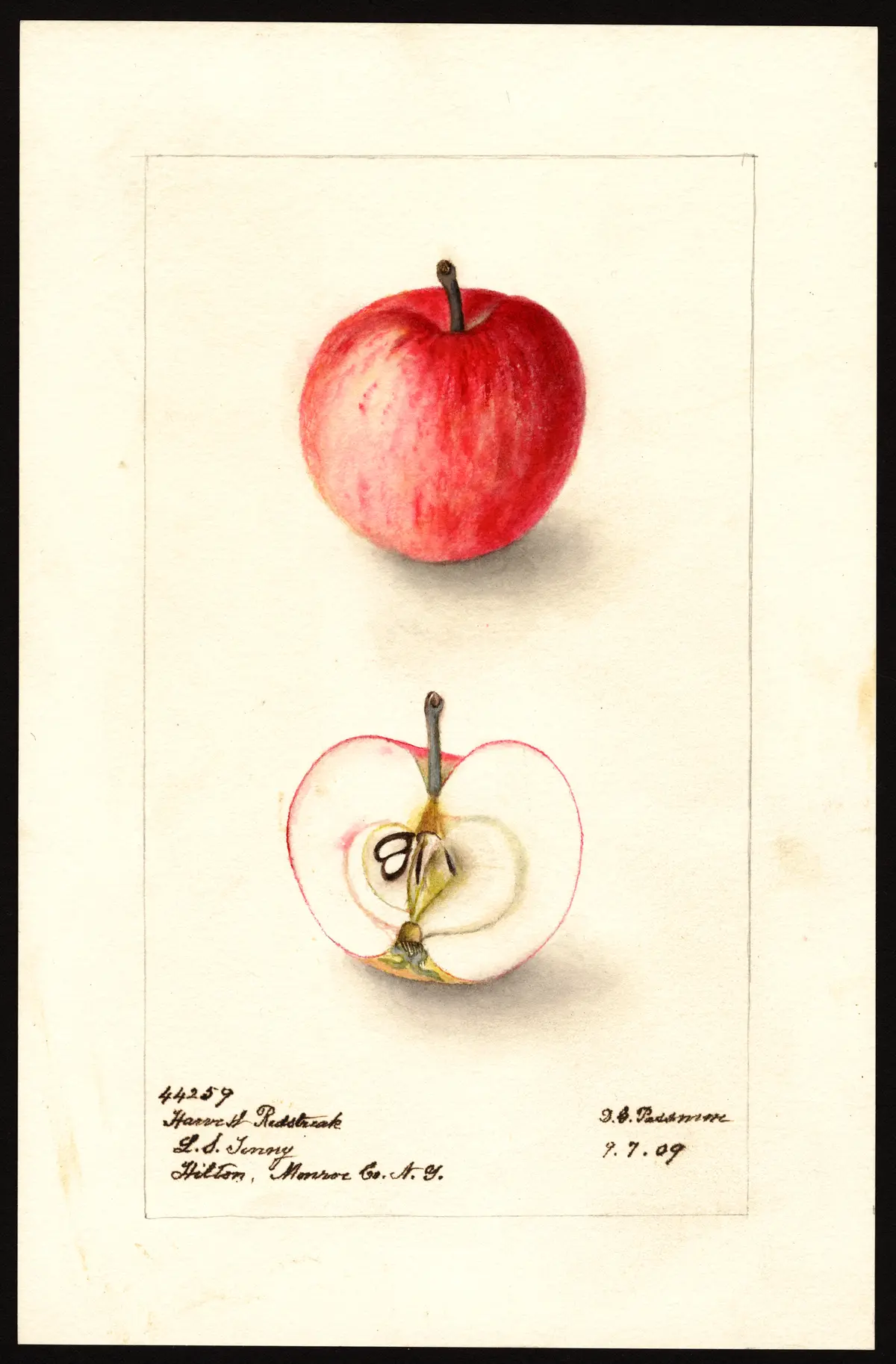
USDA Pomological Watercolor Collection
Harvest Redstreak
Origin / History
An old variety. Warder, Downing, and Beach give its origin as unknown. Elliott (1865) calls it "From Michigan," a local name, and "probably an old variety." Warder records that it was introduced into the West by Silas Wharton from the neighborhood of Philadelphia, where it was cultivated largely, and that it is not recognized among the varieties described by Coxe. Beach's references trace it in print from Downing (1857), where it appears as "Harvest Red Streak," through Warder (1867), Downing (1869), Thomas (1875), and Ragan (1905). Thomas (1903) carries only a cross-reference under "Striped Harvest" to "Harvest Red Streak." Beach (1905) calls Harvest Redstreak rarely found in New York and "now seldom or never planted."
Tree
Tree medium to large (Beach), round-headed, spreading. Warder calls it open; Downing calls it upright. A free grower, moderately vigorous to very vigorous, and productive. Beach adds that it yields good to heavy crops biennially. Twigs stout. Leaves small, mealy (Warder).
Fruit
Size: Medium; Elliott gives small or medium.
Form: Oblate (Elliott, Downing) to roundish-oblate (Warder). Warder calls it regular; Elliott calls it angular.
Stem: Medium, thick (Warder).
Cavity: Acute, regular, often brown (Warder).
Calyx: Eye medium, closed (Warder).
Basin: Medium, folded (Warder).
Skin: Smooth, greenish yellow or whitish, striped and splashed with red, the colors more or less mingled (Warder). Downing describes two shades of red. A light bloom (Warder).
Dots: Minute, dark (Warder).
Flesh and flavor: Flesh white or whitish, coarse, juicy. Warder calls it breaking and says it becomes dry; Downing calls it tender. Flavor subacid, "brisk subacid" (Downing). Warder rates the quality "inferior, except for cooking."
Core and seeds: Core regular, closed. Seeds angular (Warder).
Season
The recorded season runs from July through September. Downing and Beach give August and September; Warder gives July.
Uses
A culinary apple. Downing calls it "valuable for cooking," and Beach calls it "good for culinary use." Warder says it is "valued only as an early cooking apple, for which it has been found very profitable, by those who attend market." Beach says it "is not sufficiently attractive in color for a good market variety."
Subtypes / Variants
Not described in source.
Other
Not described in source.
Book Sources
Described in 5 period pomological works
- Warder, American Pomology: Apples (1867)
- Beach, The Apples of New York Vol. 2 (1905)
- Thomas, The American Fruit Culturist (1903)
- Downing, Fruits and Fruit Trees of America (1900) — listed as Harvest Red Streak
- Elliott, The Western Fruit Book (1865) — listed as Harvest Red Streak
View original book sources (5)
— F.R. Elliott, The Western Fruit Book (1865)Harvest Red Streak. From Michigan. A local name ; probably an old variety ; small or medium, oblate angular ; skin, whitish, striped and splashed.
— John A. Warder, American Pomology: Apples (1867)Harvest Redstreak.
This old variety is valued only as an early cooking apple, for which it has been found very profitable, by those who attend market. Origin unknown. Introduced into the West by Silas Wharton, from the neighborhood of Philadelphia, where it was cultivated largely. Not recognized among the varieties described by Coxe.
Tree spreading, open, round-headed; Twigs stout; Leaves small, mealy.
Fruit medium, roundish-oblate, regular; Surface smooth, greenish-yellow, striped and splashed with red, more or less mingled; Dots minute, dark, and a light bloom.
Basin medium, folded; Eye medium, closed.
Cavity acute, regular, often brown; Stem medium, thick.
Core regular, closed; Seeds angular; Flesh whitish, breaking, coarse, juicy, becoming dry; Quality inferior, except for cooking; Season July.
— A.J. Downing, The Fruits and Fruit Trees of America (1900)Harvest Red Streak.
Early Red Streak. Striped Harvest.
An old variety, origin unknown. Tree a free grower, upright, spreading, productive.
Fruit medium, oblate, whitish, striped and splashed with two shades of red. Flesh white, coarse, tender, juicy, brisk subacid. Valuable for cooking. August and September.
— John J. Thomas, The American Fruit Culturist (1903)Striped Harvest. See Harvest Red Streak.
— S.A. Beach, The Apples of New York, Vol. 2 (1905)HARVEST REDSTREAK.
REFERENCES. 1. Downing, 1857:214. 2. Warder, 1867:436. 3. Downing, 1869:211. 4. Thomas, 1875:501. 5. Ragan, U. S. B. P. I. Bul, 56:138. 1905.
SYNONYMS. Early Red Pippin (5). Early Redstreak (2). Early Red Streak (3). HARVEST REDSTREAK (2, 5). HARVEST RED STREAK (1, 3, 4). Striped Harvest (3, 5).
Fruit of medium size, smooth, greenish-yellow or whitish striped and splashed with red. Flesh whitish, coarse, subacid, good for culinary use; season August and September. It is not sufficiently attractive in color for a good market variety. The tree is medium to large, with round head, moderately vigorous to very vigorous and yields good to heavy crops biennially.
Historical. This is an old variety of unknown origin. It is rarely found in New York and is now seldom or never planted.