Herefordshire
Apple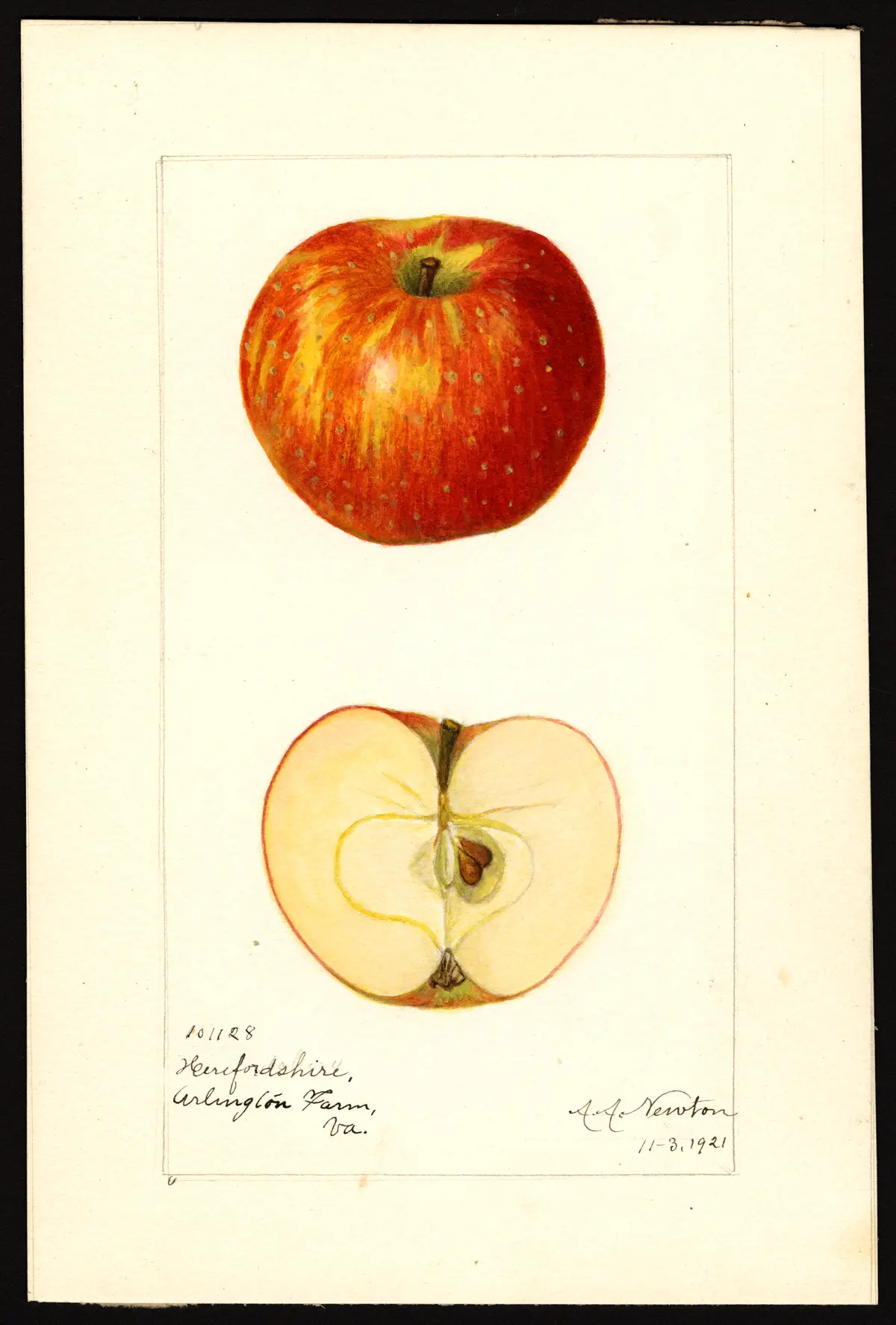
USDA Pomological Watercolor Collection
Herefordshire
Origin/History
Known in Herefordshire for more than one hundred years. Historically called Herefordshire Beefing. Little known in New York at the time of this writing (1905).
Tree
Tree not a very good grower; branches short, slender; laterals willowy and slender. Form roundish or spreading, very dense. Twigs below medium to very short, straight, slender, somewhat pubescent; internodes short. Bark clear brownish-red with some olive-green, lightly mottled with scarf-skin. Lenticels moderately numerous, scattering, small to medium, elongated, slightly raised. Buds below medium to small, broad, very obtuse, appressed, deeply set in the bark, pubescent.
Tree comes into bearing early and is productive.
Fruit
Size and form: Medium in size but with a full crop varies from below medium to small. Form usually roundish oblate, sometimes oblate conic, symmetrical; uniform in size and shape.
Stem: Short and thick.
Cavity: Obtuse, broad, deep, often russeted, usually symmetrical, sometimes furrowed.
Calyx: Medium to rather large, usually open; tips of lobes divergent.
Basin: Varies from shallow to moderately deep, rather wide, slightly wrinkled, ridged.
Skin: Thin, tough, clear greenish-yellow largely blushed with rather bright dark red, sometimes almost covered with red. Prevailing effect red with more or less contrasting yellow.
Dots: Medium in size, numerous, usually russet, sometimes submerged.
Calyx tube: Very short, rather wide, broadly conical, sometimes approaching funnel-form. Stamens median or slightly marginal.
Core: Large, abaxile; cells symmetrical, open; core lines clasping. Carpels usually elliptical, sometimes broadly obovate, emarginate, sometimes a little tufted.
Seeds: Small, rather short, plump, broadly acute, rather light colored.
Flesh: Yellowish, moderately firm and tender, moderately fine, juicy, aromatic, brisk subacid, fair to good in flavor and quality. Dark red, subacid in character.
Season
October to January or February.
Uses
Kitchen use.
Other
As fruited at the Geneva Station it is rather attractive but falls below standard commercial varieties in size, quality and appearance. It does not appear to be worthy of trial in New York state.
Sources cited in original: Hogg, 1884:106; Lyon, Michigan Horticultural Society Report, 1890:292; Bailey, Annual Report of Horticulture, 1892:241.
Book Sources
Described in 1 period pomological work
Nursery Catalog Sources
Found in 2 catalogs (1894–1911) from England, Oregon
- Woodburn Nurseries , Woodburn, Marion Co. , Oregon — 1894
- James Veitch & Sons , Ltd., Royal Exotic Nursery, Chelsea, London (also Coombe Wood, Langley, and Feltham) , England — 1911
View original book sources (1)
— S.A. Beach, The Apples of New York, Vol. 1 (1905)HEREFORDSHIRE.
REFERENCES. 1. Hogg, 1884:106. 2. Lyon, Mich. Hort. Soc. Rpt., 1890: 292. 3. Bailey, An. Hort., 1892:241. SYNONYM. HEREFORDSHIRE BEEFING (1, 3). A dark red subacid apple adapted for kitchen use. As fruited at the Geneva Station it is rather attractive but falls below standard commercial varieties in size, quality and appearance. The tree comes into bearing early and is productive. It does not appear to be worthy of trial in New York state. Historical. Known in Herefordshire for more than one hundred years (1). It is but little known in New York.
TREE. Tree not a very good grower; branches short, slender; laterals willowy and slender. Form roundish or spreading, very dense. Twigs below medium to very short, straight, slender, somewhat pubescent; internodes short. Bark clear brownish-red with some olive-green, lightly mottled with scarf-skin. Lenticels moderately numerous, scattering, small to medium, elongated, slightly raised. Buds below medium to small, broad, very obtuse, appressed, deeply set in the bark, pubescent.
FRUIT. Fruit medium in size but with a full crop it varies from below medium to small. Form usually roundish oblate, sometimes oblate conic, symmetrical; uniform in size and shape. Stem short and thick. Cavity obtuse, broad, deep, often russeted, usually symmetrical, sometimes furrowed. Calyx medium to rather large, usually open; tips of lobes divergent. Basin varies from shallow to moderately deep, rather wide, slightly wrinkled, ridged. Skin thin, tough, clear greenish-yellow largely blushed with rather bright dark red, sometimes almost covered with red. Dots medium in size, numerous, usually russet, sometimes submerged. Prevailing effect red with more or less contrasting yellow. Calyx tube very short, rather wide, broadly conical, sometimes approaching funnel-form. Stamens median or slightly marginal. Core large, abaxile; cells symmetrical, open; core lines clasping. Carpels usually elliptical sometimes broadly obovate, emarginate, sometimes a little tufted. Seeds small, rather short, plump, broadly acute, rather light colored. Flesh yellowish, moderately firm and tender, moderately fine, juicy, aromatic, brisk subacid, fair to good in flavor and quality. Season October to January or February.