Hiester
Apple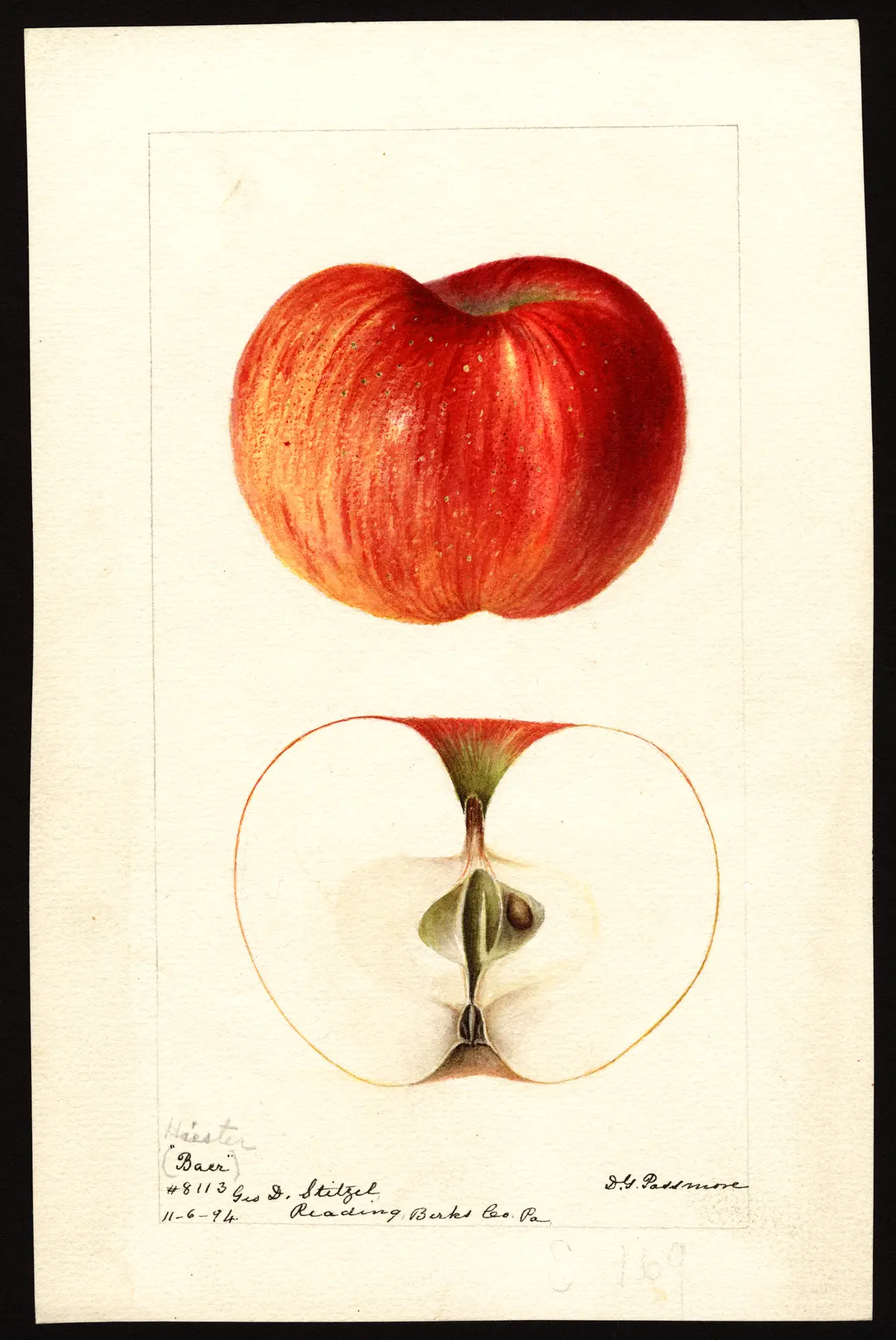
USDA Pomological Watercolor Collection
Hiester
Origin/History
Originated in Reading, Berks County, Pennsylvania (Downing; Beach). Beach notes it is "but little known in New York" and "not recommended for planting in New York," though "considered a desirable apple in some parts of Pennsylvania." Thomas describes the "Baer" entry as a Berks County, Pa. apple "identical with Hiester."
Tree
Large, vigorous, spreading, and productive (Downing). Vigorous and productive (Beach). Vigorous (Elliott). Young shoots very dark blackish brown (Downing).
Fruit
Size: Medium (Downing; Beach). Large (Elliott). Rather small (Thomas, under the "Baer" entry).
Form: Roundish oblate (Downing; Thomas). Roundish oblate, sometimes faintly ribbed (Beach). Oblate conic, angular (Elliott).
Stem: Very short and slender (Beach). Very short (Elliott). Long (Thomas, under "Baer").
Cavity: Acute, rather broad and deep (Beach). Deep (Elliott). Wide and deep (Thomas).
Calyx: Small, partly open (Beach). Partially closed (Elliott). Calyx tube rather small, cone-shape, approaching funnel-form; stamens median (Beach).
Basin: Rather abrupt to somewhat obtuse, broad, deep, slightly wrinkled (Beach). Small, uneven (Elliott). Small, plaited (Thomas).
Skin: Yellowish, shaded and indistinctly splashed and mottled with two shades of red, with few light gray dots (Downing). Pale yellow mottled with thin bright red on the shady side and washed with deeper red and narrowly streaked with deep carmine in the sun; dots gray or russet, conspicuous about the cavity (Beach). Yellow, striped and shaded with red, and covered with large brown dots (Elliott). Striped red on greenish yellow (Thomas).
Flesh/Flavor: White, crisp, juicy, tender, pleasant subacid; rated "Good" (Downing). Yellowish-white, crisp, moderately juicy, rather tender, mild subacid to somewhat sweet, fair to good in flavor and quality (Beach). Whitish, juicy, tender, pleasant, mild sub-acid (Elliott). Tender, fine grained, pleasant, very good (Thomas). Beach summarizes the variety as "a pleasant subacid apple."
Core/Seeds: Core small, somewhat abaxile; cells open or partly open; core lines meeting or clasping. Carpels broadly roundish. Seeds medium or below, rather narrow, short, plump (Beach).
Season
November to March (Downing). January to April (Elliott). Keeps till spring (Thomas). Beach reports it as in season during winter in New York, "but where it originated it is classed as a late fall and early winter variety."
Uses
Not described in source.
Subtypes/Variants
Not described in source.
Other
Not described in source.
Book Sources
Described in 4 period pomological works
View original book sources (4)
— A.J. Downing, The Fruits and Fruit Trees of America (1900)Hiester. Heaster. Heister. Baer. Stehly. Miller. Originated in Reading, Berks Co., Pa. Tree large, vigorous, spreading, productive. Young shoots very dark blackish brown. Fruit medium, roundish oblate, yellowish, shaded and indistinctly splashed and mottled with two shades of red, few light gray dots. Flesh white, crisp, juicy, tender, pleasant subacid. Good. November to March.
— S.A. Beach, The Apples of New York, Vol. 1 (1905)HIESTER.
REFERENCES. 1. Downing, 1872:215. 2. Boyer, Pa. Fr. Gr. Soc. Rpt., 1881:34. 3. Ill. Sta. Bul., 45:324. 1896.
SYNONYMS. Baer (1). Heaster (1). Heister (1). Michel Miller (2). Miller (1). Stehly (1).
A pleasant subacid apple in season here during winter, but where it originated it is classed as a late fall and early winter variety. Tree vigorous and productive (1). It is considered a desirable apple in some parts of Pennsylvania (2). Not recommended for planting in New York.
Historical. Origin, Reading, Berks county, Pa. (1). But little known in New York.
FRUIT.
Fruit medium. Form roundish oblate, sometimes faintly ribbed. Stem very short and slender. Cavity acute, rather broad and deep. Calyx small, partly open. Basin rather abrupt to somewhat obtuse, broad, deep, slightly wrinkled. Skin pale yellow mottled with thin bright red on shady side and washed with deeper red and narrowly streaked with deep carmine in the sun. Dots gray or russet, conspicuous about the cavity. Calyx tube rather small, cone-shape, approaching funnel-form. Stamens median.
Core small, somewhat abaxile; cells open or partly open; core lines meeting or clasping. Carpels broadly roundish. Seeds medium or below, rather narrow, short, plump. Flesh yellowish-white, crisp, moderately juicy, rather tender, mild subacid to somewhat sweet, fair to good in flavor and quality.
— F.R. Elliott, The Western Fruit Book (1865)STEHLY.
Origin, Berks Co., Pa. Tree, vigorous. Fruit, large, oblate conic, angular; skin, yellow, striped and shaded with red, and covered with large brown dots; stem, very short, inserted in a deep cavity; calyx, partially closed, set in a small, uneven basin; flesh, whitish, juicy, tender, pleasant, mild sub-acid. January to April.
— John J. Thomas, The American Fruit Culturist (1903)Baer. Rather small, roundish-oblate; striped red on greenish yellow; stalk long, cavity wide and deep; basin small, plaited; flesh tender, fine grained, pleasant, very good—keeps till spring. Berks County, Pa. Identical with Hiester.