Hightop
Apple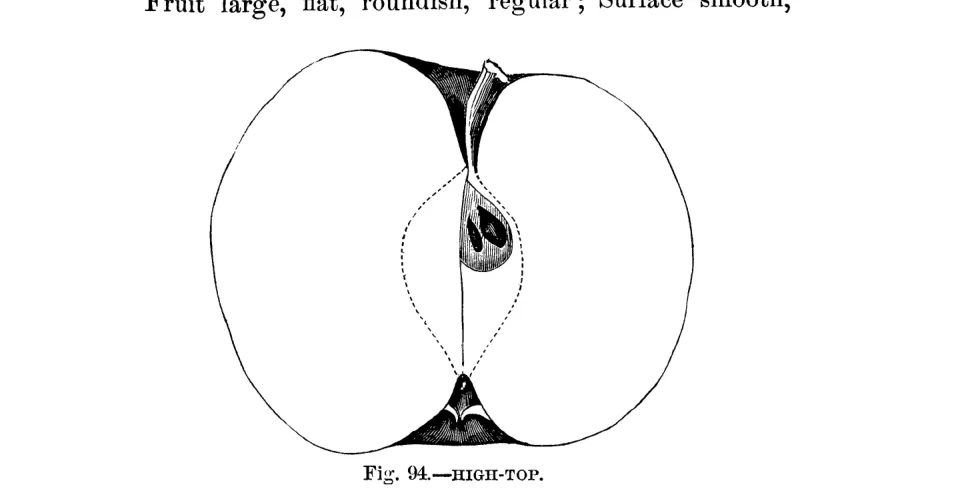
[NOTE: Source text may be incorrect — The Thomas (1903) source describes a fruit that conflicts fundamentally with the Warder (1867) and Downing (1900) sources on nearly every identifiable characteristic. Warder and Downing agree that Hightop is large, flat, roundish, smooth-surfaced, mixed dull red with carmine striping, subacid, aromatic, and a winter variety (December–January) originating in Wayne County, Indiana. The Thomas (1903) entry describes a fruit that is rather small, light yellow-skinned, very sweet, rich, a summer apple, and originating in Massachusetts — and explicitly lists "Summer Sweet of Ohio" and "Sweet June" as synonyms, with an upright productive tree. This is almost certainly a different variety entirely, conflated under the "Hightop" name in Thomas's catalog. All Thomas details are included below but flagged accordingly.]
Hightop
Origin/History
Hightop is supposed to have originated in Wayne County, Indiana, and was brought into notice by Lewis Jones. (Warder, 1867; Downing, 1900)
[NOTE: Thomas (1903) attributes a variety listed as "Hightop" to Massachusetts, which conflicts directly with the Indiana origin given by Warder and Downing. Thomas's entry additionally lists the synonyms "Summer Sweet of Ohio" and "Sweet June," suggesting this is a distinct variety sharing the name Hightop. The Thomas entry is preserved in full below for completeness but should be treated with caution as a possible misidentification or name collision.]
Tree
Per Warder (1867) and Downing (1900): Not described in source.
Per Thomas (1903) [see NOTE above]: Tree upright, productive. Described as a valuable summer sweet apple at the West.
Fruit
Size and Form
Per Warder (1867) and Downing (1900): Fruit large (Downing notes "medium to large"), flat, roundish, regular.
Per Thomas (1903) [see NOTE above]: Rather small, roundish, regular.
Stem
Per Warder (1867): Stem short, green.
Per Downing (1900) and Thomas (1903): Not described in source.
Cavity
Per Warder (1867): Cavity wavy, brown, acute.
Per Thomas (1903) [see NOTE above]: Cavity deep, narrow.
Per Downing (1900): Not described in source.
Calyx
Per Warder (1867): Eye medium, closed.
Per Thomas (1903) [see NOTE above]: Calyx small.
Per Downing (1900): Not described in source.
Basin
Per Warder (1867): Basin wide, medium, folded.
Per Thomas (1903) [see NOTE above]: Basin shallow, slightly furrowed.
Per Downing (1900): Not described in source.
Skin
Per Warder (1867) and Downing (1900): Surface smooth, mixed dull red, striped carmine. Dots scattered, minute.
Per Thomas (1903) [see NOTE above]: Skin smooth, light yellow.
Flesh and Flavor
Per Warder (1867) and Downing (1900): Flesh pale yellow, fine-grained, tender, juicy. Flavor subacid, aromatic. Quality good to very good.
Per Thomas (1903) [see NOTE above]: Flesh yellowish, very sweet, rich.
Core and Seeds
Per Warder (1867): Core regular, closed, or wide and open, clasping. Seeds numerous, short, plump, pale.
Per Downing (1900) and Thomas (1903): Not described in source.
Season
Per Warder (1867) and Downing (1900): December, January.
Per Thomas (1903) [see NOTE above]: A summer apple (implied by synonyms "Summer Sweet of Ohio" and "Sweet June," and by the heading's asterisk notation).
Uses
Per Warder (1867): Table, kitchen, market.
Per Downing (1900) and Thomas (1903): Not described in source.
Subtypes/Variants
Not described in source.
Other
Warder (1867) notes that the fruit "reminds one somewhat of Domine."
Warder's entry is accompanied by an illustration captioned "Fig. 94.—HIGH-TOP."
Downing (1900) cites Warder as the authority for the entry: "(Warder.)"
Thomas (1903) accompanies his entry with "Fig. 353." The entry carries an asterisk after the variety name, the significance of which is not explained in the excerpted text.
Book Sources
Described in 3 period pomological works
Nursery Catalog Sources
Found in 15 catalogs (1892–1920) from Illinois, Nebraska, Oregon, Washington
- Puyallup & Yakima Nurseries , Puyallup, Washington (Lock Box 191) and North Yakima , Washington — 1892 — listed as Sweet June
- Woodburn Nurseries , Woodburn, Marion Co. , Oregon — 1894 — listed as Sweet June
- The Vineland Nurseries (Kelsey & Co. , Proprietors), St. Joseph, Missouri (Office: 13th and Atchison Sts., 2 Blocks East of the Citizens St. Car Line) — 1894 — listed as Sweet June, or High Top Sweet
- Washington Nursery Co. , Toppenish , Washington — 1901 — listed as Sweet June
- Pacific Nursery Company (W. O. Hudson & A. D. Hudson) , Tangent , Oregon — 1903 — listed as Sweet June
- Henderson Luelling / Traveling Nursery (historical recall) , Oregon — 1904 — listed as Sweet June
- Phoenix Nursery Company (W. E. Rossney , President; Sidney Tuttle, Vice-President), Bloomington , Illinois — 1904 — listed as Sweet June
- The Dalles Nurseries , The Dalles , Oregon — 1906 — listed as Sweet June
- Milton Nursery Co. (A. Miller & Sons , Proprietors), Milton , Oregon — 1909 — listed as Sweet June
- Washington Nursery Company , Toppenish , Washington — 1909 — listed as Sweet June
- Galbraith Nursery Co. (DeWitt Hansen , Pres.-Mgr.), Fairbury , Nebraska — 1911 — listed as Sweet June
- Pacific Nursery Company , Portland , Oregon — 1912 — listed as Sweet June
- Vineland Nurseries Company , Clarkston , Washington — 1912 — listed as Sweet June
- Washington Nursery Company , Toppenish , Washington — 1912 — listed as Sweet June
- Oregon Nursery Co. , Orenco , Oregon — 1920 — listed as Sweet June
View original book sources (3)
— John A. Warder, American Pomology: Apples (1867)High-Top.—[LEWIS JONES.]
This handsome apple is supposed to have originated in Wayne County, Indiana, and was brought into notice by Lewis Jones.
Fruit large, flat, roundish, regular; Surface smooth,
[Fig. 94.—HIGH-TOP.]
mixed dull red, striped carmine; Dots scattered, minute.
Basin wide, medium, folded; Eye medium, closed.
Cavity wavy, brown, acute; Stem short, green.
Core regular, closed, or wide and open, clasping; Seeds numerous, short, plump, pale; Flesh pale yellow, fine-grained, tender, juicy; Flavor sub-acid, aromatic; Quality good to very good; Use table, kitchen, market; Season, December, January; reminds one somewhat of Domine.
— A.J. Downing, The Fruits and Fruit Trees of America (1900)Hightop.
Supposed origin, Wayne Co., Ind.
Fruit medium to large, flat, roundish, regular. Surface smooth, mixed dull red, striped carmine, dots scattered, minute. Flesh pale yellow, fine-grained, tender, juicy, subacid, aromatic. December, January. (Warder.)
— John J. Thomas, The American Fruit Culturist (1903)Hightop.* (Summer Sweet of Ohio, Sweet June.) Rather small, roundish, regular; skin smooth, light yellow; cavity deep, narrow; calyx small, in a shallow, slightly furrowed basin; flesh yellowish, very sweet, rich; tree upright, productive. A valuable summer sweet apple at the West. Massachusetts. Fig. 353.