Hightop Sweet
Apple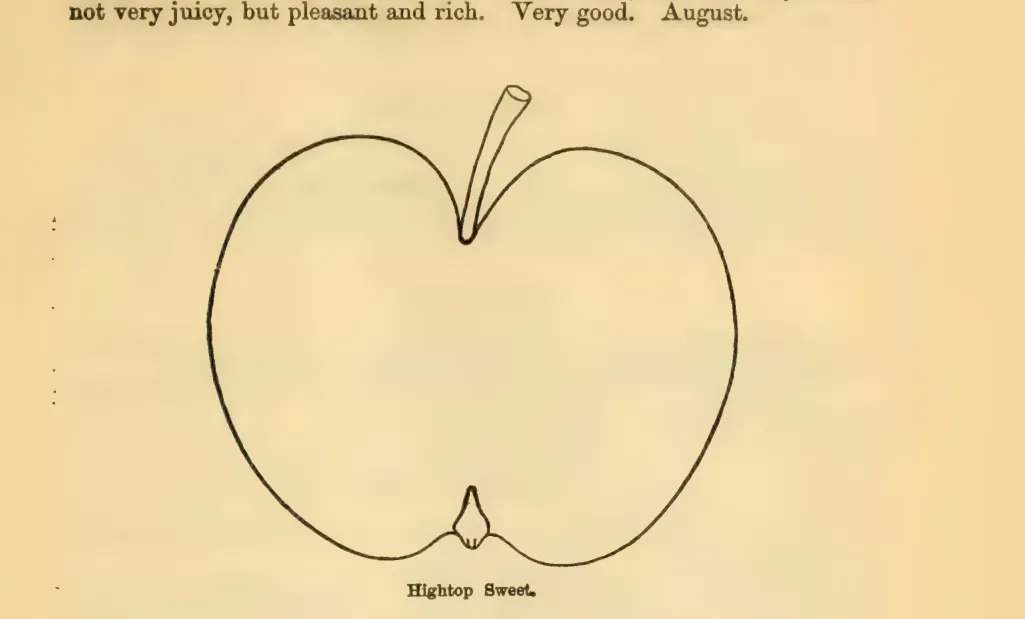
Hightop Sweet
Origin / History
Originated in Plymouth, Massachusetts. An old variety. Thacher noted in 1822: "This tree, it is believed, is peculiar to the old Plymouth colony. The first settlers, either from choice, or for want of other varieties, cultivated it more generally than any other apple. It is now much on the decline. The fruit is under the middle size; of a yellowish colour, pleasant taste; but chiefly used for baking, and for drying. It is ripe in August, and is not long preserved. The tree is remarkable for its long upright stem."
The variety was introduced into Ohio from Connecticut and Massachusetts and afterward disseminated westward under the name of Sweet June. Highly prized at the West and very popular Southwest and West. In 1892 Bailey found that although various nurserymen were offering Sweet June for sale, none of them mentioned Hightop Sweet. Some have held that the Sweet June of the West is not identical with the Hightop Sweet of Massachusetts, though Beach (1905) had not had the opportunity of determining whether this is true; he noted it appears strange that the name Hightop Sweet should be entirely dropped by those propagating it in the West if the two are identical. Little known in New York as of 1905.
Tree
Vigorous, very upright (remarkable for its long upright stem per Thacher), hardy, exceedingly productive and profitable. Shoots bright reddish brown (Downing).
Fruit
Size: Small to medium; generally medium or below; "under the middle size" (Thacher); "rather small" (Thomas); "small" (Lowther).
Form: Round to roundish, regular; Budd-Hansen add "somewhat truncated."
Surface / Skin: Very smooth. Color light yellow to greenish-yellow; Budd-Hansen describe it as clear light yellow becoming unctuous, sometimes with a faint bronze blush. Downing describes it as light yellow partially covered with green dots.
Dots: Minute. Warder calls them black; Downing describes green dots over the yellow ground; Elliott describes greenish white dots; Budd-Hansen describe dots as many, obscure, minute, and green.
Stem / Stalk: Medium (Warder, Downing, Budd-Hansen); slender (Elliott).
Cavity: Deep and narrow (Warder, Downing, Thomas); Budd-Hansen describe it as regular, acute, deep, with thin stellate russet; Downing notes the cavity is surrounded by thin russet.
Calyx / Eye: Small, closed; Budd-Hansen add segments erect convergent; calyx tube funnel-shaped; stamens marginal.
Basin: Variously described. Warder calls it medium and regular. Downing calls it shallow and slightly furrowed. Thomas calls it shallow and slightly furrowed. Budd-Hansen call it nearly smooth, abrupt, regular, and rather shallow.
Flesh / Flavor: Yellow to yellowish (Downing, Thomas, Budd-Hansen) or white to greenish-white (Warder); Elliott describes it as yellowish white. Budd-Hansen note yellow veinings. Texture fine-grained (Warder), tender (Warder, Elliott, Budd-Hansen). Juiciness varies by source: Warder calls it juicy; Elliott calls it juicy; Downing says "not very juicy, but pleasant and rich"; Budd-Hansen call it moderately juicy. Flavor very sweet, rich. Quality "very good" or "good."
Core / Seeds: Core very small, oval, separate from the eye (Warder); Budd-Hansen describe the core as closed with round, entire cells. Seeds numerous, angular, yellow (Warder); long, pointed, angular (Budd-Hansen).
Season
June through August, depending on source and locale. Warder: June and July. Elliott: last of July. Beach: July and August. Downing: August. Thacher: ripe in August, not long preserved. Budd-Hansen: June to August.
Uses
Table and kitchen (Warder); both kitchen and market (Lowther); chiefly used for baking and for drying in the early Plymouth colony (Thacher). A valuable summer sweet apple at the West (Thomas).
Subtypes / Variants
Not described in source.
Other
Lowther (1914) reports the variety from the following stations: Northern Division 6 (also reported in another division), Central Division 10 (also reported in another division), Southern Division 2 (also reported in another division).
Book Sources
Described in 7 period pomological works
- Beach, The Apples of New York Vol. 2 (1905)
- Downing, Fruits and Fruit Trees of America (1900)
- Warder, American Pomology: Apples (1867)
- Budd & Hansen, Systematic Pomology (1914)
- Thomas, The American Fruit Culturist (1903)
- Elliott, The Western Fruit Book (1865) — listed as High Top Sweet
- Lowther (ed.), Encyclopedia of Practical Horticulture (1914) — listed as High Top Sweet
Nursery Catalog Sources
Found in 3 catalogs (1900–1913) from Illinois
- Central Experimental Farm , Dominion Department of Agriculture, Agassiz, British Columbia (under test; Bulletin No. 3, Second Series) — 1900
- Benjamin Buckman (personal inventory) , Farmingdale , Illinois — 1901
- Benjamin Buckman (personal inventory) , Farmingdale , Illinois — 1913
View original book sources (7)
— John A. Warder, American Pomology: Apples (1867)Hightop Sweet. SWEET JUNE.
From Plymouth, Massachusetts. Tree vigorous, very upright, exceedingly productive and profitable. Fruit small to medium, round, regular; Surface smooth, greenish-yellow; Dots minute, black. Basin medium, regular; Eye small, closed. Cavity deep, narrow; Stem medium. Core very small, oval, separate from the eye; Seeds numerous, angular, yellow; Flesh white, or greenish-white, fine-grained, tender, juicy; Flavor sweet; Quality good; Use, table and kitchen; Season, June and July.
— A.J. Downing, The Fruits and Fruit Trees of America (1900)Hightop Sweet. Summer Sweet. Sweet June. Origin, Plymouth, Mass. An old variety, highly prized at the West. Growth upright, vigorous. Tree hardy, very productive, bright reddish brown shoots. Fruit medium or below, roundish, regular. Skin very smooth. Color light yellow, partially covered with green dots. Stalk medium, inserted in a deep narrow cavity, surrounded by thin russet. Calyx small, closed. Basin shallow, slightly furrowed. Flesh yellowish, very sweet, not very juicy, but pleasant and rich. Very good. August.
— S.A. Beach, The Apples of New York, Vol. 2 (1905)HIGHTOP SWEET.
REFERENCES. 1. Thacher, 1822:128. 2. Hovey, Mag. Hort., 14:390. 1848. 3. Cole, 1849:97. 4. Phoenix, Horticulturist, 4:472. 1850. 5. Emmons, Nat. Hist. N. Y., 3:16. 1851. fig. 6. Elliott, 1854:139. 7. Am. Pom. Soc. Cat., 1856. 8. Mag. Hort., 22:181. 1856. 9. Downing, 1857:151. 10. Gregg, 1857:40. 11. Warder, 1867:553. 12. Ill. Hort. Soc. Rpt., 1869:33. 13. Fitz, 1872:145. 14. Thomas, 1875:189. 15. Downing, 1881:11 index, app. 16. Barry, 1883:333. 17. Lyon, Mich. Hort. Soc. Rpt., 1890:292. 18. Bailey, An. Hort., 1892:250. 19. Munson, Me. Sta. Rpt., 1893:132. 20. Hoskins, Rural N. Y., 1894:248. 21. Budd-Hansen, 1903:99. fig.
SYNONYMS. Early Sweet (15). HIGH Top SWEET (19). High Top Sweet' (13). HIGHTOP Sweet (21). HIGH TOP SWEETING (1, 5, 6, 8, 12, 15). High Top Sweeting? (2, 3). SUMMER SWEET (3). Summer Sweet (5, 6, 9, 14). SUMMER SWEETING (2). SWEET JUNE (4, 10, 13, 18). Sweet June (6, 9, 11, 14, 16, 19, 20, 21).
Fruit of medium size; flesh yellowish, very sweet, rich and of very good quality; season July and August. Tree upright, vigorous, very productive.
Historical. In 1822 Thacher (1) remarked: "This tree, it is believed, is peculiar to the old Plymouth colony. The first settlers, either from choice, or for want of other varieties, cultivated it more generally than any other apple. It is now much on the decline. The fruit is under the middle size; of a yellowish colour, pleasant taste; but chiefly used for baking, and for drying. It is ripe in August, and is not long preserved. The tree is remarkable for its long upright stem." It appears that this variety was introduced into Ohio from Connecticut and Massachusetts and afterward disseminated westward under the name of Sweet June. In 1892 Bailey (18) found that although various nurserymen were offering Sweet June for sale none of them mentioned Hightop Sweet. Some have held that the Sweet June of the West is not identical with the Hightop Sweet of Massachusetts (12). We have not had the opportunity of determining whether this is true, but if they are identical it appears strange that the name Hightop Sweet should be entirely dropped by those who are propagating it in the West. This variety is but little known in New York.
— Granville Lowther (ed.), Encyclopedia of Practical Horticulture (1914)High Top Sweet (8). Size: small. Form: round. Color: greenish yellow (green-yellow). Quality: very good. Use: both kitchen and market. Reporting stations: Northern Division 6 (also reported in another division), Central Division 10 (also reported in another division), Southern Division 2 (also reported in another division).
— F.R. Elliott, The Western Fruit Book (1865)High Top Sweet. Summer Sweet, of Ohio | Sweet June, of Illinois. From Plymouth, Mass. Tree, upright, productive. Fruit, medium, roundish, greenish yellow, with greenish white dots; stem, slender; calyx, closed; flesh, yellowish white, tender, juicy, sweet; "very good." Last of July. Very popular Southwest and West.
— John J. Thomas, The American Fruit Culturist (1903)Hightop.* (Summer Sweet of Ohio, Sweet June.) Rather small, roundish, regular; skin smooth, light yellow; cavity deep, narrow; calyx small, in a shallow, slightly furrowed basin; flesh yellowish, very sweet, rich; tree upright, productive. A valuable summer sweet apple at the West. Massachusetts. Fig. 353.
— J.L. Budd & N.E. Hansen, American Horticultural Manual, Part II: Systematic Pomology (1914)Hightop Sweet (Sweet June). — Origin, Plymouth, Massachusetts; tree very upright, vigorous, and productive.
Fruit medium, or below, roundish, regular, somewhat truncated; surface very smooth, clear, light yellow, becoming unctuous, sometimes with faint bronze blush; dots many, obscure, minute, green; cavity regular, acute, deep, with thin stellate russet; stem medium; basin nearly smooth, abrupt, regular, rather shallow; calyx closed; segments erect convergent. Core closed; cells round, entire; calyx tube funnel-shaped; stamens marginal; seeds long, pointed, angular; flesh yellow, with yellow veinings, tender, moderately juicy, very sweet. Very good. June to August.