Hilaire
Apple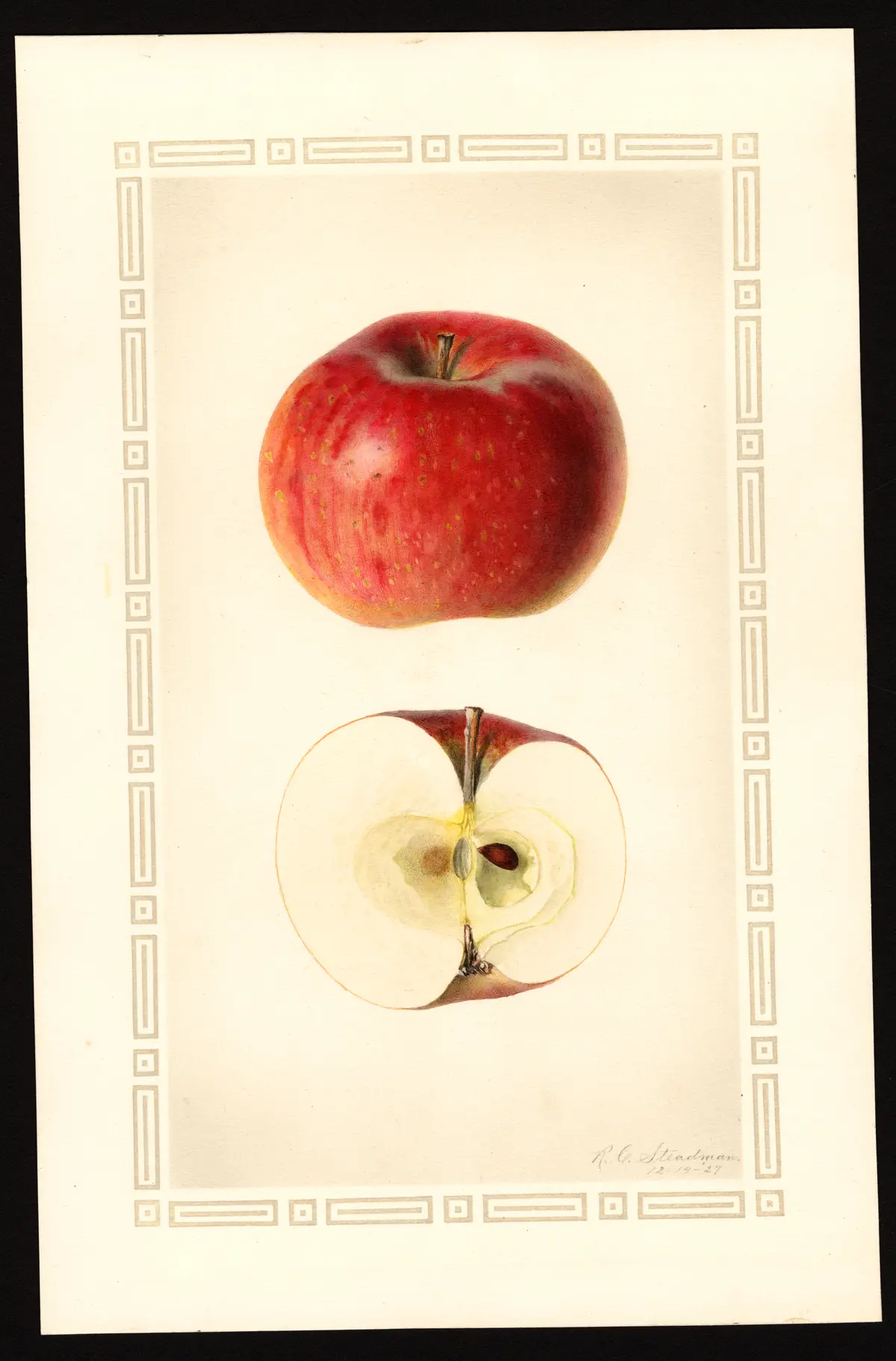
USDA Pomological Watercolor Collection
Hilaire (St. Hilaire)
Origin / History
Hilaire is said to have originated in the orchard of Alexis Dery, Province of Quebec, approximately 1875, at St. Hilaire, Quebec. It is considered a probable seedling of Fameuse, which it closely resembles in the color of its skin and in the color and texture of its flesh. Downing (1900) notes it was a favorite in the neighborhood of its origin. Waugh (as cited in Beach, 1905) reports that by the early twentieth century it was no longer grown in the vicinity of its origin, and Beach notes it was not grown in New York as of 1905. Hedrick (1922) states its culture is largely confined to the French settlements in Canada. Professor U. P. Hedrick of the Michigan Agricultural College supplied the fruit for Beach's description and noted that as grown in Michigan the variety is hardy, productive, and gives promise of being a valuable acquisition.
Tree
Tree large, vigorous. Downing notes it is as hardy as Fameuse and similar to it in growth and bearing. It is a heavy alternate bearer (Beach, citing Montreal Hort. Soc. Rpt. 1886–87).
Twigs short, curved, slender; internodes short. Bark dark brown, with a light coat of streaked scarf-skin, slightly pubescent. Lenticels scattering, small, oblong, raised. Buds small, plump, acute, free, slightly pubescent. (Beach; Hedrick gives only "tree large, vigorous.")
Fruit
Size and Form
Beach (1905) describes the fruit as medium to above, uniform in size; Hedrick (1922) describes it as medium to large, uniform in size. Downing (1900) describes it as medium or below. All three agree that the fruit is a little larger than Fameuse. Form is oblate to roundish-oblate (Beach, Hedrick); Downing specifies oblate or round oblate, very slightly conical. Beach and Hedrick describe the form as rather irregular; Downing does not use this qualifier.
Stem
Downing: short to medium, slender. Beach: medium, moderately slender. Hedrick: medium, slender.
Cavity
Beach: acuminate or acute, moderately deep and broad, not russeted, symmetrical. Hedrick: acuminate, deep and broad, not russeted, symmetrical. Downing describes it simply as medium and regular — a notable difference from the acuminate, deep description of Beach and Hedrick.
Calyx
Medium, usually closed; lobes broad, obtuse (Beach, Hedrick). Downing notes only that the calyx is closed.
Basin
Downing: rather small, slightly corrugated. Beach: medium in depth to shallow, moderately wide to rather narrow, rather abrupt, slightly wrinkled, symmetrical. Hedrick: shallow, wide, abrupt, wrinkled, symmetrical. The basin width is in conflict across sources: Beach gives "moderately wide to rather narrow" while Hedrick gives "wide."
Skin
Skin thin, tender, smooth (Beach, Hedrick). Downing describes it as smooth, white, shaded with light and dark red and crimson, purplish crimson in the sun, with sometimes obscure splashes. Beach describes it as pale yellow or whitish, almost completely overspread with attractive red of the Fameuse hue, becoming as highly colored as the Fameuse or McIntosh, covered with faint bloom; stripes obscure if any; prevailing effect brilliant deep pinkish-red deepening to purplish-red. Hedrick describes it as pale yellow overspread with red, covered with faint bloom, stripes obscure; prevailing effect brilliant red deepening to dark red.
Dots: Downing notes a few light and brown dots, more and minute near the basin. Beach and Hedrick agree: dots very numerous, small, red, sometimes gray or russet.
Flesh and Flavor
Flesh whitish, sometimes tinged with red (Beach); white tinged with red (Hedrick); Downing describes it as quite white. Fine, crisp (Beach, Hedrick; Downing does not use "crisp"), tender, juicy, sprightly subacid. Quality good to very good (Beach, Hedrick). Downing additionally notes a slight cranberry flavor. All sources agree the flesh resembles Fameuse in color and texture but has a more sprightly, acidulous character.
Calyx Tube
Long, rather narrow, funnel-shape (Beach); long, narrow, funnel-shape (Hedrick).
Stamens
Beach: median to basal. Hedrick: median.
Core and Seeds
Downing: core small only. Beach: core nearly axile, small to medium; cells closed or partly open; core lines clasping the funnel cylinder; carpels round, slightly emarginate; seeds dark, numerous, medium to large, wide, obtuse to acute. Hedrick: core axile, small; cells closed or partly open; core-lines clasping the funnel cylinder; carpels round, emarginate; seeds dark, numerous, large, wide, obtuse to acute.
Conflicts: Beach gives "nearly axile" where Hedrick gives "axile"; Beach gives core "small to medium" where Hedrick gives "small"; Beach gives seeds "medium to large" where Hedrick gives "large"; Beach gives "slightly emarginate" where Hedrick gives "emarginate."
Season
November to January (all sources). A better keeper than Fameuse; Downing notes it keeps longer and carries better than Fameuse.
Uses
Downing notes the variety was a favorite in the neighborhood of its origin. Its longer keeping and better carrying qualities relative to Fameuse are emphasized across all sources as commercially relevant attributes.
Subtypes / Variants
Not described in source.
Other
Not described in source.
Book Sources
Described in 3 period pomological works
Nursery Catalog Sources
Found in 3 catalogs (1900–1913) from Illinois
- Central Experimental Farm , Dominion Department of Agriculture, Agassiz, British Columbia (under test; Bulletin No. 3, Second Series) — 1900 — listed as St. Hilaire
- Benjamin Buckman (personal inventory) , Farmingdale , Illinois — 1901 — listed as St. Hilaire
- Benjamin Buckman (personal inventory) , Farmingdale , Illinois — 1913 — listed as St. Hilaire
View original book sources (3)
— A.J. Downing, The Fruits and Fruit Trees of America (1900)St. Hilaire.
Cabane du Chien. Fameuse Baldwin (of some).
This apple is said to have originated in the orchard of Alexis Dery, Province of Quebec, and is supposed to be a seedling of the Fameuse, which it much resembles in the color and form of the fruit, but is a little larger, more variable in size, bears nearly as early, and quite as heavily, keeps longer, will carry better, and is a favorite in the neighborhood of its origin; tree as hardy as the Fameuse, and similar to it in growth and bearing.
Fruit medium or below, oblate or round oblate, very slightly conical, skin smooth, white, shaded with light and dark red and crimson (purplish crimson in the sun), sometimes obscure splashes, and sprinkled with a few light and brown dots, more and minute ones near the basin; stalk short to medium, slender; cavity medium, regular; calyx closed; basin rather small, slightly corrugated; flesh quite white, fine, tender, juicy, sprightly subacid, possessing a slight cranberry flavor; core small. November, January.
— S.A. Beach, The Apples of New York, Vol. 2 (1905)HILAIRE.
REFERENCES. 1. Ia. Hort. Soc. Rpt., 1879:453. 2. Montreal Hort. Soc. Rpt., 1886-87:95. 3. Bailey, Mich. Sta. Bul., 31:154. 1887. 4. Downing, 1881:102 app. fig. 5. Waugh, Vt. Sta. Bul., 83:87. 1900.
SYNONYMS. Cabane du Chien (3, 5, 6). Fameuse Baldwin, of some (5). ST. HILAIRE (1, 2, 3, 4, 5, 6).
An apple which resembles Fameuse in the color of its skin and in the color and texture of its flesh, but the flesh has more of a sprightly acid flavor and the fruit keeps better than that of Fameuse. Waugh reports (5) that it is not now grown in the vicinity of its origin. Professor U. P. Hedrick of the Michigan Agricultural College, who supplied the fruit for the following description, states that as grown in Michigan the variety is hardy, productive and gives promise of being a valuable acquisition.
Historical. This is said to have originated in the orchard of Alexis Dery, Quebec (4). Probably a seedling of Fameuse (2). So far as we know it is not grown in New York.
TREE.
Tree large, vigorous; a heavy alternate bearer (2). Twigs short, curved, slender; internodes short. Bark dark brown, with light coat of streaked scarf-skin, slightly pubescent. Lenticels scattering, small, oblong, raised. Buds small, plump, acute, free, slightly pubescent.
FRUIT.
Fruit medium to above, uniform in size. Form oblate to roundish-oblate, rather irregular. Stem medium, moderately slender. Cavity acuminate or acute, moderately deep and broad, not russeted, symmetrical. Calyx medium, usually closed; lobes broad, obtuse. Basin medium in depth to shallow, moderately wide to rather narrow, rather abrupt, slightly wrinkled, symmetrical. Skin thin, tender, smooth, pale yellow or whitish almost completely overspread with attractive red of the Fameuse hue becoming as highly colored as the Fameuse or McIntosh and covered with faint bloom; stripes obscure if any. Dots very numerous, small, red, sometimes gray or russet. Prevailing effect brilliant deep pinkish-red deepening to purplish-red. Calyx tube long, rather narrow, funnel-shape. Stamens median to basal. Core nearly axile, small to medium; cells closed or partly open; core lines clasping the funnel cylinder. Carpels round, slightly emarginate. Seeds dark, numerous, medium to large, wide, obtuse to acute. Flesh whitish sometimes tinged with red, fine, crisp, tender, juicy, sprightly subacid, good to very good. Season November to January. A better keeper than Fameuse.
— U.P. Hedrick, Cyclopedia of Hardy Fruits (1922)HILAIRE. St. Hilaire.
Hilaire is a seedling of Fameuse, from which it differs in bearing fruits a little larger, which keep longer and have a more acidulous flavor. Like Fameuse, Hilaire is of Canadian origin, having come from St. Hilaire, Quebec, about 1875, where it originated on the farm of Alexis Dery. Its culture is largely confined to the French settlements in Canada.
Tree large, vigorous. Fruit medium to large, uniform in size, oblate or round-oblate, irregular; stem medium, slender; cavity acuminate, deep and broad, not russeted, symmetrical; calyx medium, usually closed; lobes broad, obtuse; basin shallow, wide, abrupt, wrinkled, symmetrical; skin thin, tender, smooth, pale yellow overspread with red, covered with faint bloom, stripes obscure; dots very numerous, small, red, sometimes gray or russet; prevailing effect brilliant red deepening to dark red; calyx-tube long, narrow, funnel-shape; stamens median; core axile, small; cells closed or partly open; core-lines clasping the funnel cylinder; carpels round, emarginate; seeds dark, numerous, large, wide, obtuse to acute; flesh white tinged with red, fine, crisp, tender, juicy, sprightly subacid; good to very good; November to January.