Hook
Apple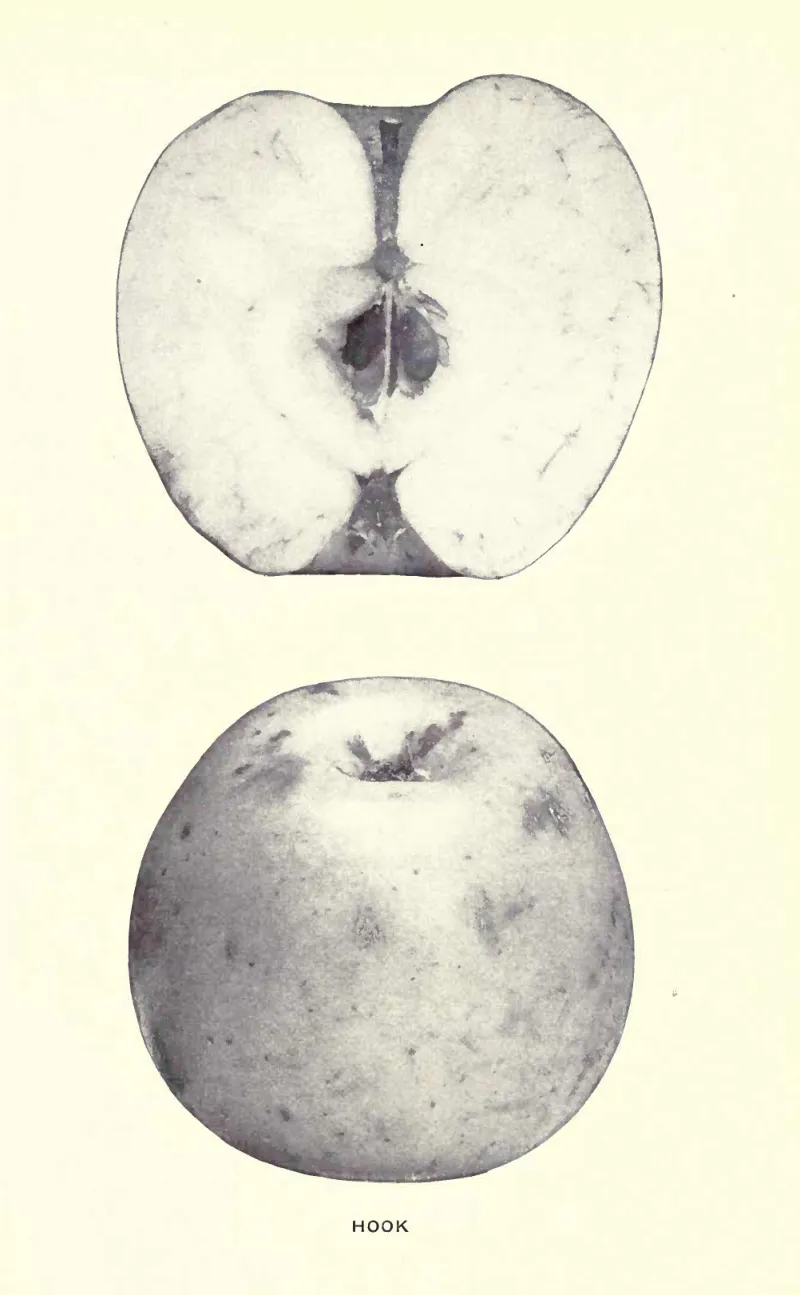
Hook
Origin and History
This variety was received from Schoharie County, New York, where it is well known and has earned a reputation as one of the most desirable dessert apples of its season. Origin has not yet been determined, nor is the extent of its distribution fully known.
Tree
Not described in source.
Fruit
General form and size: Medium size, remarkably uniform in shape and size. Form roundish ovate or inclined to oblong conic, sometimes roundish truncate.
Stem: Short, rather slender.
Cavity: Acuminate, moderately shallow to deep, broad, often lipped. Surface smooth or with some outspreading russet rays.
Calyx: Medium size, usually somewhat open. Lobes rather narrow to wide, acute to acuminate.
Basin: Medium in width and depth, obscurely furrowed and wrinkled.
Skin: Smooth, clear yellow or greenish-yellow.
Dots: Inconspicuous, minute, usually submerged.
Calyx tube: Large, conical or approaching funnel-form. Stamens median or below median.
Flesh: Whitish with slight tinge of yellow. Very tender, fine-grained, juicy. Flavor mild subacid, somewhat aromatic. Quality very good.
Core: Rather small, axile. Cells symmetrical, closed or a little open. Core lines meeting or somewhat clasping. Carpels smooth, flat, obcordate to elliptical, emarginate.
Seeds: Medium brown, rather large, wide, flat, obtuse.
Season
October and November.
Uses
Especially esteemed for dessert use.
Subtypes or Variants
Not described in source.
Other
Not described in source.
Book Sources
Described in 1 period pomological work
View original book sources (1)
— S.A. Beach, The Apples of New York, Vol. 2 (1905)HOOK.
REFERENCE. 1. (?) Mich. Pom. Soc. Rpt., 1880:183. SYNONYMS. None.
Fruit of good medium size, rather attractive pale yellow with tender flesh of mild subacid flavor. It is in season during October and November. It is especially esteemed for dessert use.
Historical. This variety was received from Schoharie county, N. Y., where it is well known and has the reputation of being one of the most desirable dessert apples of its season. We have not yet been able to determine its origin, nor the extent of its distribution.
FRUIT.
Fruit medium size, pretty uniform in shape and size. Form roundish ovate or inclined to oblong conic, sometimes roundish truncate. Stem short, rather slender. Cavity acuminate, moderately shallow to deep, broad, often lipped, smooth or with some outspreading russet rays. Calyx medium size, usually somewhat open; lobes rather narrow to wide, acute to acuminate. Basin medium in width and depth, obscurely furrowed and wrinkled.
Skin smooth, clear yellow or greenish-yellow. Dots inconspicuous, minute, usually submerged.
Calyx tube large, conical or approaching funnel-form. Stamens median or below.
Core rather small, axile; cells symmetrical, closed or a little open; core lines meeting or somewhat clasping. Carpels smooth, flat, obcordate to elliptical, emarginate. Seeds medium brown, rather large, wide, flat, obtuse.
Flesh whitish with slight tinge of yellow, very tender, fine-grained, juicy, mild subacid, somewhat aromatic, very good.
Season October and November.