Hunge
Apple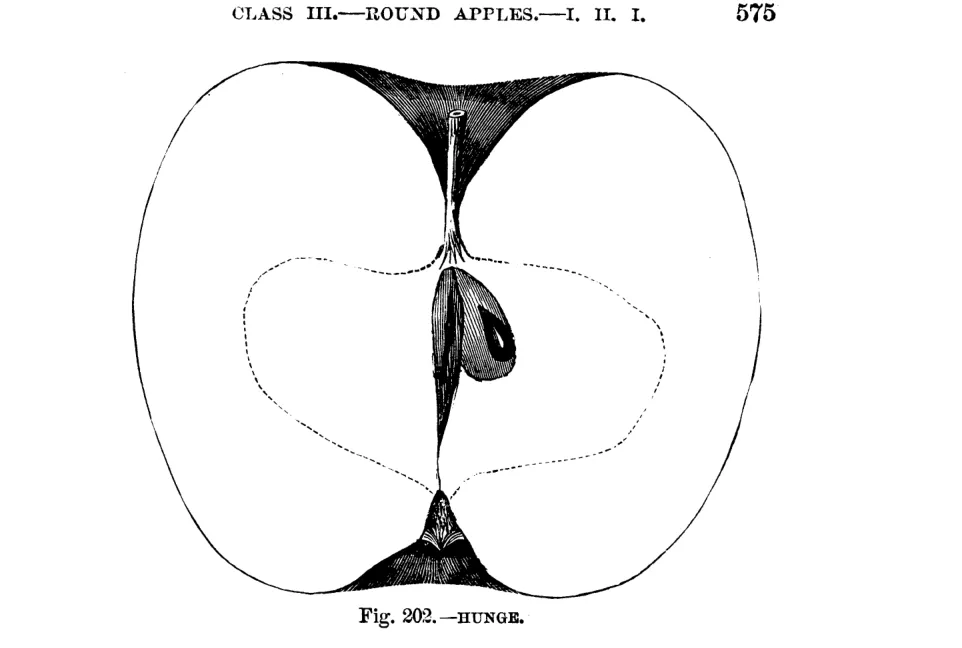
Origin & History
Origin uncertain, popular and long cultivated in North Carolina. Warder's described specimens were received from W. S. Carpenter, New York.
Tree
Vigorous and very productive (Downing).
Fruit
Size: Large to rather large; Warder describes it as above medium.
Form: Roundish. Warder describes it as roundish, conic, and unequal. Thomas describes it as roundish, somewhat irregular and oblique.
Skin: Smooth. Sources disagree on ground color: Warder describes it as greenish-yellow; Thomas as bright yellow with a faint delicate blush; Downing and Elliott as green with a blush. Dots numerous, minute, distinct, whitish, and indented (Warder).
Stem: Warder describes the stem as long, slender, and green. Thomas describes it as half an inch long.
Cavity: Wide, wavy, brown (Warder).
Calyx: Eye medium, closed (Warder).
Basin: Warder describes the basin as abrupt, wavy, and folded. Thomas describes it as rather deep, slightly ribbed.
Flesh & Flavor: Greenish-yellow, tender, fine-grained, juicy, sub-acid. Warder describes the flavor as "sub-acid, rich, very agreeable" and rates the quality as "best." Thomas describes the flesh as "fine-grained, tender, sub-acid" and rates it "very good." Downing describes it as "soft, subacid, pleasant" and rates it "Good." Elliott describes it as "soft, sub-acid, pleasant."
Core & Seeds: Core very wide, closed, clasping the eye; axis short; seeds angular, pale (Warder).
Season
September and October. Warder gives the season as October only.
Uses
Table and kitchen (Warder). Downing notes it is valuable for drying and culinary uses.
Subtypes & Variants
Not described in source.
Other
Warder's description is accompanied by an illustration (Fig. 203).
Book Sources
Described in 4 period pomological works
View original book sources (4)
— John A. Warder, American Pomology: Apples (1867)Fig. 203.—HUNGE.
Knickerbocker.
Specimens from W. S. Carpenter, New York.
Fruit above medium, roundish, conic, unequal; Surface smooth, greenish-yellow; Dots numerous, minute, distinct, whitish, indented.
Basin abrupt, wavy, folded; Eye medium, closed.
Cavity wide, wavy, brown; Stem long, slender, green.
Core very wide, closed, clasping the eye; Axis short; Seeds angular, pale; Flesh greenish-yellow, tender, fine-grained, juicy; Flavor sub-acid, rich, very agreeable; Quality best; Use, table, kitchen; Season, October.
— A.J. Downing, The Fruits and Fruit Trees of America (1900)Hunge.
Hunger
Origin uncertain, popular, and long cultivated in North Carolina.
Tree vigorous and very productive.
Fruit large, roundish, green, with a blush. Flesh soft, subacid, pleasant, valuable for drying and culinary uses. Good. September, October.
— F.R. Elliott, The Western Fruit Book (1865)HUNGE. Hunger. Origin, uncertain. Popular, and long cultivated in North Carolina. Fruit, large, roundish; skin, green, with a blush; flesh, soft, sub-acid, pleasant. September, October.
— John J. Thomas, The American Fruit Culturist (1903)Hunge. Rather large, roundish, somewhat irregular and oblique; skin smooth, bright yellow, with a faint delicate blush; stem half an inch long; basin rather deep, slightly ribbed; flesh fine-grained, tender, sub-acid, "very good." Cultivated in North Carolina. September and October.