Hyde King
Apple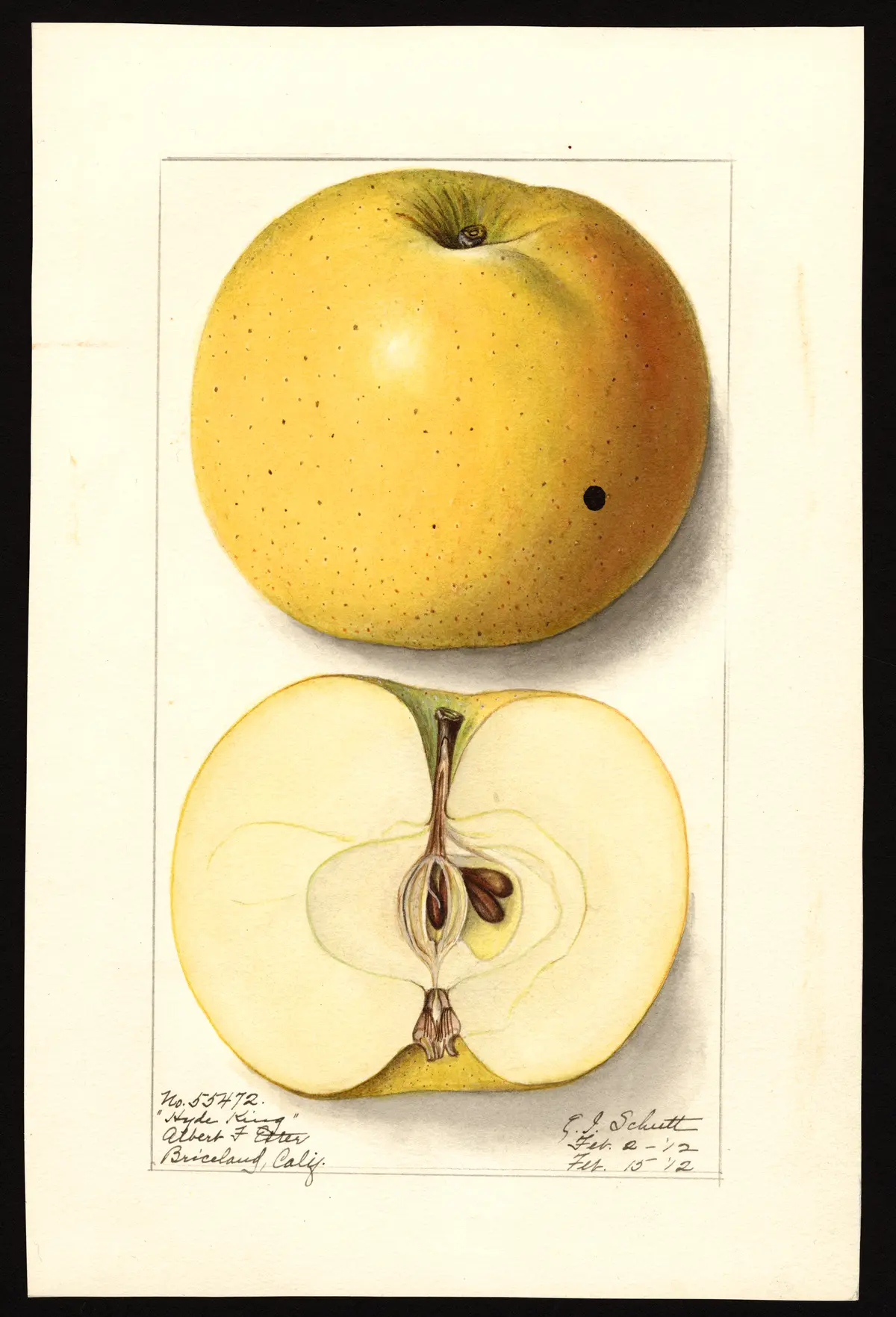
USDA Pomological Watercolor Collection
Hyde King
Origin / History
Not described in source.
Tree
Tree vigorous. Twigs medium to long, stout; internodes short. Bark dull brown tinged with olive-green, somewhat streaked with scarf-skin; pubescent. Lenticels quite numerous, medium to below, round, raised. Buds medium, plump, obtuse, free, pubescent.
Bearing habit: Almost an annual bearer. Not a very heavy cropper, but the fruit is very uniformly large with a low percentage of culls.
Fruit
Size and Form
Fruit large to very large, pretty uniform in size and shape. Form nearly globular varying to slightly oblate or somewhat conic, often obscurely ribbed, sometimes with sides unequal but usually pretty symmetrical.
Stem
Stem short, stout.
Cavity
Cavity acute to obtuse, moderately deep to deep, broad, usually smooth and bright green with contrasting large white dots, sometimes partly russeted.
Calyx
Calyx medium to large, closed or somewhat open; lobes short, obtuse. Calyx tube usually short, cone-shape, sometimes approaching funnel-form. Stamens median to basal.
Basin
Basin moderately deep, rather narrow, sometimes becoming broad, somewhat furrowed and wrinkled.
Skin
Skin thin, tough, smooth, glossy, light green shading to pale or whitish yellow, often with a thin blush and sometimes faintly striped with darker red and marked towards the cavity with broken stripes of whitish scarf-skin. Dots numerous, sometimes with a russet point, usually large about the cavity.
Flesh and Flavor
Flesh whitish, slightly tinged with yellow, firm, rather coarse, breaking, rather tender, juicy, mild subacid, somewhat aromatic. Quality good but not of high flavor.
Core and Seeds
Core medium to rather large, somewhat abaxile; cells open or partly closed; core lines meeting or somewhat clasping. Carpels smooth, concave, roundish or very broadly elliptical. Seeds above medium, wide, obtuse to acute.
Season
December to April or May. Commercial limit in ordinary storage February or March; in cold storage, May.
Uses
Suitable for culinary use and desirable for general market purposes. A good keeper.
Subtypes / Variants
Not described in source.
Other
The fruit is quite attractive for a green apple. Hyde King appears to be one of the most valuable of the newer varieties of apples which have been tested at this Station.
Book Sources
Described in 1 period pomological work
Nursery Catalog Sources
Found in 21 catalogs (1893–1917) from Alabama, Illinois, Missouri, Oregon, Washington
- Milwaukie-Canby Nurseries , Canby, OR (and Milwaukie, OR) — 1893 — listed as Hyde's King
- The Vineland Nurseries (Kelsey & Co. , Proprietors), St. Joseph, Missouri (Office: 13th and Atchison Sts., 2 Blocks East of the Citizens St. Car Line) — 1894 — listed as Hyde's King
- Stark Bros. Nurseries & Orchards Co. , Louisiana , Missouri — 1898 — listed as Hyde's King
- Alabama Nursery Co. , Huntsville , Alabama — 1900 — listed as Hyde's King
- Washington Nursery Co. , Toppenish , Washington — 1901 — listed as Hyde's King
- The Dalles Nurseries , The Dalles , Oregon — 1906 — listed as Hyde's King
- Stark Bros. Nurseries & Orchards Co. , Louisiana , Missouri — 1906 — listed as Hyde's King
- Washington Nursery Company , Toppenish , Washington — 1909 — listed as Hyde's King
- Island Nurseries & Fruit Farm , Vashon (Vashon Island) , Washington — 1910 — listed as Hyde's King
- Stark Bros. Nurseries & Orchards Co. , Louisiana , Missouri — 1910 — listed as Hyde's King
- Island Nurseries & Fruit Farm , Vashon (Vashon Island) , Washington — 1911 — listed as Hyde's King
- Stark Bros. Nurseries & Orchards Co. , Louisiana , Missouri — 1911 — listed as Hyde's King
- Pacific Nursery Company , Portland , Oregon — 1912 — listed as Hyde's King
- Stark Bros. Nurseries & Orchards Co. , Louisiana , Missouri — 1912 — listed as Hyde's King
- Vineland Nurseries Company , Clarkston , Washington — 1912 — listed as Hyde's King
- Washington Nursery Company , Toppenish , Washington — 1912 — listed as Hyde's King
- Benjamin Buckman (personal inventory) , Farmingdale , Illinois — 1913 — listed as Hyde's King
- Island Nurseries & Fruit Farm , Vashon (Vashon Island) , Washington — 1914 — listed as Hyde's King
- Island Nurseries & Fruit Farm , Vashon (Vashon Island) , Washington — 1915 — listed as Hyde's King
- Island Nurseries & Fruit Farm , Vashon (Vashon Island) , Washington — 1916 — listed as Hyde's King
- Island Nurseries & Fruit Farm , Vashon (Vashon Island) , Washington — 1917 — listed as Hyde's King
View original book sources (1)
— S.A. Beach, The Apples of New York, Vol. 1 (1905)HYDE KING.
REFERENCES. 1. Bailey, An. Hort., 1892:241. 2. Beach, N. Y. Sta. An. Rpt., 13:592. 1894. 3. Ib., 14:265. 1895. 4. Ib., 15:284. 1896. 5. Beach, W. N. Y. Hort. Soc. Rpt., 1900:37. 6. Powell and Fulton, U. S. B. P. I. Bul., 48:60. 1903. 7. Beach and Clark, N. Y. Sta. Bul., 248:114. 1904.
SYNONYMS. CHASE (7), but incorrectly. HYDE'S KING (OF THE WEST) (1). WESTERN BEAUTY (2, 3, 4, 5, 6), but incorrectly.
Hyde King appears to be one of the most valuable of the newer varieties of apples which have been tested at this Station. The fruit is large or very large, pretty uniform, smooth, glossy, pale green or yellow, often a little shaded with red. It is quite attractive for a green apple. Although not high-flavored it is good in quality, suitable for culinary use and evidently desirable for general market purposes being a good keeper. So far as tested here the tree is vigorous, and almost an annual bearer. It is not a very heavy cropper but the fruit is very uniformly large with a low percentage of culls.
TREE. Tree vigorous. Twigs medium to long, stout; internodes short. Bark dull brown tinged with olive-green, somewhat streaked with scarf-skin; pubescent. Lenticels quite numerous, medium to below, round, raised. Buds medium, plump, obtuse, free, pubescent.
FRUIT. Fruit large to very large, pretty uniform in size and shape. Form nearly globular varying to slightly oblate or somewhat conic, often obscurely ribbed, sometimes with sides unequal but usually pretty symmetrical. Stem short, stout. Cavity acute to obtuse, moderately deep to deep, broad, usually smooth and bright green with contrasting large white dots, sometimes partly russeted. Calyx medium to large, closed or somewhat open; lobes short, obtuse. Basin moderately deep, rather narrow, sometimes becoming broad, somewhat furrowed and wrinkled. Skin thin, tough, smooth, glossy, light green shading to pale or whitish yellow, often with a thin blush and sometimes faintly striped with darker red and marked towards the cavity with broken stripes of whitish scarf-skin. Dots numerous, sometimes with a russet point, usually large about the cavity. Calyx tube usually short, cone-shape, sometimes approaching funnel-form. Stamens median to basal. Core medium to rather large, somewhat abaxile; cells open or partly closed; core lines meeting or somewhat clasping. Carpels smooth, concave, roundish or very broadly elliptical. Seeds above medium, wide, obtuse to acute. Flesh whitish, slightly tinged with yellow, firm, rather coarse, breaking, rather tender, juicy, mild subacid, somewhat aromatic, good but not of high flavor. Season December to April or May. Commercial limit in ordinary storage February or March; in cold storage, May (7).