Idaho
Pear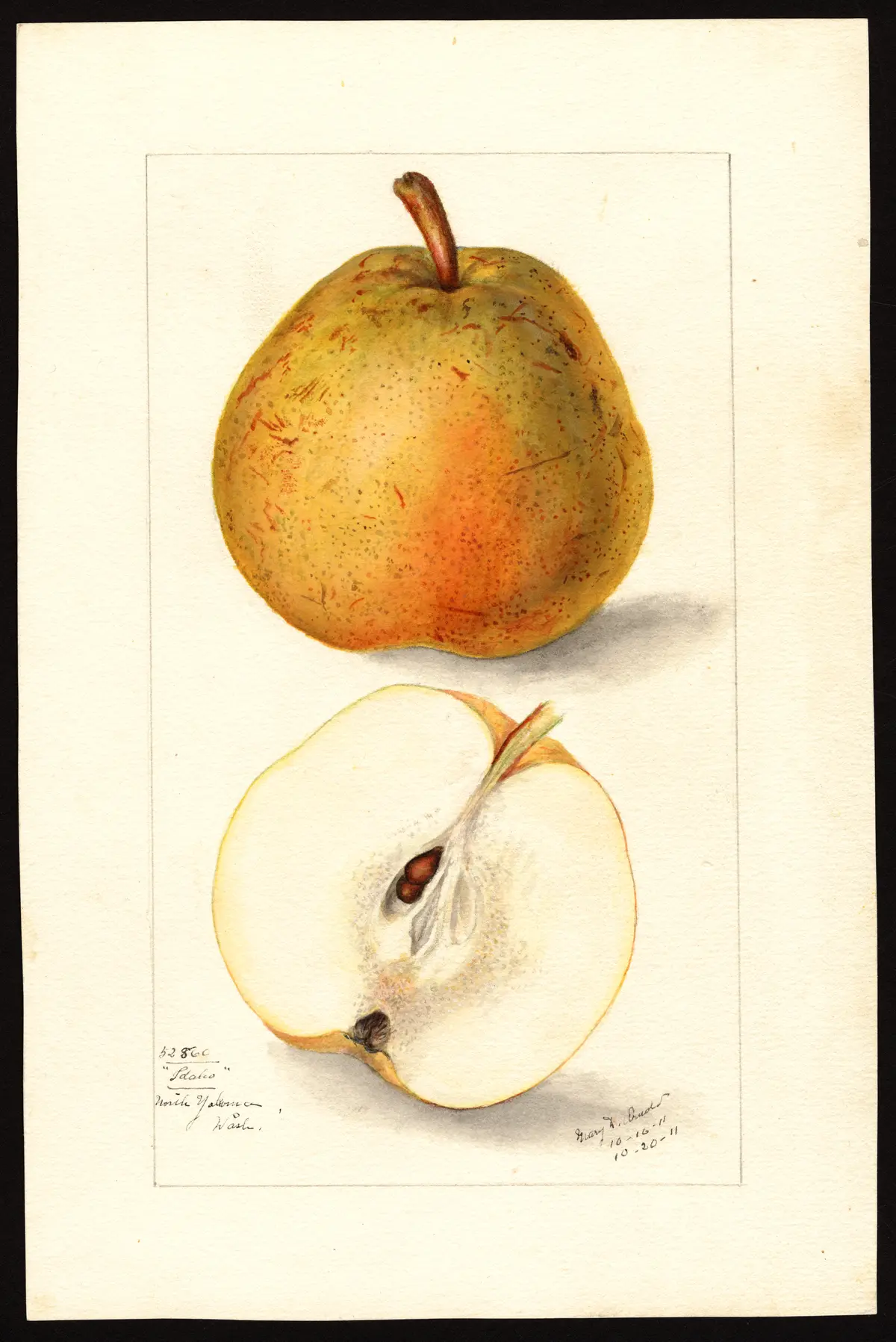
USDA Pomological Watercolor Collection
Idaho
Origin / History
Idaho was raised from seed of an unknown variety about 1867 by a Mrs. Mulkey of Lewiston, Idaho. It was propagated by the Idaho Pear Company and first brought to public notice in the autumn of 1886 by John H. Evans of Lewiston. Hedrick records that it was introduced to Europe in 1888 and shown at the congress of fruit growers held at Geneva, Switzerland, in 1899. Bunyard says it was "raised at Idaho, and introduced in 1889." The American Pomological Society added Idaho to its list of fruits recommended for general cultivation in 1899. At the Central Experimental Farm, Agassiz, British Columbia, it was planted in spring 1891.
Hedrick writes that "there is much difference of opinion as to the value of Idaho in America." He holds that "without question" the variety is of considerable worth in parts of the Pacific Northwest, especially in regions where hardihood is a prime requisite. There, presumably, the fruits are larger and better flavored than in the East. Budd and Hansen double-star it in Colorado, Utah, and Idaho, and also name Nevada.
Tree
Tree medium in size, vigorous, upright-spreading, hardy, very productive. Bunyard gives growth very vigorous and fertility good, and the Agassiz station calls it a strong grower. Hedrick also calls the trees dwarf ("rather dwarf" in the Cyclopedia) and fruitful to a fault, so that the pears often run small. He finds them hardier than those of almost any other pear and says they bear annually. Against these good characters the trees have "the fatal fault of blighting" (Hedrick), so that the variety is of value only in regions where blight is not an annual scourge of this fruit.
Trunk smooth. Branches slender, smooth, reddish-brown, overspread with much gray scarf-skin, sprinkled with many small lenticels. Branchlets dull brownish-red, overlaid with scarf-skin, smooth, glabrous, with small lenticels.
Leaf-buds small, short, conical, pointed, free; leaf-scars prominent. Leaves 2½ in. long, 1½ in. wide, leathery; apex abruptly pointed; margin glandular, finely serrate; petiole ⅝ in. long. The Cyclopedia prints the leaves 3½ in. long and the petiole ¾ in.
Flower-buds short, conical, very plump, free, singly on short spurs. Flowers showy, 1⅛ in. across (1¼ in. in the Cyclopedia), in dense racemes ("dense clusters, nearly in racemes," Cyclopedia), average 8 buds in a cluster. Pedicels 1⅛ in. long, pubescent.
Fruit
Size: Medium to large. Thomas and Bunyard call it large; Bunyard measures it 3½ by 3. The Agassiz station gives medium to large. On the grounds of his Station Hedrick found the pears only medium, 2⅝ in. long by 2⅝ in. wide; the Cyclopedia prints 2⅛ by 2⅛ in. In many regions, Hedrick says, the pears are large, rough, and gross. On trees fruitful to a fault they often run small.
Form: Roundish to nearly round. Thomas calls it regular, and Hedrick calls it slightly pyriform and symmetrical. Bunyard has it flattened round, "quite apple like," uneven. The large, rough fruits of many regions are, per Hedrick, sometimes a facsimile of Duchesse d'Angoulême.
Stem: Thick, very stout (Bunyard), slightly curved, 1 in. long (Hedrick; ¾ in. in the Cyclopedia). Budd and Hansen call it short, largest at the upper end.
Cavity: Irregular and furrowed, rather deep to deep; Budd and Hansen call it quite deep. Hedrick describes it as acute, narrow, and slightly lipped.
Calyx: Closed; Bunyard calls the eye twisted. Lobes broad, acute. Calyx-tube short, wide, conical (Hedrick).
Basin: Shallow, somewhat furrowed. Thomas calls it pointed; Hedrick calls it obtuse. Bunyard alone gives a deep basin.
Skin: Thick, granular, tough, rough to roughish. Ground golden yellow (Thomas), light yellow (Bunyard), or dull lemon-yellow tinged with green (Hedrick); the Agassiz station calls the skin green. Dotted and streaked with russet and splashed with russet patches; Bunyard describes it as largely marked and marbled with rough russet. Attractive in color (Hedrick).
Dots: Numerous, small, russet, conspicuous.
Flesh and flavor: Flesh dull white tinged with yellow, fine-grained, firm, tender, buttery, juicy, almost free from granulation; melting (Thomas). The Agassiz station calls it woody.
Flavor sweet, rich, vinous; Hedrick's technical description says "almost vinous," and Thomas adds sprightly. Bunyard finds it sweet, "with a curious flavour not very attractive." Quality runs from "very good" (Thomas) and "good to very good," with "excellent taste" (Hedrick), down to "only good in quality" (Budd and Hansen) and "quality poor" (Agassiz).
Core and seeds: Core small, closed, with clasping core-lines. Seeds wide, acute, often abortive and sometimes wanting (Hedrick).
Season
September to December. Most authors give early autumn, the fruit maturing in September and October. Bunyard alone gives November to December.
Uses
Dessert (Bunyard).
Subtypes / Variants
Not described in source.
Other
Hedrick's references begin with U. S. D. A. Rpt. 572, Pl. II, 1888. They continue with Can. Hort. 12:2, fig. 1, Pl., 1889; Wickson Col. Fruits 341, 1889; Thomas Am. Fruit Cult. 477, fig. 691, 1897; Am. Pom. Soc. Cat. 36, 1899; Rev. Hort. 60, 1901; and Budd-Hansen Am. Hort. Man. 2:249, 1903.
Book Sources
Described in 5 period pomological works
Nursery Catalog Sources
Found in 38 catalogs (1884–1925) from Alabama, California, Florida, Illinois, Maryland, Massachusetts, Missouri, Nebraska, New Jersey, New York, Oregon, Pennsylvania, Washington
- Felix Gillet , Barren Hill Nursery, Nevada City , California — 1884
- William H. Moon Co. , Morrisville, Bucks County , Pennsylvania — 1890
- Missouri Nursery Co. , Louisiana , Missouri — 1891
- Glen St. Mary Nurseries (G.L. Taber , Proprietor), Glen St. Mary , Florida — 1893
- Rogers Nursery Co. , Moorestown , New Jersey — 1893
- Oregon Wholesale Nurseries , Salem , Oregon — 1893
- Green's Nursery Co. (Charles A. Green) , Rochester , New York — 1894
- Multnomah Nurseries , Russellville , Oregon — 1894
- The Vineland Nurseries (Kelsey & Co. , Proprietors), St. Joseph, Missouri (Office: 13th and Atchison Sts., 2 Blocks East of the Citizens St. Car Line) — 1894
- The Lovett Company , Little Silver , New Jersey — 1896
- J.V. Cotta (Cotta Nursery) , Carroll County , Illinois — 1898
- Reading Nursery , Jacob W. Manning, Proprietor, Reading , Massachusetts — 1898
- Brown Brothers Co. , Continental Nurseries, Rochester, NY (also operated from Toronto, Canada) — 1899
- Alabama Nursery Co. , Huntsville , Alabama — 1900
- Central Experimental Farm , Dominion Department of Agriculture, Agassiz, British Columbia (under test; Bulletin No. 3, Second Series) — 1900
- The Dalles Nurseries , The Dalles , Oregon — 1901
- Washington Nursery Co. , Toppenish , Washington — 1901
- Benjamin Buckman (personal inventory) , Farmingdale , Illinois — 1901
- Brown Brothers Co. , Continental Nurseries, Rochester, NY (also operated from Toronto, Canada) — 1901
- Mountain Grove Nurseries (Tippin & Moore , Proprietors; Geo. T. Tippin, J. W. Tippin, J. C. Moore), Mountain Grove , Missouri — 1901
- Pacific Nursery Company (W. O. Hudson & A. D. Hudson) , Tangent , Oregon — 1903
- J.B. Pilkington , Portland , Oregon — 1907
- Russellville Nursery Co. , Montavilla Station, Portland, OR (three miles east of Portland, one mile from Montavilla car line) — 1907
- Carlton Nursery Co. , Carlton , Oregon — 1909
- Milton Nursery Co. (A. Miller & Sons , Proprietors), Milton , Oregon — 1909
- Wm. J. Corse (successor to Robert Sinclair / Sinclair Nurseries) , Baltimore , Maryland — 1909
- Washington Nursery Company , Toppenish , Washington — 1909
- C.F. Lansing , Salem , Oregon — 1910
- Galbraith Nursery Co. (DeWitt Hansen , Pres.-Mgr.), Fairbury , Nebraska — 1911
- Ballygreen Nurseries , Hanford , Washington — 1912
- Pacific Nursery Company , Portland , Oregon — 1912
- Vineland Nurseries Company , Clarkston , Washington — 1912
- Washington Nursery Company , Toppenish , Washington — 1912
- Van Holderbeke Nursery Co. , Incorporated, Spokane, Washington (nurseries at Otis Orchards WA, Pasadena WA, Kennewick WA) — 1913
- Fancher Creek Nurseries , George C. Roeding, Fresno , California — 1918
- Oregon Nursery Co. , Orenco , Oregon — 1920
- Christopher Nurseries / John Stewart & Sons , Christopher , Washington — 1920
- Columbia & Okanogan Nursery Co. , Wenatchee , Washington — 1925
View original book sources (6)
— John J. Thomas, The American Fruit Culturist (1903)Idaho. (Mulkey.) Large, nearly round, regular; golden yellow, many russet dots; cavity irregular, rather deep; basin shallow, pointed; flesh melting, juicy, sprightly, vinous, very good. Early autumn.
— J.L. Budd & N.E. Hansen, American Horticultural Manual, Part II: Systematic Pomology (1914)Idaho. — Large, nearly round, regular; color golden yellow; dots numerous; stalk short, largest at upper end, inserted in irregular and quite deep cavity. Flesh melting, juicy, vinous, only good in quality. Season, early autumn. Double starred in Colorado, Utah, and Idaho. Nevada.
— E.A. Bunyard, A Handbook of Hardy Fruits (1920)IDAHO. (Lindsey.) Dessert, November to December, large, 3½ by 3, flattened round, quite apple like, uneven. Skin, rough. Colour, light yellow, largely marked and marbled with rough russet. Flesh, fine grained, juicy, sweet, with a curious flavour not very attractive. Eye closed, twisted in a deep basin. Stem, very stout in a deep cavity. Growth, very vigorous; fertility good. Origin, raised at Idaho, and introduced in 1889.
— U.P. Hedrick, The Pears of New York (1921)IDAHO
- U. S. D. A. Rpt. 572, Pl. II. 1888. 2. Can. Hort. 12:2, fig. 1, Pl. 1889. 3. Wickson Col. Fruits 341. 1889. 4. Thomas Am. Fruit Cult. 477, fig. 691. 1897. 5. Am. Pom. Soc. Cat. 36. 1899. 6. Rev. Hort. 60. 1901. 7. Budd-Hansen Am. Hort. Man. 2:249. 1903.
There is much difference of opinion as to the value of Idaho in America. Without question, the variety is of considerable worth in parts of the Pacific Northwest, and especially in regions where hardihood is a prime requisite. There, presumably, the fruits are larger and better flavored than in the East. As the accompanying plate shows, the pears are only medium in size on the grounds of this Station, but they are attractive in color and of excellent taste. The core is small, and the seeds are often abortive and sometimes wanting. The flesh is tender, buttery and almost free from granulation, with a rich, sweet, vinous flavor which make the rating for this fruit "good to very good." In many regions the pears are large, rough, and gross — sometimes a facsimile of Duchesse d'Angoulême. The trees are dwarf and fruitful to a fault so that the pears often run small; they are hardier than those of almost any other pear and bear annually. To offset these good characters, however, the trees have the fatal fault of blighting, so that the variety is of value only in regions where blight is not an annual scourge of this fruit.
Idaho was raised from seed of an unknown variety about the year 1867 by a Mrs. Mulkey, Lewiston, Idaho, and, having been propagated by the Idaho Pear Company, was first brought to public notice in the autumn of 1886 by John H. Evans of Lewiston. In 1888 it was introduced to Europe and was shown at the congress of fruit growers held at Geneva, Switzerland, in 1899. Idaho is included in the American Pomological Society's list of fruits recommended for general cultivation, having been added to this list in 1899.
Tree medium in size, vigorous, upright-spreading, hardy, very productive; trunk smooth; branches slender, smooth, reddish-brown overspread with much gray scarf-skin, sprinkled with many small lenticels; branchlets dull brownish-red, overlaid with scarf-skin, smooth, glabrous, with small lenticels.
Leaf-buds small, short, conical, pointed, free; leaf-scars prominent. Leaves 2½ in. long, 1½ in. wide, leathery; apex abruptly pointed; margin glandular, finely serrate; petiole ⅝ in. long.
Flower-buds short, conical, very plump, free, singly on short spurs; flowers showy, 1⅛ in. across, in dense racemes, average 8 buds in a cluster; pedicels 1⅛ in. long, pubescent.
Fruit matures in late September and October; medium in size, 2⅝ in. long, 2⅝ in. wide, roundish, slightly pyriform, symmetrical; stem 1 in. long, thick, slightly curved; cavity acute, narrow, furrowed, slightly lipped; calyx closed; lobes broad, acute; basin shallow, obtuse, somewhat furrowed; skin thick and granular, tough, roughish; color dull lemon-yellow, tinged with green, dotted and streaked with russet, splashed with russet patches; dots numerous, small, russet, conspicuous; flesh dull white, tinged with yellow, firm, tender, buttery, juicy, sweet, rich, almost vinous; quality good to very good. Core closed, with clasping core-lines; calyx-tube short, wide, conical; seeds wide, acute.
— U.P. Hedrick, Cyclopedia of Hardy Fruits (1922)IDAHO. There is much difference of opinion as to the value of Idaho. Without question, the variety is of considerable worth in parts of the Pacific Northwest, especially in regions where hardihood is a prime requisite. In the East, the pears are only medium in size, but they are attractive in color and of excellent taste. The core is small, and the seeds are often abortive and sometimes wanting. The flesh is tender, buttery and almost free from granulation, with a rich, sweet, vinous flavor which make the rating for this fruit "good to very good." In many regions, the pears are large, rough and gross, sometimes a facsimile of Duchesse d'Angouleme. The trees are rather dwarf and are fruitful to a fault, so that the pears often run small; they are hardier than those of almost any other pear and bear annually. To offset these good characters, the trees have the fault of blighting, so that the variety is of value only in regions where blight is not an annual scourge of this fruit. Idaho was raised from seed of an unknown variety about the year 1867 by a Mrs. Mulkey, Lewiston, Idaho.
Tree vigorous, upright-spreading, hardy, very productive; branches slender, smooth, reddish-brown, sprinkled with many small lenticels. Leaves 3½ inches long, 1½ inches wide, leathery; apex abruptly pointed; margin glandular, finely serrate; petiole ¾ inches long. Flowers showy, 1¼ inches across, in dense clusters, nearly in racemes, average 8 buds in a cluster. Fruit matures late September-October; medium in size, 2⅛ inches long, 2⅛ inches wide, roundish, slightly pyriform, symmetrical; stem ¾ inch long, thick, slightly curved; cavity acute, narrow, furrowed, slightly lipped; calyx closed; lobes broad, acute; basin shallow, obtuse, somewhat furrowed; skin thick and granular, tough, roughish; color dull lemon-yellow, tinged with green, dotted and streaked with russet, splashed with russet patches; dots numerous, small, russet, conspicuous; flesh dull white, tinged with yellow, firm, tender, buttery, juicy, sweet, rich, almost vinous; quality good to very good; core closed, with clasping core-lines; calyx-tube short, wide, conical; seeds wide, acute.
— Central Experimental Farm, Central Experimental Farm, Agassiz BC — Catalogue of Fruit Trees under Test (Bulletin No. 3, 1900) (1900)Planted Spring 1891. Tree a strong grower. Fruit medium to large, roundish, Skin green. Flesh woody, quality poor. Season September.