IOWA BLUSH
Apple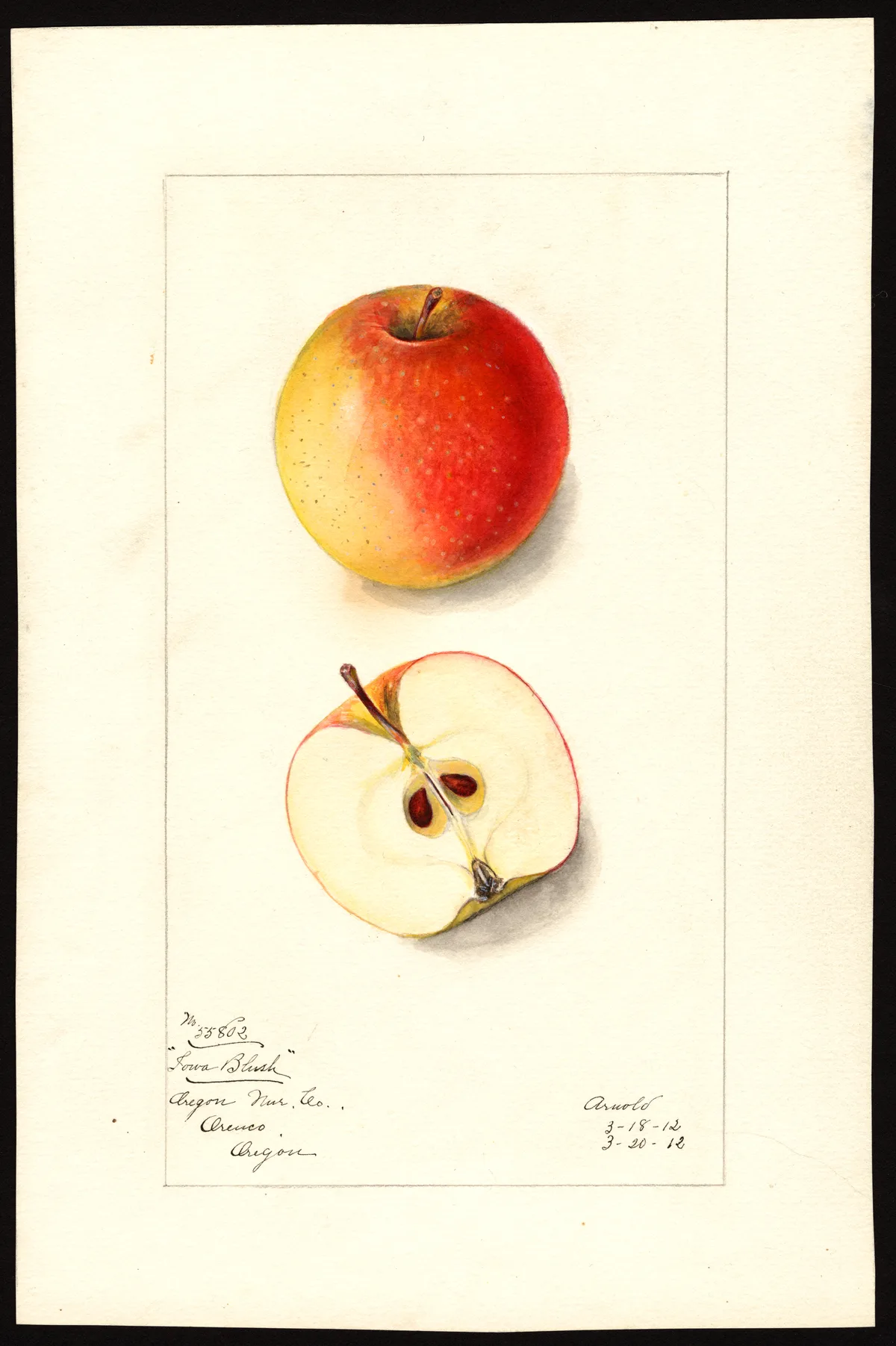
USDA Pomological Watercolor Collection
IOWA BLUSH
Origin / History
IOWA BLUSH was distributed from Iowa City, Iowa, and is supposed to be an unknown stray from Ohio (Hansen 1902; Budd & Hansen 1914). Thomas (1903) describes it as a seedling originating in Iowa. Hedrick (1922) notes that the variety is briefly described by nurserymen of Iowa and Nebraska, who speak of it in superlative terms; it seems not to be known elsewhere, and Hedrick was unable to learn its history other than that it had been grown in the states named for at least twelve years. Thomas (1903) classifies it as Russian.
Tree
Very productive and a strong, vigorous grower in nursery and orchard (Hansen 1902; Budd & Hansen 1914; Hedrick 1922; Central Experimental Farm 1900). Under the bark of young, thrifty trees are hard, detached warty excrescences (Hansen 1902; Budd & Hansen 1914). Hedrick (1922) adds that the tree is only second-hardy, not thriving in the Dakotas and northern Minnesota. At the Central Experimental Farm, Agassiz BC, the tree was planted Spring 1893 and noted as a vigorous grower.
Fruit
Size
Sources differ on size: Hansen (1902) and Budd & Hansen (1914) describe the fruit as small; Thomas (1903), Hedrick (1922), and the Central Experimental Farm (1900) describe it as medium.
Form
Roundish conical (Hansen 1902; Budd & Hansen 1914); conical, regular (Thomas 1903); round-conical (Hedrick 1922); oblate, conical (Central Experimental Farm 1900).
Stem
Medium (Hansen 1902; Thomas 1903; Budd & Hansen 1914).
Cavity
Regular, acuminate, deep, narrow (Hansen 1902); regular, deep (Thomas 1903); regular, acuminate, narrow (Budd & Hansen 1914 — omits "deep").
Calyx
Prominent, closed; segments erect convergent (Hansen 1902; Budd & Hansen 1914).
Basin
Rather shallow, narrow, abrupt, with fine corrugations (Hansen 1902; Budd & Hansen 1914).
Skin
Surface smooth, yellow, with bright mottled red blush, or washed with bronze on sunny side (Hansen 1902; Budd & Hansen 1914). Thomas (1903) describes it as smooth, yellow, blushed red on the sunny side. Hedrick (1922) gives pale yellow with a red cheek. The Central Experimental Farm (1900) describes it as bright yellow, with a warm blush, sprinkled with dots. Dots are obscure, numerous, minute, white, with many large areolar dots (Hansen 1902; Budd & Hansen 1914).
Flesh / Flavor
White, juicy, mild subacid, good (Hansen 1902; Budd & Hansen 1914). Fine grained, juicy, sub-acid, good (Thomas 1903). Yellowish, subacid or tart, rich and good (Hedrick 1922). Crisp, tender, juicy, mildly sub-acid (Central Experimental Farm 1900).
Core / Seeds
Core closed, clasping; cells obovate; tube funnel-shaped; stamens median; seeds many, plump, pointed, ovate, nearly black, packed tightly in cells (Hansen 1902; Budd & Hansen 1914).
Season
Early winter (Hansen 1902; Budd & Hansen 1914). Midwinter (Thomas 1903). November to February (Hedrick 1922). December and January (Central Experimental Farm 1900).
Uses
Not described in source.
Subtypes / Variants
Not described in source.
Other
Thomas (1903) references Fig. 453 in connection with this variety.
Book Sources
Described in 5 period pomological works
Nursery Catalog Sources
Found in 6 catalogs (1894–1921) from Illinois, Oregon
- The Vineland Nurseries (Kelsey & Co. , Proprietors), St. Joseph, Missouri (Office: 13th and Atchison Sts., 2 Blocks East of the Citizens St. Car Line) — 1894
- Central Experimental Farm , Dominion Department of Agriculture, Agassiz, British Columbia (under test; Bulletin No. 3, Second Series) — 1900
- Benjamin Buckman (personal inventory) , Farmingdale , Illinois — 1901
- Pacific Nursery Company , Portland , Oregon — 1912
- Union Nurseries , J.B. Weaver & Sons, Union , Oregon — 1915
- Benedict Nursery Co. , Portland , Oregon — 1921
View original book sources (5)
— N.E. Hansen, A Study of Northwestern Apples (1902)Iowa Blush.
Iowa Blush—Distributed from Iowa City, Iowa, supposed to be an unknown stray from Ohio. Tree very productive, a strong grower in nursery and orchard. Under the bark of the young, thrifty trees are hard detached warty excrescenses—Fruit small, roundish conical; surface smooth, yellow, with bright mottled red blush, or washed with bronze on sunny side; dots obscure, numerous, minute, white, many large areolar dots; cavity regular, acuminate, deep, narrow; stem medium; basin rather shallow, narrow, abrupt, with fine corrugations; calyx prominent, closed, segments erect convergent. Core closed, clasping; cells obovate; tube funnel-shaped; stamens median; seeds many, plump, pointed, ovate, nearly black, packed tightly in cells; flesh white, juicy, mild subacid, good. Early winter.
— John J. Thomas, The American Fruit Culturist (1903)Iowa Blush. Medium, conical, regular, smooth; yellow, blushed red on sunny side; cavity regular, deep; stem medium; flesh fine grained, juicy, sub-acid, good. A seedling originating in Iowa. Midwinter. Fig. 453. Russian.
— J.L. Budd & N.E. Hansen, American Horticultural Manual, Part II: Systematic Pomology (1914)Iowa Blush. — Distributed from Iowa City, Iowa.; supposed to be an unknown stray from Ohio. Tree very productive, a strong grower in nursery and orchard; under the bark of young thrifty trees are hard, detached warty excrescences.
Fruit small, roundish conical; surface smooth, yellow with bright mottled red blush, or washed with bronze on sunny side; dots obscure, numerous, minute, white, many large areolar dots; cavity regular, acuminate, narrow; stem medium; basin rather shallow, narrow, abrupt, with fine corrugations; calyx prominent, closed; segments erect convergent. Core closed, clasping; cells obovate; tube funnel-shaped; stamens median; seeds many, plump, pointed ovate, nearly black, packed tightly in cells; flesh white, juicy, mild subacid, good. Early winter.
— U.P. Hedrick, Cyclopedia of Hardy Fruits (1922)IOWA BLUSH. This variety is briefly described by nurserymen of Iowa and Nebraska, who speak of it in superlative terms. It seems not to be known elsewhere. The author has been unable to learn its history, other than that it has been grown in the states named for at least twelve years. The tree is described as very vigorous and productive, but only second-hardy, not thriving in the Dakotas and northern Minnesota. The fruit is medium in size, round-conical, pale yellow with a red cheek. The flesh is yellowish, subacid or tart, rich and good. The season is November to February.
— Central Experimental Farm, Central Experimental Farm, Agassiz BC — Catalogue of Fruit Trees under Test (Bulletin No. 3, 1900) (1900)Planted Spring 1893. Tree a vigorous grower. Fruit of medium size, oblate, conical. Skin bright yellow, with a warm blush, sprinkled with dots. Flesh crisp, tender, juicy, mildly sub-acid. Season December and January.