Irish Apple
Apple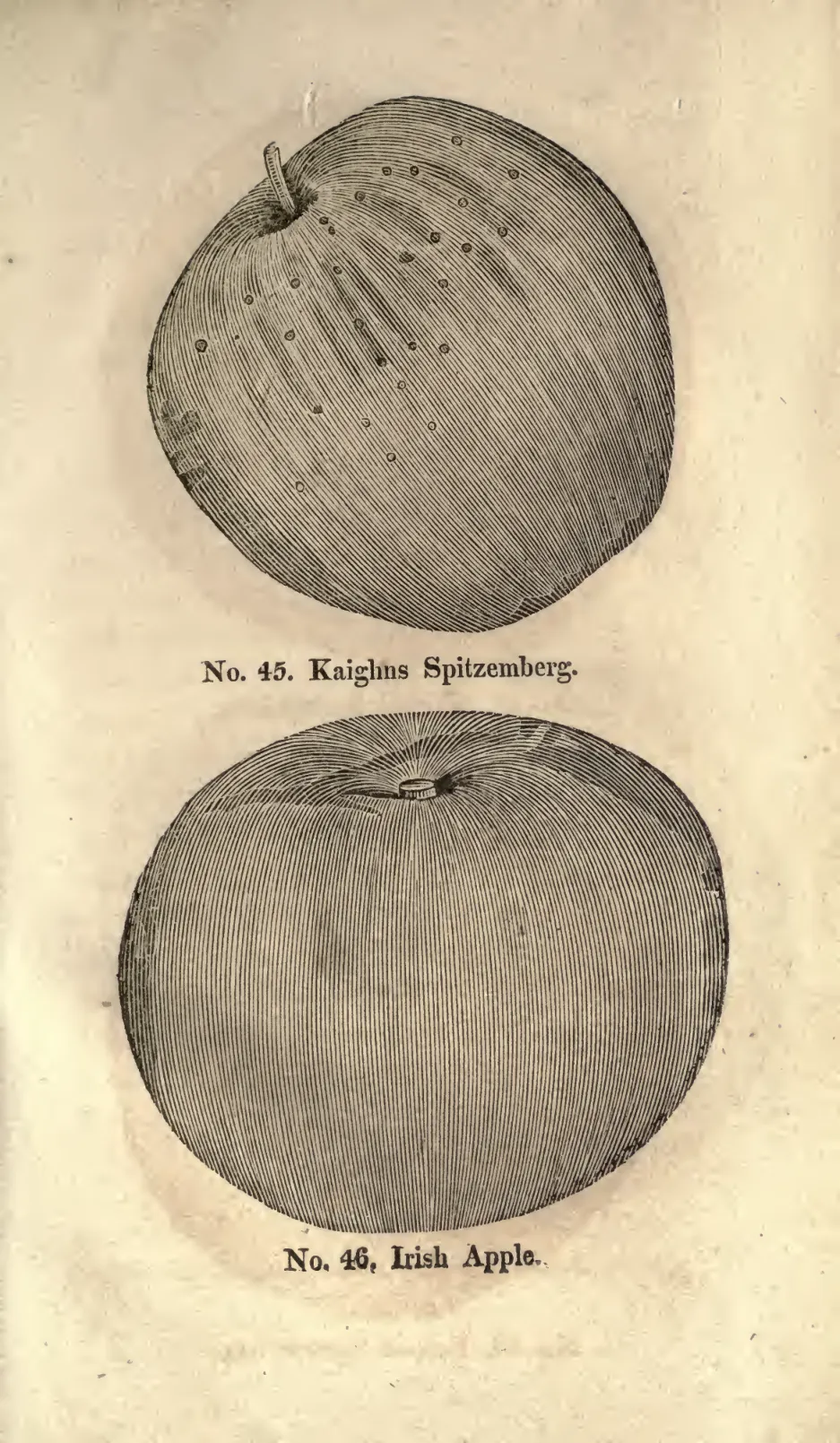
Irish Apple
Origin / History
The Irish Apple is described by William Coxe in A View of the Cultivation of Fruit Trees (1817) as No. 46. Coxe records observations on the variety's performance in his own plantings. He found the tree deficient in hardiness in light soils: in a row of twenty planted twelve years before his account, a large portion died at an early age.
Tree
The tree grows upright with delicate limbs. It is deficient in hardiness in light soils, where in a row of twenty planted twelve years earlier a large portion died at an early age.
Fruit
Size: Fruit large.
Form: Form flat. The fruit bears a strong resemblance to the yellow Newton Pippin in form and color.
Stem: Stem short and deeply planted.
Cavity: Not described in source.
Calyx: Not described in source.
Basin: Not described in source.
Skin: Skin color bears a strong resemblance to the yellow Newton Pippin.
Dots: Skin full of small red spots.
Flesh and flavor: Flesh pleasant, rich, juicy, and sweet.
Core and seeds: Not described in source.
Season
Ripens in November. Will keep for some months.
Uses
Not described in source.
Subtypes / Variants
Not described in source.
Other
Not described in source.
Book Sources
Described in 1 period pomological work
View original book sources (1)
— William Coxe, A View of the Cultivation of Fruit Trees (1817)NO. 46. IRISH APPLE.
This is a fruit of large size, bearing a strong resemblance to the yellow Newton† Pippin both in form and colour: the skin is full of small red spots—the form is flat—the stem short and deeply planted: the flesh is pleasant, rich juicy, and sweet—it ripens in November, and will keep for some months—the tree grows upright with delicate limbs. I have discovered this tree to be deficient in hardiness in light soils; in a row of twenty, planted twelve years ago, a large portion died at an early age; those which sur- [text continues on next page]