Jersey Sweeting
Apple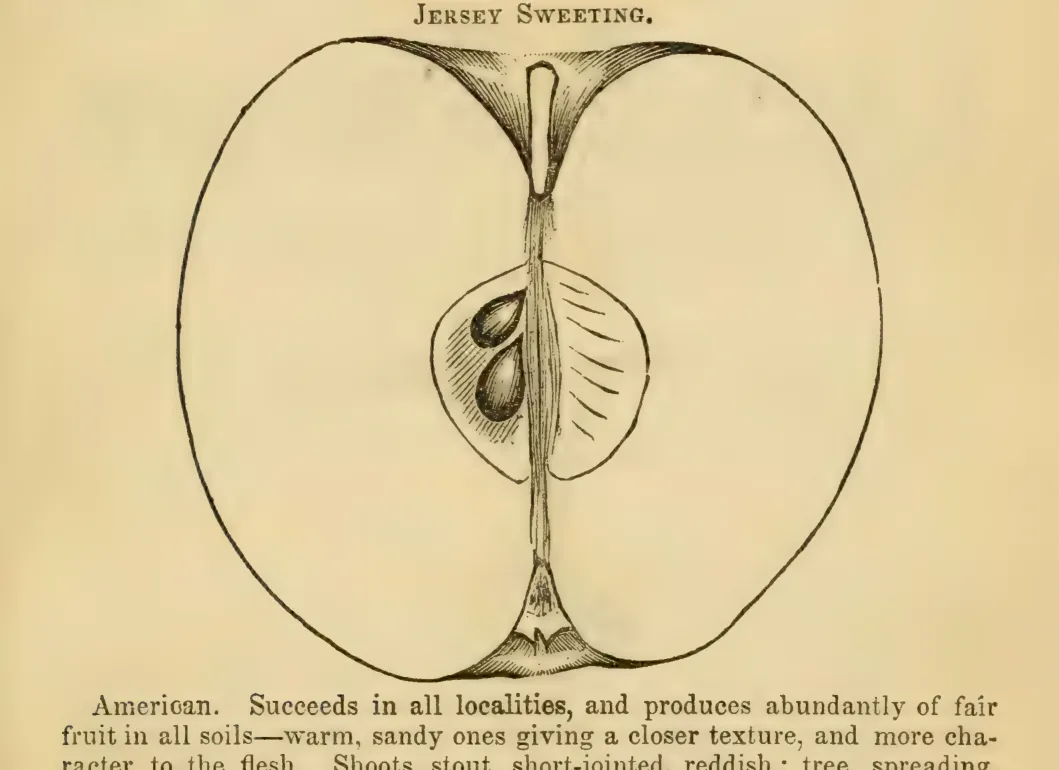
Jersey Sweeting
Origin/History
Origin unknown (Downing). Elliott identifies it as American and notes it succeeds in all localities, producing abundantly of fair fruit in all soils, with warm, sandy soils giving a closer texture and more character to the flesh. A very popular apple in the Middle States, where it is highly valued both for the dessert and, owing to its saccharine quality, planted largely for the fattening of swine (Downing).
Tree
Moderately vigorous (Downing), spreading, forming a handsome round head (both sources). Productive, bearing abundantly (both sources). Young wood dark reddish brown, downy (Downing); shoots stout and short-jointed, reddish (Elliott).
Fruit
Size and Form: Medium size. Roundish ovate, tapering to the eye.
Stem: Elliott describes the stem as short; Downing gives it as approximately an inch long. Cavity rather narrow (both sources).
Calyx: Downing describes it as small and closed, very slightly sunk. Elliott describes it as half closed. Basin small with a plaited character (Downing); not deep, sometimes slightly furrowed (Elliott).
Skin: Thin (Downing). Greenish yellow, washed and marked with stripes of pale and dull red, often nearly or entirely covered with that coloring (both sources).
Flesh and Flavor: White, fine-grained, exceedingly juicy, and tender (both sources). Downing characterizes the flavor as sprightly; Elliott describes it as sweet. Quality rated good to very good (Downing).
Core and Seeds: Core rather open, medium, round ovate; seeds full, ovate pointed (Elliott).
Season
Commences maturing about the last of August and continues ripening until frost (Downing). September and October (Elliott).
Uses
Dessert, cooking, and stock feeding (Elliott). Especially valued for fattening swine due to its saccharine quality (Downing).
Other
Elliott notes that the variety is said to decay young, but considers that assessment incorrect.
Book Sources
Described in 2 period pomological works
View original book sources (2)
— A.J. Downing, The Fruits and Fruit Trees of America (1900)Jersey Sweeting.
Origin unknown. Tree moderately vigorous, forming a handsome round head, productive. Young wood dark reddish brown, downy.
A very popular Apple in the Middle States, where it is not only highly valued for the dessert, but, owing to its saccharine quality, it is planted largely for the fattening of swine.
Fruit medium size, roundish ovate, tapering to the eye. The calyx is small, closed, very slightly sunk, in a small plaited basin. Stalk an inch long, in a rather narrow cavity. Skin thin, greenish yellow, washed and often entirely covered with stripes of pale and dull red. Flesh white, fine-grained, and exceedingly juicy, tender, and sprightly. Good to very good. Young wood stout, and short-jointed. This apple commences maturing about the last of August, and continues ripening till frost.
— F.R. Elliott, The Western Fruit Book (1865)Jersey Sweeting.
American. Succeeds in all localities, and produces abundantly of fair fruit in all soils—warm, sandy ones giving a closer texture, and more character to the flesh. Shoots, stout, short-jointed, reddish; tree, spreading, round head. For dessert, cooking, or stock, valuable. Is said to decay young; we think incorrect.
Fruit, medium; form, roundish ovate, tapering to the eye; color, greenish yellow, marked and streaked, often nearly covered with stripes of pale and dull red; stem, short; cavity, narrow; calyx, half closed; basin, not deep, sometimes slightly furrowed; flesh, white, fine-grained, juicy, tender, sweet; core, rather open, medium, round ovate; seeds, full, ovate pointed. September and October.