Jonathan Buler
Apple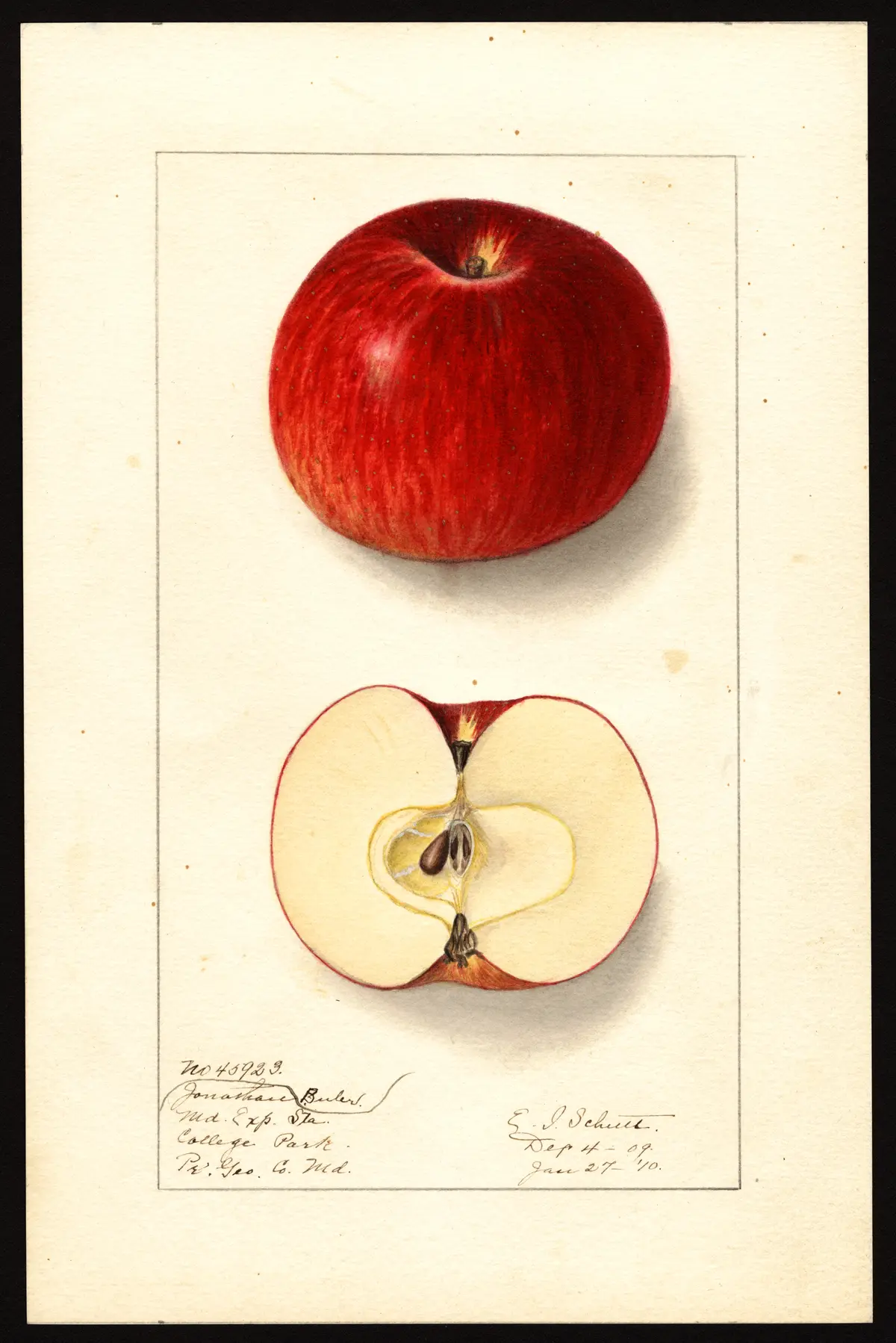
USDA Pomological Watercolor Collection
Jonathan Buler
Origin & History
Origin uncertain. The variety was tested at the Illinois Experiment Station and reported in 1896 as worthy of further trial. It appears to be grown primarily at experimental stations; no knowledge exists of its cultivation in New York outside of the Station.
Tree
Moderately vigorous with long, moderately stout branches. Form upright spreading or roundish and dense. Twigs medium to short, straight, rather stout with large terminal buds; internodes medium. Bark brown tinged with red, mottled with scarf-skin, rather pubescent. Lenticels quite numerous, medium or below, oval or elongated, slightly raised. Buds medium to large, broad, plump, acute, free, slightly pubescent.
Comes into bearing rather young and is an annual bearer. Sometimes yields heavy crops but usually is a moderate cropper. Considerable amount of fruit lost by dropping.
Fruit
Size & Form: Rather large to medium. Oblate, fairly symmetrical, broadly and obscurely ribbed, sometimes a little onesided.
Stem: Very short.
Cavity: Acute to acuminate, broad, deep, with radiating red stripes, sometimes thinly russeted.
Calyx: Small to rather large, closed or partly open; lobes often erect.
Basin: Usually abrupt, moderately wide to wide, rather deep, sometimes compressed, somewhat furrowed and slightly wrinkled.
Skin: Smooth, waxen, glossy, whitish-yellow or green largely overspread with bright red being blushed and mottled with light red striped and splashed with deep carmine. Dots whitish or russet, small.
Calyx tube: Long, meeting the core, varying from slender and funnel-form to wide cone-shape. Stamens basal.
Core: Small to medium, abaxile; cells often symmetrical and closed, sometimes open and unsymmetrical; core lines somewhat clasping. Carpels broadly roundish to elliptical and almost truncate.
Seeds: Short, wide, plump, obtuse, dark.
Flesh & Flavor: White, often streaked or stained with red. Firm, tender, very crisp, moderately coarse, very juicy. Mild subacid with a peculiar aroma which is not altogether pleasing. Fair to almost good in quality.
Season & Storage
Season November to April; however, in common storage it is apt to scald after January.
Uses & Commercial Value
Of good size and decidedly attractive in appearance, being predominantly of a bright red color. Hardly good enough in quality to take first rank as a commercial variety and is excelled by others for dessert and culinary purposes. Probably not worthy of planting for trial in New York.
Subtypes & Variants
Not described in source.
Book Sources
Described in 1 period pomological work
View original book sources (1)
— S.A. Beach, The Apples of New York, Vol. 1 (1905)JONATHAN BULER.
REFERENCES. 1. Beach, N. Y. Sta. An. Rpt., 14:253. 1895. 2. Ill. Sta. Bul., 45:309, 328. 1896. 3. Powell and Fulton, U. S. B. P. I. Bul., 48:38. 1903. 4. Beach and Clark, N. Y. Sta. Bul., 248:127. 1904.
SYNONYMS. BULER (3). Buler (4). JONATHAN OF BULER (2). Jonathan of Buler (3).
Fruit of good size and decidedly attractive being predominantly of a bright red color. It is hardly good enough in quality to take first rank as a commercial variety and it is excelled by others for dessert and culinary purposes. It probably is not worthy of planting for trial in New York.
Tree comes into bearing rather young and is an annual bearer. Sometimes it yields heavy crops but usually it is a moderate cropper. There is considerable amount of fruit lost by dropping.
Historical. Origin uncertain. Tested at the Illinois Experiment Station and reported in 1896 as worthy of further trial. We have no knowledge of its being grown anywhere in New York except at this Station.
TREE.
Tree moderately vigorous; branches long, moderately stout. Form upright spreading or roundish, dense. Twigs medium to short, straight, rather stout with large terminal buds; internodes medium. Bark brown tinged with red, mottled with scarf-skin, rather pubescent. Lenticels quite numerous, medium or below, oval or elongated, slightly raised. Buds medium to large, broad, plump, acute, free, slightly pubescent.
FRUIT.
Fruit rather large to medium. Form oblate, fairly symmetrical, broadly and obscurely ribbed, sometimes a little onesided. Stem very short. Cavity acute to acuminate, broad, deep, with radiating red stripes, sometimes thinly russeted. Calyx small to rather large, closed or partly open; lobes often erect. Basin usually abrupt, moderately wide to wide, rather deep, sometimes compressed, somewhat furrowed and slightly wrinkled. Skin smooth, waxen, glossy, whitish-yellow or green largely overspread with bright red being blushed and mottled with light red striped and splashed with deep carmine. Dots whitish or russet, small. Calyx tube long, meeting the core, varying from slender and funnel-form to wide cone-shape. Stamens basal. Core small to medium, abaxile; cells often symmetrical and closed, sometimes open and unsymmetrical; core lines somewhat clasping. Carpels broadly roundish to elliptical and almost truncate. Seeds short, wide, plump, obtuse, dark. Flesh white, often streaked or stained with red, firm, tender, very crisp, moderately coarse, very juicy, mild subacid with a peculiar aroma which is not altogether pleasing, fair to almost good in quality. Season November to April but in common storage it is apt to scald after January.