Kansas Keeper
Apple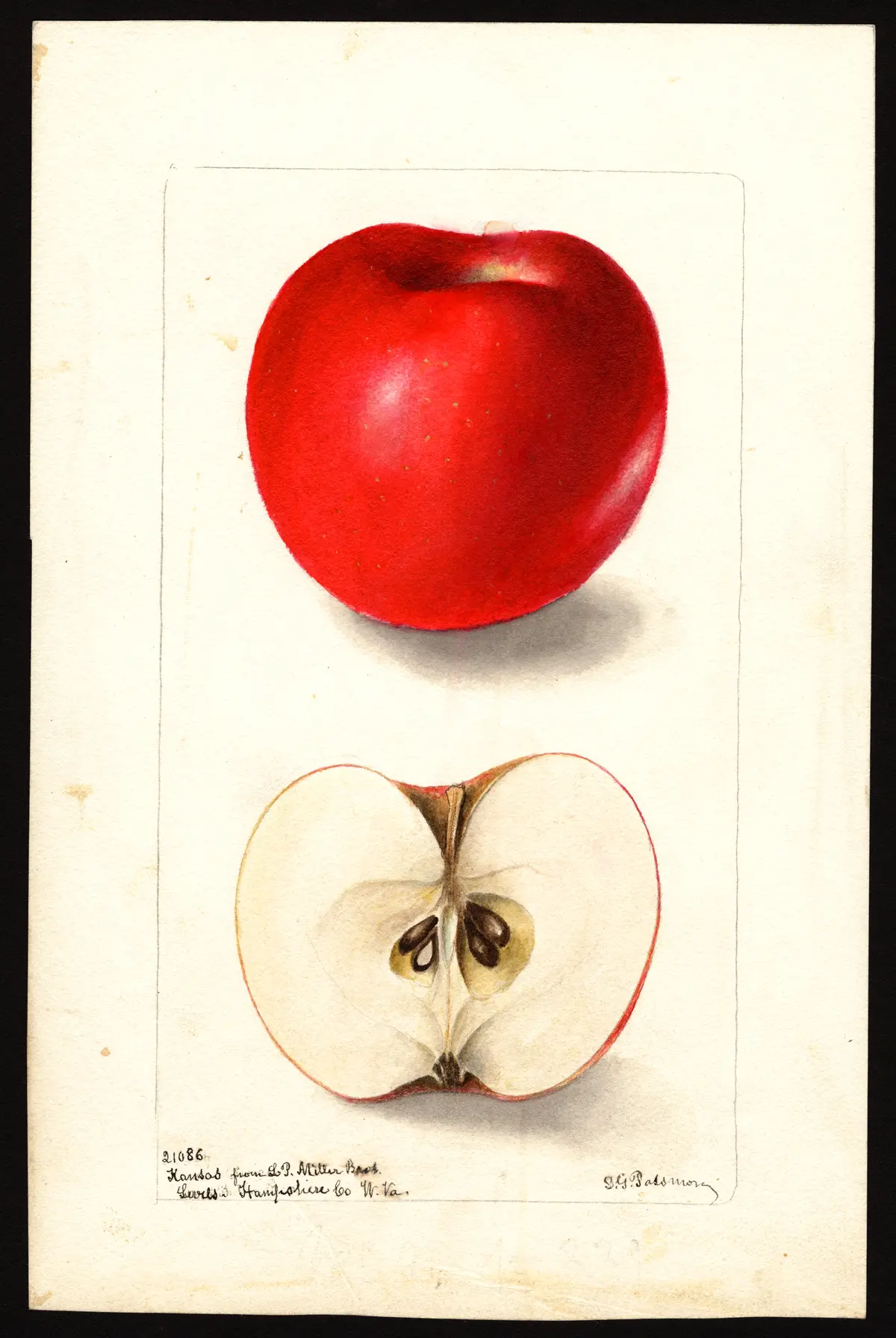
USDA Pomological Watercolor Collection
KANSAS KEEPER
Origin and History
Origin unknown. Historical records indicate uncertainty about whether Kansas Keeper is identical with the variety known as "Keeper." References to this uncertainty appear in U.S. Pomological reports dating to 1895 and 1897.
Synonym: Kansas
Tree
Vigor and Form: Moderately vigorous; form upright.
Twigs: Short to nearly long, rather slender, generally straight; internodes medium. Bark dull reddish or brownish-red, quite uniformly overlaid with a moderately heavy scarf-skin, somewhat pubescent.
Lenticels: Inconspicuous, generally scattering, but on some twigs numerous, small, elongated or roundish.
Buds: Small, acute, somewhat pubescent, lightly attached to the bark or nearly free.
Bearing Habit: Comes into bearing moderately young; bears annually, yielding moderate crops.
Fruit
Size and Form: Medium to large, sometimes averaging below medium; pretty uniform in size and shape. Form roundish or inclined to conic or somewhat oblate, often obscurely ribbed and with sides unequal.
Stem: Rather short.
Cavity: Acuminate, deep, broad to rather narrow, symmetrical, often with outspreading russet rays.
Calyx: Small to medium, closed, varying to large and open. Calyx tube long, funnel-form with wide limb. Stamens median to basal.
Basin: Often oblique, very abrupt, rather narrow, often somewhat furrowed.
Skin: Smooth, pale yellow or greenish, thinly overspread with orange-red or pinkish-red, becoming clear red on exposed cheek, abundantly striped with bright carmine, mottled with thin gray scarf-skin towards the cavity. Dots whitish, often conspicuous, sometimes with russet point. Prevailing effect in highly colored specimens striped red, bright and attractive.
Core and Seeds: Core somewhat abaxile, rather small; cells closed or partly open; core lines clasp the funnel cylinder. Carpels broad at base, narrow at apex, emarginate, tufted. Seeds dark, medium in size, moderately wide, somewhat acute, tufted.
Flesh and Flavor: Whitish, firm, somewhat coarse, moderately crisp, rather tender, juicy, sprightly subacid, fair to good.
Season
December to June. A very late keeper.
Growing Characteristics and Regional Variation
Kansas Keeper as grown in Western New York is usually less highly colored than when grown in more southern localities and often is below good marketable size and rather dull and unattractive in color. In southern regions, the fruit achieves better coloring and more consistent marketable size.
Book Sources
Described in 1 period pomological work
View original book sources (1)
— S.A. Beach, The Apples of New York, Vol. 1 (1905)KANSAS KEEPER.
REFERENCES. 1. Stayman, Am. Pom. Soc. Rpt., 1877:44. 2. Powell and Fulton, U. S. B. P. I. Bul., 48:46. 1903. 3. Beach and Clark, N. Y. Sta. Bul., 248:127. 1904.
SYNONYM. KANSAS (2).
Kansas Keeper as grown in Western New York is usually less highly colored than when grown in more southern localities and often is below good marketable size and rather dull and unattractive in color. It is a very late keeper. The tree comes into bearing moderately young, and bears annually, yielding moderate crops.
Historical. Origin unknown (1). We have not had the opportunity of deciding whether it is identical with Keeper.¹
¹ U. S. Pom. Rpt., 1895:27. Taylor, Am. Pom. Soc. Rpt., 1897:39. Ragan, U. S. B. P. I. Bul., 56:161, 162. 1905.
TREE.
Tree moderately vigorous. Form upright. Twigs short to nearly long, rather slender, generally straight; internodes medium. Bark dull reddish or brownish-red, quite uniformly overlaid with a moderately heavy scarf-skin, somewhat pubescent. Lenticels inconspicuous, generally scattering, but on some twigs numerous, small, elongated or roundish. Buds small, acute, somewhat pubescent, lightly attached to the bark or nearly free.
FRUIT.
Fruit medium to large, sometimes averaging below medium; pretty uniform in size and shape. Form roundish or inclined to conic or somewhat oblate, often obscurely ribbed and with sides unequal. Stem rather short. Cavity acuminate, deep, broad to rather narrow, symmetrical, often with outspreading russet rays. Calyx small to medium, closed, varying to large and open. Basin often oblique, very abrupt, rather narrow, often somewhat furrowed. Skin smooth, pale yellow or greenish, thinly overspread with orange-red or pinkish-red, becoming clear red on exposed cheek, abundantly striped with bright carmine, mottled with thin gray scarf-skin towards the cavity. Dots whitish, often conspicuous, sometimes with russet point. Prevailing effect in highly colored specimens striped red, bright and attractive. Calyx tube long, funnel-form with wide limb. Stamens median to basal. Core somewhat abaxile, rather small; cells closed or partly open; core lines clasp the funnel cylinder. Carpels broad at base, narrow at apex, emarginate, tufted. Seeds dark, medium in size, moderately wide, somewhat acute, tufted. Flesh whitish, firm, somewhat coarse, moderately crisp, rather tender, juicy, sprightly subacid, fair to good.
Season December to June.