Klaproth
Apple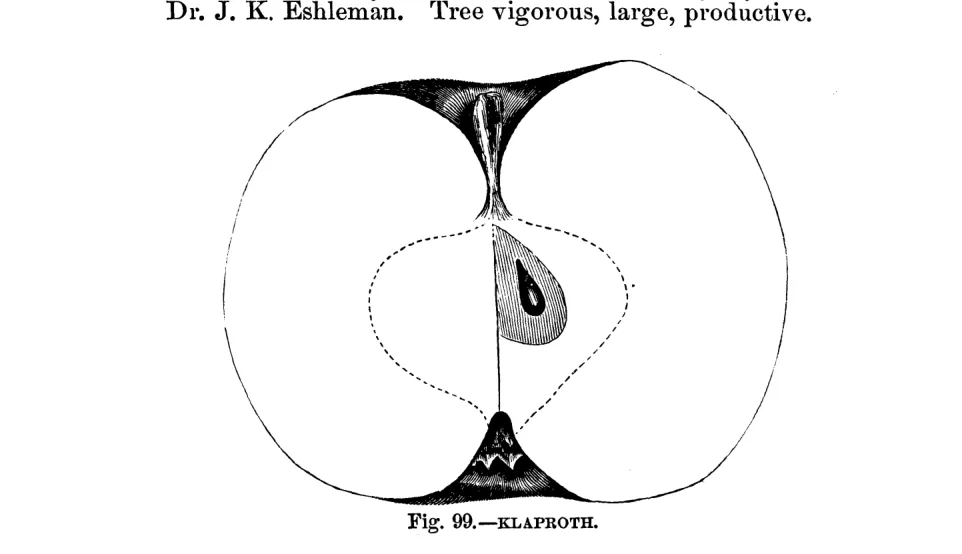
Origin & History
A native of Lancaster County, Pennsylvania, originating on the farm of Mr. Brennaman (Downing). It was brought into notice by Dr. J. K. Eshleman of Downingtown, Pa., and was regarded as an excellent fruit, especially for market purposes (Downing). Warder describes Eshleman as "my friend" and credits him with introducing the variety.
Tree
Vigorous and large, a strong grower and most prolific bearer. Young wood very grayish dull reddish brown (Downing).
Fruit
Size: Medium.
Form: Oblate to roundish flattened, regular (Warder).
Skin: Greenish yellow, streaked and stained with red, deepened on the sunny side (Downing). Warder describes the ground color as "dull yellow" rather than greenish yellow. Dotted all over with bright specks (Downing) — Warder describes the dots as numerous and light. Occasional russet spots near the stalk (Downing, Elliott).
Stem: Short; Warder says short to medium.
Cavity: Deep, smooth (Downing, Elliott, Thomas). Warder describes the cavity as deep, regular, and brown.
Calyx: Small and closed. Segments reflexed.
Basin: Wide, regular, and well-formed (Downing). Thomas describes it as wide and even; Elliott as broad.
Flesh & Flavor: Flesh white, very crisp, juicy, and tender. Flavor a pleasant subacid, though until quite ripe acid predominates (Downing). Warder describes the flesh as breaking, tender, and very juicy, with flavor "acid, to sub-acid when ripe." Rated "Very good" by Downing, Elliott, and (implicitly) Thomas; Warder rates it "Good."
Core & Seeds: Not described in source.
Season
August to October.
Uses
Highly valued as a market apple. Bears carriage remarkably well (Downing, Thomas), making it especially suited for transport and sale.
Subtypes & Variants
Not described in source.
Book Sources
Described in 4 period pomological works
View original book sources (4)
— John A. Warder, American Pomology: Apples (1867)Klaproth.
Another Pennsylvania apple, introduced by my friend Dr. J. K. Eshleman. Tree vigorous, large, productive.
Fig. 99.—KLAPROTH.
Fruit medium, regular, oblate ; Surface dull yellow, more or less covered with red stripes ; Dots numerous, light.
Basin wide, regular ; Eye closed, small ; Calyx reflexed.
Cavity deep, regular, brown ; Stem short to medium.
Flesh white, breaking, tender, very juicy ; Flavor acid, to sub-acid when ripe ; Good ; August till October.
— A.J. Downing, The Fruits and Fruit Trees of America (1900)Klaproth.
This beautiful Apple, a native of Lancaster Co., Pa. (on the farm of Mr. Brennaman), was brought into notice by Dr. J. K. Eshleman, of Downington, Pa., and promises to be an excellent fruit, especially for market purposes. It bears carriage remarkably well, a most prolific bearer and vigorous grower. We give the Dr.'s description. Young wood very grayish dull reddish brown. Size medium, form oblate. Skin greenish yellow, streaked and stained with red, deepened on the sunny side, dotted all over with bright specks, and occasional russet spots near the stalk, which is short and inserted in a smooth deep cavity. Calyx small and closed. Segments reflexed, set in a wide, regular, and well-formed basin. Flesh white, very crisp, juicy, tender, and pleasant subacid flavor, and until quite ripe acid predominates. Very good. August to October.
— F.R. Elliott, The Western Fruit Book (1865)Klaproth.
From Lancaster Co., Pa. Tree, vigorous, prolific. Fruit, medium, roundish flattened, greenish yellow, streaked and stained with red, light specks and russet spots; stem, short; cavity, smooth, deep; calyx, small, closed; segments, reflexed; basin, broad; flesh, white, crisp, juicy, sub-acid; "very good." August to October. Valuable for market.
— John J. Thomas, The American Fruit Culturist (1903)Klaproth. Size medium, oblate; streaked and stained with red on greenish yellow; stalk short, cavity deep; basin wide, even; flesh white, crisp, with a pleasant sub-acid flavor. Tree a strong grower and great bearer. Fruit bears carriage well. A good market sort. Lancaster County, Pa. August to October.