Lamb Abbey Pearmain
Apple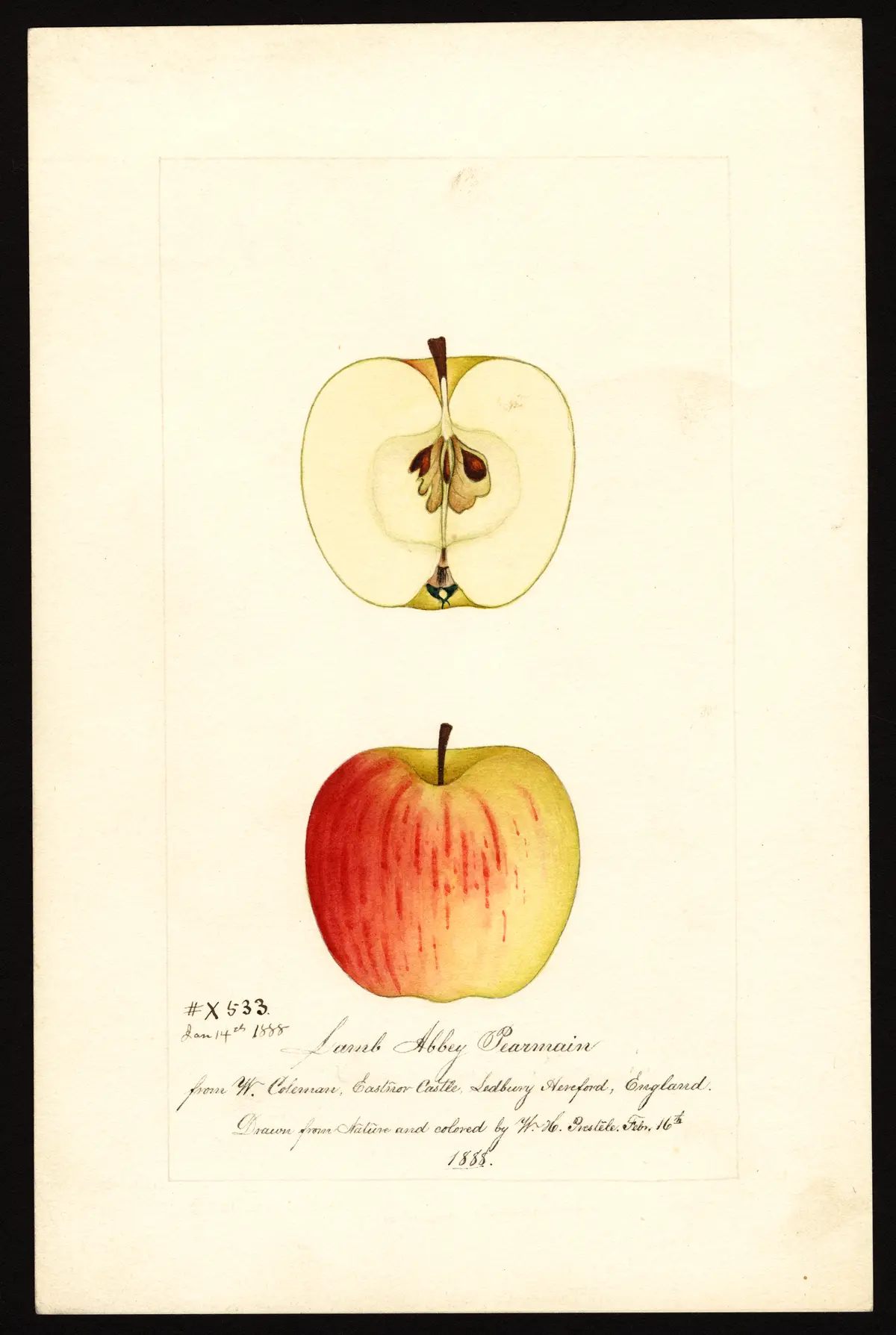
USDA Pomological Watercolor Collection
Lamb Abbey Pearmain
Origin / History
Lamb Abbey Pearmain is a seedling raised from a pip of the Newtown Pippin, the celebrated American apple. It was grown in 1804 by Mrs. Malcolm, wife of Niel Malcolm, Esq., of Lamb Abbey, near Dartford, in Kent, England — though Bunyard places the raising more broadly at "the end of the eighteenth century." The variety is figured in the Transactions of the London Horticultural Society, vol. viii, p. 267, and in Ronalds' Pyrus Malus Brentfordiensis, plate xxi, fig. 2. By Bunyard's time (1920) it was of good quality but little grown.
Tree
Sources disagree on tree health and vigor: the Herefordshire Pomona (1885) describes the tree as healthy, a free grower, and bearing well; Downing (1900) states flatly that the tree is "not healthy." Bunyard (1920) describes growth as vigorous and rather upright, with the tree fertile.
Leaf (Bunyard): Round-oval, very boldly bi-serrate, held flat.
Fruit
Size and Form
Sources disagree on size. The Herefordshire Pomona calls the fruit small; Downing calls it medium; Bunyard gives it as very small, measuring approximately 2¼ inches by 2 inches. All agree the form is roundish to oblong and regular. The Herefordshire Pomona specifies "roundish, or oblate oblong, regularly and handsomely shaped."
Stem
Quarter to half an inch long, slender, deeply inserted in a russety cavity (Herefordshire Pomona; corroborated by Bunyard: "slender, in a russet cavity").
Cavity
Deep, russety (Herefordshire Pomona, Bunyard).
Calyx / Eye
Rather large and open, with long broad segments reflexed at the tips (Herefordshire Pomona). Bunyard concurs: "large and open."
Basin
Wide and deep, plaited (Herefordshire Pomona). Bunyard confirms wide.
Skin
Smooth (Herefordshire Pomona). On the shaded side, greenish yellow, becoming clear yellow when at maturity. On the side exposed to the sun, dull orange, streaked and striped with red, the red becoming more faint as it extends toward the shaded side. The entire surface is dotted with minute, punctured, russety dots (Herefordshire Pomona). Bunyard describes the color as clear yellow with a dull red flush and stripes. Downing describes the ground color as yellow, shaded, splashed, and striped with two shades of red.
Flesh / Flavor
Sources diverge on flavor character. The Herefordshire Pomona describes the flesh as yellowish white, firm, crisp, very juicy and sugary, with a brisk and rich vinous flavour. Bunyard similarly calls it firm, pale yellow, sugary and rich. Downing, by contrast, describes the flesh as whitish, compact, juicy, and subacid — a meaningful discrepancy from the other two sources, which emphasize sweetness and richness.
Season
The Herefordshire Pomona places the season from Christmas to April, during which it remains long in perfection. Bunyard gives January to April. Downing records November — a notable discrepancy, substantially earlier than the other two accounts.
Uses
A first-rate dessert apple (Herefordshire Pomona). Bunyard also classifies it as a dessert variety. Downing rates it simply "Good."
Subtypes / Variants
Not described in sources.
Other
Not described in sources.
Book Sources
Described in 3 period pomological works
View original book sources (3)
— Woolhope Naturalists Field Club, The Herefordshire Pomona (1885)
- LAMB ABBEY PEARMAIN.
This variety is a seedling from the Newtown Pippin, the celebrated American apple. It was grown in 1804 by Mrs. Malcolm, the wife of Niel Malcolm, Esq., of Lamb Abbey, near Dartford, in Kent. It is figured in the Transactions of the London Horticultural Society, vol. viii, p. 267, and also in Ronalds' Pyrus Malus Brentfordiensis, plate xxi, fig. 2.
Description.—Fruit, small, roundish, or oblate oblong, regularly and handsomely shaped. Skin, smooth, greenish yellow on the shaded side, but becoming clear yellow when at maturity; on the side next the sun it is dull orange, streaked and striped with red, which becomes more faint as it extends to the shaded side, and dotted all over with minute, punctured, russety dots. Eye, rather large and open, with long broad segments reflexed at the tips, and set in a wide, deep, and plaited basin. Stalk, from a quarter to half an inch long, slender, deeply inserted in a russety cavity. Flesh, yellowish white, firm, crisp, very juicy and sugary, with a brisk and rich vinous flavour.
A very valuable dessert apple, of first-rate quality, both as regards the richness of the flavour, and the long period during which it remains in perfection. It is in season from Christmas to April.
The tree is healthy, a free grower, and bears well.
— A.J. Downing, The Fruits and Fruit Trees of America (1900)Lamb Abbey Pearmain.
An old variety, from Kent, England. Tree not healthy.
Fruit medium, roundish, yellow, shaded, splashed, and striped with two shades of red. Flesh whitish, compact, juicy, subacid. Good. November.
— E.A. Bunyard, A Handbook of Hardy Fruits (1920)LAMB ABBEY PEARMAIN. Ronalds, p. 21. Dessert, January to April, very small, 2¼ by 2, oblong, regular. Colour, clear yellow with dull red flush and stripes. Flesh, firm, pale yellow, sugary and rich. Eye, large and open in a wide basin. Stem, slender, in a russet cavity. Growth, vigorous, rather upright; fertile. Leaf, round, oval, very boldly bi-serrate, held flat. Origin, raised near Dartford, at the end of the eighteenth century from a pip of a Newtown Pippin. Of good quality but little grown now.
Lammas: see Red Joaneting.
Lancashire Crab: see Minchall Crab.
Landmere Russet: see Hanwell Souring.