Lawver
Apple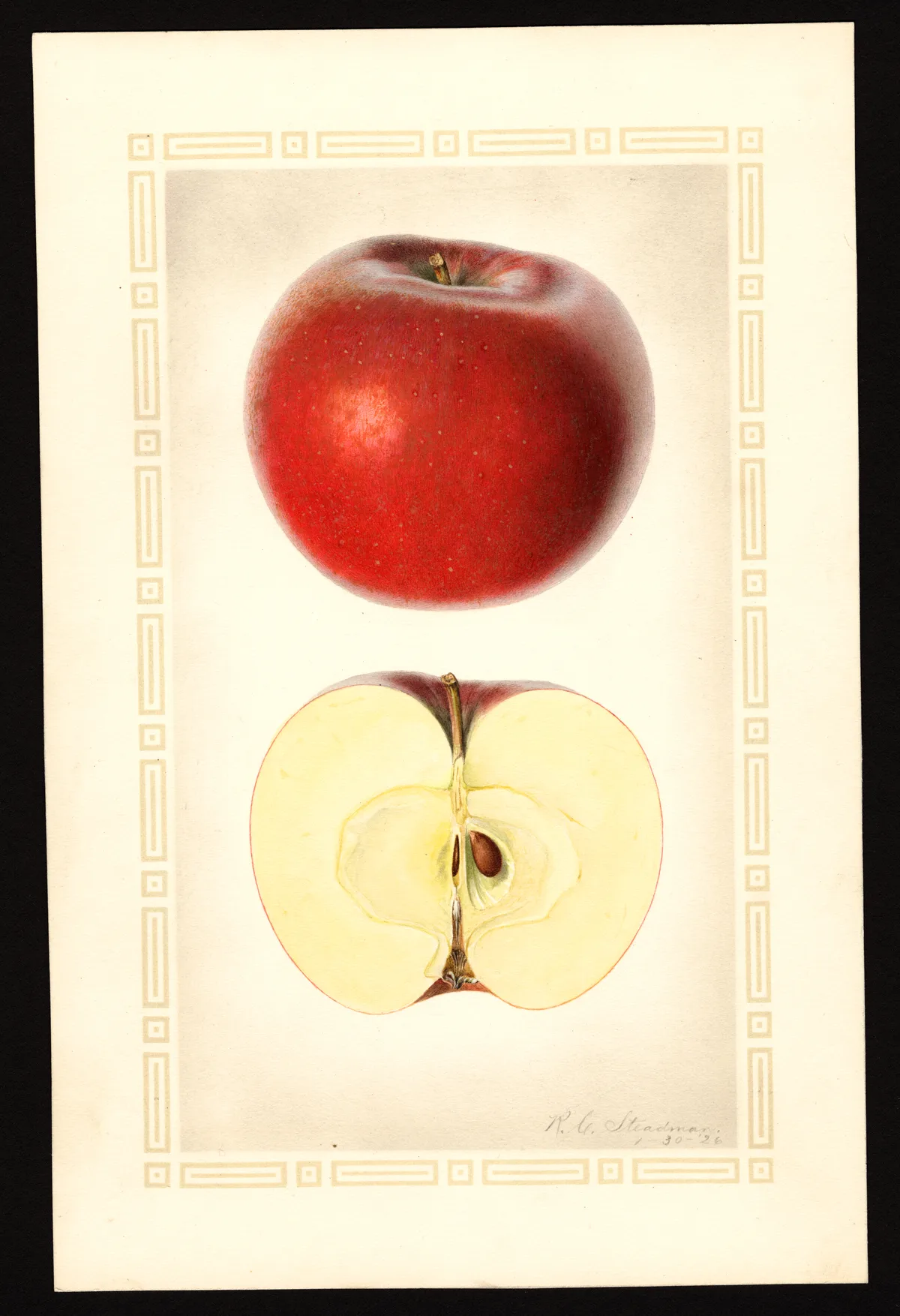
USDA Pomological Watercolor Collection
Lawver
Origin / History
Origin uncertain. Introduced by George S. Park of Parkville, Missouri, and said to have been found in an old Indian orchard in Kansas (Downing; Beach). Beach and Hedrick note it was reintroduced from Delaware under the name Delaware Winter, and Beach adds that it has also been disseminated in some portions of New York under the name Black Spy. Hedrick places its introduction from Parkville "soon after the Civil War." Beach writes that by the early 1900s it had been "pretty thoroughly disseminated throughout the country" over the preceding forty years. Thomas attributes the variety to Missouri.
Tree
Tree medium or above in size, vigorous or moderately vigorous (Beach), described by Hedrick as vigorous and round-spreading and dense, and by Downing simply as vigorous, spreading. Branches long, moderately stout (Beach) to stout (Hedrick), curved. Form roundish or somewhat flat, spreading, rather dense. Twigs short to rather long, curved, moderately stout; internodes medium to rather long. Bark dark brownish-red mingled with olive-green, mottled with rather heavy scarf-skin, slightly pubescent near the tips. Lenticels dull, inconspicuous, rather scattering, medium to large, elongated, raised. Buds large to medium, broad, plump, obtuse, free, slightly pubescent.
Bearing habits: Downing and Budd-Hansen describe the tree as an early and annual bearer. Beach and Hedrick instead report that it usually comes into bearing rather early and is a reliable biennial bearer, often yielding very heavy crops; Beach notes that in some places the tree is not a good cropper. Thomas comments that "it is not very productive and does not promise well for a market variety." Fruit and foliage are quite subject to the attacks of the apple-scab fungus, though Beach notes this may be readily controlled by proper treatment.
Fruit
Size
Large (Downing, Thomas, Lowther), or medium to large (Hedrick), or above medium (Budd-Hansen). Beach writes "medium or above" but notes that as fruited in New York it usually averages no more than medium and often a considerable portion of the crop runs below medium; Hedrick likewise observes that in the North the apples run small in size and poor in color and quality, the variety being at its best in southern latitudes. Beach considers it pretty uniform in size and shape.
Form
Roundish oblate (Downing, Budd-Hansen, Lowther), or roundish, regular (Thomas), or roundish or somewhat oblate, ribbed but slightly if at all, regular and symmetrical (Beach), or round or oblate, regular and symmetrical (Hedrick). Budd-Hansen describes it as roundish oblate, irregular, and broadly ribbed.
Stem / Stalk
Stalk medium (Downing); stem medium to long, slender (Budd-Hansen); stem variable, often long and slender (Beach, Hedrick).
Cavity
Deep, regular (Downing); deep, regular, with radiate russet (Budd-Hansen); acute or approaching acuminate, deep, rather large and broad, often compressed or distinctly furrowed, usually more or less russeted and often with outspreading russet rays (Beach; similarly Hedrick).
Calyx
Small, closed (Downing); closed, with segments connivent (Budd-Hansen); rather small, closed or partly open, often leafy, with lobes sometimes separated at the base (Beach; similarly Hedrick, who describes calyx small, closed or open, often leafy).
Basin
Medium, furrowed (Downing); nearly flat, narrow, wrinkled (Budd-Hansen); usually rather wide, flat and obtuse, sometimes moderately deep and moderately abrupt, gently furrowed, sometimes wrinkled (Beach; Hedrick similarly describes basin wide, flat and obtuse, sometimes deep and abrupt, gently furrowed, sometimes wrinkled).
Skin / Color
Dark bright red, covered with small dots (Downing). Surface handsomely striped with red (Thomas). Surface polished, greenish yellow, almost wholly covered with dark bright red, with obscure dark crimson splashes; dots few, yellow and russet, minute (Budd-Hansen). Red (Lowther). Beach: skin moderately thin, tough, sometimes a little waxy, smooth, occasionally showing some of the yellow ground color but usually completely covered with solid bright red which about the base deepens to purplish and is often mottled and streaked with dull grayish scarf-skin; toward the apex it has a characteristic lighter and brighter red tone. Hedrick: skin thin, tough, smooth, occasionally showing the yellow ground-color but usually covered with bright red which deepens about the base and is often mottled and streaked with dull gray scarf-skin, toward the apex lighter red. Beach describes it overall as "an attractive bright red apple," and Hedrick as "a handsome red," very uniform in shape and size.
Dots
Small dots (Downing); few, yellow and russet, minute (Budd-Hansen); whitish or russet, small and numerous about the basin, larger and scattering toward the cavity (Beach); white or russet, small and numerous about the basin, large and scattering toward the cavity (Hedrick).
Flesh / Flavor
White, firm, crisp, sprightly, aromatic, mild subacid (Downing). Sub-acid, good (Thomas). Firm, yellowish white, juicy, tender, pleasant subacid, good (Budd-Hansen). Quality very good (Lowther). Beach: slightly tinged with yellow or greenish, rather hard, somewhat breaking, moderately fine, crisp, tender, juicy, rather brisk subacid, somewhat aromatic, not highly flavored, fair to good in quality. Hedrick: yellow, firm, breaking, fine, crisp, tender, juicy, brisk subacid, aromatic; fair to good. Beach summarizes that the variety does not rank high in quality and is less suitable for dessert than for market and culinary uses; Hedrick concurs that it is but mediocre in quality, scarcely desirable for either dessert or culinary purposes.
Core / Seeds
Budd-Hansen: core small, half open, outline indistinct; cells round, slit; tube funnel-shaped; stamens marginal. Beach: calyx tube rather long, narrow at top, funnel-form; stamens median; core abaxile, medium or above; cells pretty symmetrical, open or partly closed; core lines clasping; carpels somewhat concave, roundish to broadly obcordate, but slightly emarginate if at all, somewhat tufted; seeds dark, medium to rather large, wide, obtuse, somewhat tufted. Hedrick: calyx-tube long, narrow at top, funnel-form; stamens median; core abaxile, medium in size; cells symmetrical, open or closed; core-lines clasping; carpels concave, round to obcordate, tufted; seeds dark, large, wide, obtuse, tufted.
Season
January to May (Downing); winter (Thomas); late winter to May or later (Budd-Hansen); January to May or June (Beach, Hedrick). Beach gives the commercial limit as March or possibly April. The fruit is very firm, ships well, and keeps late — in common storage until May or June (Hedrick). Lowther alone gives the season as "early autumn" for the Central Division.
Uses
Better suited to market and culinary uses than to dessert (Beach); Hedrick judges it scarcely desirable for either dessert or culinary purposes but valued for attractive appearance and long-keeping quality. Lowther lists the use as both kitchen and market. Thomas considers it not promising as a market variety owing to lack of productiveness. Beach notes the variety is seldom regarded favorably for commercial planting by New York fruit growers, and the quality is not high enough to give it a place among the varieties recommended for the home orchard. Both Beach and Hedrick observe that the variety is better adapted to more southern latitudes.
Subtypes / Variants
Not described in source.
Other
Lowther reports the variety from Central Division 3 and notes it was reported in more than one division. Beach's catalog of references traces it through pomological literature from 1868 (Prairie Farmer; Warder, Ill. Hort. Soc. Rpt.) through the American Pomological Society catalog of 1871, Downing 1872, Fitz 1872, Thomas 1885, and a series of state and federal bulletins (Missouri, Arkansas, Massachusetts Hatch, Virginia, New York, and the Canadian Department of Agriculture) into Ragan's U.S. B.P.I. Bul. 56 of 1905.
Book Sources
Described in 6 period pomological works
- Beach, The Apples of New York Vol. 1 (1905)
- Hedrick, Cyclopedia of Hardy Fruits (1922)
- Budd & Hansen, Systematic Pomology (1914) — listed as Lawyer
- Downing, Fruits and Fruit Trees of America (1900)
- Lowther (ed.), Encyclopedia of Practical Horticulture (1914)
- Thomas, The American Fruit Culturist (1903)
Nursery Catalog Sources
Found in 26 catalogs (1892–1920) from Alabama, Arkansas, Illinois, Missouri, Oregon, Virginia, Washington
- Puyallup & Yakima Nurseries , Puyallup, Washington (Lock Box 191) and North Yakima , Washington — 1892
- Oregon Wholesale Nurseries , Salem , Oregon — 1893
- Milwaukie-Canby Nurseries , Canby, OR (and Milwaukie, OR) — 1893
- The Vineland Nurseries (Kelsey & Co. , Proprietors), St. Joseph, Missouri (Office: 13th and Atchison Sts., 2 Blocks East of the Citizens St. Car Line) — 1894
- Multnomah Nurseries , Russellville , Oregon — 1894
- Woodburn Nurseries , Woodburn, Marion Co. , Oregon — 1894
- Stark Bros. Nurseries & Orchards Co. , Louisiana , Missouri — 1896
- The Salem Nursery (John A. Francis , Proprietor), Salem , Virginia — 1897
- Central Experimental Farm , Dominion Department of Agriculture, Agassiz, British Columbia (under test; Bulletin No. 3, Second Series) — 1900 — listed as Delaware Red Winter
- Alabama Nursery Co. , Huntsville , Alabama — 1900
- Central Experimental Farm , Dominion Department of Agriculture, Agassiz, British Columbia (under test; Bulletin No. 3, Second Series) — 1900 — listed as Delaware Winter
- Benjamin Buckman (personal inventory) , Farmingdale , Illinois — 1901 — listed as Delaware Red Winter
- Washington Nursery Co. , Toppenish , Washington — 1901
- Yarbrough Bros. , Stephens , Arkansas — 1901
- Pacific Nursery Company (W. O. Hudson & A. D. Hudson) , Tangent , Oregon — 1903
- Phoenix Nursery Company (W. E. Rossney , President; Sidney Tuttle, Vice-President), Bloomington , Illinois — 1904
- The Dalles Nurseries , The Dalles , Oregon — 1906
- Russellville Nursery Co. , Montavilla Station, Portland, OR (three miles east of Portland, one mile from Montavilla car line) — 1907
- Carlton Nursery Co. , Carlton , Oregon — 1909
- Washington Nursery Company , Toppenish , Washington — 1909
- Milton Nursery Co. (A. Miller & Sons , Proprietors), Milton , Oregon — 1909
- Pacific Nursery Company , Portland , Oregon — 1912
- Washington Nursery Company , Toppenish , Washington — 1912
- Vineland Nurseries Company , Clarkston , Washington — 1912
- Benjamin Buckman (personal inventory) , Farmingdale , Illinois — 1913 — listed as Delaware Red Winter
- Oregon Nursery Co. , Orenco , Oregon — 1920
View original book sources (6)
— A.J. Downing, The Fruits and Fruit Trees of America (1900)Lawver. Origin uncertain. Introduced by George S. Park, of Parkville, Mo., and said to have been found in an old Indian orchard in Kansas. Tree vigorous, spreading, an early and annual bearer, a beautiful fruit, and a long keeper. Fruit large, roundish oblate. Color dark bright red, covered with small dots. Stalk medium. Cavity deep, regular. Calyx small, closed. Basin medium, furrowed. Flesh white, firm, crisp, sprightly, aromatic, mild subacid. January to May. (Prairie Farmer.)
— John J. Thomas, The American Fruit Culturist (1903)Lawver. Large, roundish, regular; with surface handsomely striped with red, sub-acid, good. It is not very productive and does not promise well for a market variety. Winter. West. Fig. 468. Missouri.
— S.A. Beach, The Apples of New York, Vol. 1 (1905)LAWVER.
REFERENCES. 1. Prairie Farmer, 1868. (cited by 19). 2. Warder, Ill. Hort. Soc. Rpt., 1868:95-97. 3. Am. Pom. Soc. Cat., 1871:8. 4. Downing, 1872:251. 5. Fitz, 1872:121, 143. 6. Thomas, 1885:516. 7. Am. Pom. Soc. Rpt., 1887:92. 8. Mo. Sta. Bul., 6:7. 1889. 9. Wickson, 1891:246. 10. Bailey, An. Hort., 1892:243. 11. Beach, Paddock and Close, N. Y. Sta. An. Rpt., 15:272. 1896. 12. Stinson, Ark. Sta. Bul., 43:103. 1896. 13. Mass. Hatch Sta. Bul., 44:4. 1897. 14. Macoun, Can. Dept. Agr. Rpt., 1899:78. 15. Alwood, Va. Sta. Bul., 130:135. 1901. 16. Powell and Fulton, U. S. B. P. I. Bul., 48:47. 1903. 17. Budd-Hansen, 1903:114. 18. Beach and Clark, N. Y. Sta. Bul., 248:129. 1904. 19. Ragan, U. S. B. P. I. Bul., 56:176. 1905.
SYNONYMS. Black Spy. Delaware Red Winter (11, 14, 15, 16, 18, 19). DELAWARE WINTER (7). Delaware Winter (11, 13).
An attractive bright red apple, pretty uniform in size and shape. It is very firm, ships well and keeps late. It does not rank high in quality and is less suitable for dessert than for market and culinary uses. As grown in this state often a considerable portion of the fruit grades below medium size and lacks proper development in quality and color. It is better adapted to more southern latitudes. In some places the tree is not a good cropper, but usually it comes into bearing rather early and is a reliable biennial bearer, often yielding very heavy crops. The fruit and foliage are quite subject to the attacks of the apple scab fungus, but this may be readily controlled by proper treatment. This variety is seldom regarded favorably for commercial planting by New York fruit growers, and the quality is not high enough to give it a place among the varieties recommended for the home orchard.
Historical. Origin uncertain. "Introduced by Geo. S. Park, of Parkville, Mo., and said to have been found in an old Indian orchard in Kansas" (1, 4). Reintroduced from Delaware under the name Delaware Winter (7). It has also been disseminated in some portions of New York under the name Black Spy. During the last forty years it has been pretty thoroughly disseminated throughout the country.
TREE. Tree medium or above, vigorous or moderately vigorous; branches long, moderately stout, curved. Form roundish or somewhat flat, spreading, rather dense. Twigs short to rather long, curved, moderately stout; internodes medium to rather long. Bark dark brownish-red mingled with olive-green, mottled with rather heavy scarf-skin, slightly pubescent near the tips. Lenticels dull, inconspicuous, rather scattering, medium to large, elongated, raised. Buds large to medium, broad, plump, obtuse, free, slightly pubescent.
FRUIT. Fruit medium or above; as fruited here it usually averages no more than medium and often a considerable portion of the crop runs below medium. Form roundish or somewhat oblate, ribbed but slightly if at all, regular and symmetrical. Stem variable, often long and slender. Cavity acute or approaching acuminate, deep, rather large and broad, often compressed or distinctly furrowed, usually more or less russeted and often with outspreading russet rays. Calyx rather small, closed or partly open, often leafy; lobes sometimes separated at the base. Basin usually rather wide, flat and obtuse, sometimes moderately deep and moderately abrupt, gently furrowed, sometimes wrinkled. Skin moderately thin, tough, sometimes a little waxy, smooth, occasionally showing some of the yellow ground color but usually completely covered with solid bright red which about the base deepens to purplish and is often mottled and streaked with dull grayish scarf-skin. Toward the apex it has a characteristic lighter and brighter red tone. Dots whitish or russet, small and numerous about the basin, larger and scattering toward the cavity. Calyx tube rather long, narrow at top, funnel-form. Stamens median. Core abaxile, medium or above; cells pretty symmetrical, open or partly closed; core lines clasping. Carpels somewhat concave, roundish to broadly obcordate, but slightly emarginate if at all, somewhat tufted. Seeds dark, medium to rather large, wide, obtuse, somewhat tufted. Flesh slightly tinged with yellow or greenish, rather hard, somewhat breaking, moderately fine, crisp, tender, juicy, rather brisk subacid, somewhat aromatic, not highly flavored, fair to good in quality. Season January to May or June. Commercial limit March or possibly April.
[Additional entry in this volume: "Lawyer", pp. 320–322]
LAWYER.
REFERENCES. 1. Prairie Farmer, 1868. (cited by 19). 2. Warder, Ill. Hort. Soc. Rpt., 1868:95-97. 3. Am. Pom. Soc. Cat., 1871:8. 4. Downing, 1872:251. 5. Fitz, 1872:121, 143. 6. Thomas, 1885:516. 7. Am. Pom. Soc. Rpt., 1887:92. 8. Mo. Sta. Bul. 6:7. 1889. 9. Wickson, 1891:246. 10. Bailey, An. Hort., 1892:243. 11. Beach, Paddock and Close, N. Y. Sta. An. Rpt., 15:272. 1896. 12. Stinson, Ark. Sta. Bul., 43:103. 1896. 13. Mass. Hatch Sta. Bul., 44:4. 1897. 14. Macoun, Can. Dept. Agr. Rpt., 1899:78. 15. Alwood, Va. Sta. Bul., 130:135. 1901. 16. Powell and Fulton, U. S. B. P. I. Bul. 48:47. 1903. 17. Budd-Hansen, 1903:114. 18. Beach and Clark, N. Y. Sta. Bul., 248:129. 1904. 19. Ragan, U. S. B. P. I. Bul., 56:176. 1905.
SYNONYMS. Black Spy. Delaware Red Winter (11, 14, 15, 16, 18, 19). DELAWARE WINTER (7). Delaware Winter (11, 13).
An attractive bright red apple, pretty uniform in size and shape. It is very firm, ships well and keeps late. It does not rank high in quality and is less suitable for dessert than for market and culinary uses. As grown in this state often a considerable portion of the fruit grades below medium size and lacks proper development in quality and color. It is better adapted to more southern latitudes. In some places the tree is not a good cropper, but usually it comes into bearing rather early and is a reliable biennial bearer, often yielding very heavy crops. The fruit and foliage are quite subject to the attacks of the apple scab fungus, but this may be readily controlled by proper treatment. This variety is seldom regarded favorably for commercial planting by New York fruit growers, and the quality is not high enough to give it a place among the varieties recommended for the home orchard.
Historical. Origin uncertain. "Introduced by Geo. S. Park, of Parkville, Mo., and said to have been found in an old Indian orchard in Kansas" (1, 4). Reintroduced from Delaware under the name Delaware Winter (7). It has also been disseminated in some portions of New York under the name Black Spy. During the last forty years it has been pretty thoroughly disseminated throughout the country.
TREE.
Tree medium or above, vigorous or moderately vigorous; branches long, moderately stout, curved. Form roundish or somewhat flat, spreading, rather dense. Twigs short to rather long, curved, moderately stout; internodes medium to rather long. Bark dark brownish-red mingled with olive-green, mottled with rather heavy scarf-skin, slightly pubescent near the tips. Lenticels dull, inconspicuous, rather scattering, medium to large, elongated, raised. Buds large to medium, broad, plump, obtuse, free, slightly pubescent.
FRUIT.
Fruit medium or above; as fruited here it usually averages no more than medium and often a considerable portion of the crop runs below medium. Form roundish or somewhat oblate, ribbed but slightly if at all, regular and symmetrical. Stem variable, often long and slender. Cavity acute or approaching acuminate, deep, rather large and broad, often compressed or distinctly furrowed, usually more or less russeted and often with outspreading russet rays. Calyx rather small, closed or partly open, often leafy; lobes sometimes separated at the base. Basin usually rather wide, flat and obtuse, sometimes moderately deep and moderately abrupt, gently furrowed, sometimes wrinkled. Skin moderately thin, tough, sometimes a little waxy, smooth, occasionally showing some of the yellow ground color but usually completely covered with solid bright red which about the base deepens to purplish and is often mottled and streaked with dull grayish scarf-skin. Toward the apex it has a characteristic lighter and brighter red tone. Dots whitish or russet, small and numerous about the basin, larger and scattering toward the cavity. Calyx tube rather long, narrow at top, funnel-form. Stamens median. Core abaxile, medium or above; cells pretty symmetrical, open or partly closed; core lines clasping. Carpels somewhat concave, roundish to broadly obcordate, but slightly emarginate if at all, somewhat tufted. Seeds dark, medium to rather large, wide, obtuse, somewhat tufted. Flesh slightly tinged with yellow or greenish, rather hard, somewhat breaking, moderately fine, crisp, tender, juicy, rather brisk subacid, somewhat aromatic, not highly flavored, fair to good in quality. Season January to May or June. Commercial limit March or possibly April.
— J.L. Budd & N.E. Hansen, American Horticultural Manual, Part II: Systematic Pomology (1914)Lawyer. — Origin uncertain, introduced by Geo. S. Park, of Parkville, Missouri; tree spreading, an early and annual bearer.
Fruit above medium, roundish oblate, irregular, broadly ribbed; surface polished, greenish yellow, almost wholly covered with dark bright red, with obscure dark crimson splashes; dots few, yellow and russet, minute; cavity deep, regular, with radiate russet; stem medium to long, slender; basin nearly flat, narrow, wrinkled; calyx closed; segments connivent. Core small, half open, outline indistinct; cells round, slit; tube funnel-shaped; stamens marginal; flesh firm, yellowish white, juicy, tender, pleasant subacid, good. Late winter to May or later.
— Granville Lowther (ed.), Encyclopedia of Practical Horticulture (1914)Lawver: size large, form roundish (oblate), color red, quality very good, use both kitchen and market, season early autumn, Central Division 3 (reported in more than one division).
— U.P. Hedrick, Cyclopedia of Hardy Fruits (1922)LAWVER. Black Spy. Delaware Winter.
Lawver retains a place in pomology because of the attractive appearance and long-keeping quality of the fruit. The apples are a handsome red, very uniform in shape and size, and keep in common storage until May or June. They are, however, but mediocre in quality scarcely desirable for either dessert or culinary purposes. The trees come in bearing early, and, as a rule, yield large crops biennially. The variety is at its best in southern latitudes; in the North the apples run small in size and poor in color and quality. Fruit and foliage are subject to apple-scab. The origin of Lawver is uncertain, but it is said to have come from Parkville, Missouri, soon after the Civil War, and to have been reintroduced from Delaware under the name Delaware Winter.
Tree vigorous, round-spreading, dense; branches long, stout, curved.
Fruit medium to large, round or oblate, regular and symmetrical; stem variable, often long and slender; cavity acute or acuminate, deep, large and broad, often compressed or furrowed, more or less russeted and often with outspreading russet rays; calyx small, closed or open, often leafy; lobes sometimes separated at the base; basin wide, flat and obtuse, sometimes deep and abrupt, gently furrowed, sometimes wrinkled; skin thin, tough, smooth, occasionally showing the yellow ground-color but usually covered with bright red which deepens about the base and is often mottled and streaked with dull gray scarf-skin, toward the apex lighter red; dots white or russet, small and numerous about the basin, large and scattering toward the cavity; calyx-tube long, narrow at top, funnel-form; stamens median; core abaxile, medium in size; cells symmetrical, open or closed; core-lines clasping; carpels concave, round to obcordate, tufted; seeds dark, large, wide, obtuse, tufted; flesh yellow, firm, breaking, fine, crisp, tender, juicy, brisk subacid, aromatic; fair to good; January to May or June.