Lehigh Greening
Apple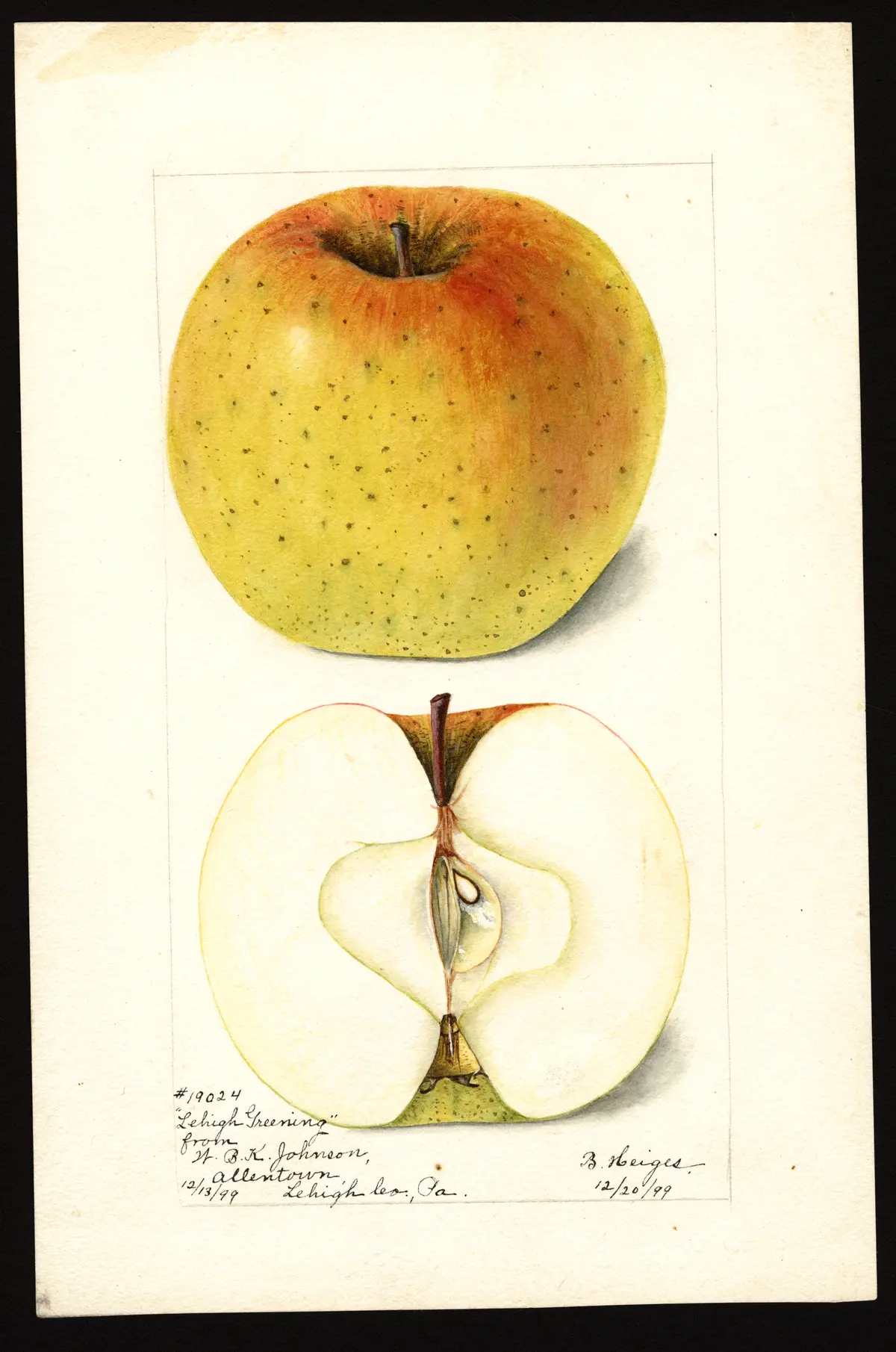
USDA Pomological Watercolor Collection
[A.J. Downing, The Fruits and Fruit Trees of America (1900)] French Pippin.
Of unknown origin. Tree hardy and vigorous; with dark reddish brown shoots.
Fruit rather large, roundish oblate, greenish yellow, with a faint dull cheek, thinly sprinkled with large brown dots, and traces of russet. Flesh yellowish, tender, pleasant, subacid. Good. Core small. October, January.
Quite distinct from Newark or French Pippin, which has slender branches. There are several apples under name of French Pippin, and it is difficult to decide which has priority to the name, except as connected with the oldest description.
[S.A. Beach, The Apples of New York, Vol. 1 (1905)] FRENCH PIPPIN.
The name French Pippin has been applied to several varieties of the Fall Pippin group. These vary in season from autumn till late spring or early summer and are characterized by rather large, roundish or oblong fruit which at first is green but later assumes more or less of a yellowish tone. It is sometimes slightly blushed and has yellowish subacid flesh. An apple of this class is described on a following page as the Lehigh Greening, the name under which it has been disseminated within recent years from Allentown, Pennsylvania. Some believe that the Lehigh Greening is identical with an old variety grown in portions of Southeastern Pennsylvania under the name French Pippin. An apple which is grown in some parts of New York under the name French Pippin is described below. It is a very late keeper being in season from January to May or June. The fruit is large, brightly colored and attractive for a yellow apple. It bears a very close resemblance to Lehigh Greening and possibly is identical with it. Comparisons of the fruit from various localities have been made but as yet we have been unable to decide whether or not these two are identical. We have not determined definitely whether the variety described below is the French Pippin of Southeastern Pennsylvania above mentioned, nor whether it is the variety referred to by Warder¹ and Downing² as the French Pippin of Pennsylvania.
TREE.
Tree medium in size to rather large, moderately vigorous, a biennial or in some cases an annual bearer, a reliable cropper and productive. Form upright, somewhat spreading. Twigs medium in length; erect, moderately stout; bark rather dark.
FRUIT.
Fruit large to very large, pretty uniform in size and shape. Form roundish to roundish oblate, faintly ribbed, pretty regular, sides sometimes slightly unequal. Stem short, moderately thick. Cavity acute to acuminate, moderately deep to deep, narrow to rather wide, thinly russeted, sometimes compressed or lipped. Calyx medium in size, somewhat open; lobes acuminate.
Basin abrupt, shallow to moderately deep, medium in width to rather wide, smooth or gently furrowed and slightly wrinkled.
Skin tough, thin, smooth, bright pale yellow or greenish-yellow with numerous, conspicuous russet or green dots, often with thin brownish blush.
Calyx tube long, funnel-form, sometimes approaching cone-shape, with very wide limb. Stamens median.
Core rather small, slightly abaxile; cells fairly symmetrical, closed or partly open; core lines clasping. Carpels roundish, slightly emarginate. Seeds broad, obtuse.
Flesh nearly as yellow as that of Fall Pippin, firm, rather fine-grained, tender, crisp, juicy, sprightly with an agreeable subacid flavor, good to very good in quality.
Season January to May or June.
¹Warder, 1867: 19. ²Downing, 1857: 144.
[Granville Lowther (ed.), Encyclopedia of Practical Horticulture (1914)] Lehigh (also known as L. Greening). Size: medium. Form: oblate. Color: yellow. Quality: good. Use: both kitchen and market. Season: winter.
[J.L. Budd & N.E. Hansen, American Horticultural Manual, Part II: Systematic Pomology (1914)] Lehigh Greening. — Origin, Pennsylvania.
Fruit very large, roundish; surface moderately smooth with leather-cracking and erupted dots; skin thick, tenacious; color greenish yellow, with bronze blush on exposed side; dots numerous, variable, russet; cavity large, regular, deep, russeted; stem medium; basin large, regular, deep, furrowed and leather-cracked; calyx medium, partially reflexed; eye large, partially open. Core medium, oval, clasping; seeds few, medium, plump, brown; flesh yellow, medium fine, breaking, juicy; flavor sprightly subacid; quality good to very good. Winter. (U. S. Div. of Pomology.)
[U.P. Hedrick, Cyclopedia of Hardy Fruits (1922)] LEHIGH GREENING.
Lehigh Greening is of the Pippin rather than of the Greening type, though the two groups are very similar. Were there not several other better sorts of its kind, the variety would be rated as an excellent green winter-apple. Its origin is not known, but it has been grown in Lehigh County, Pennsylvania, since 1840 at least.
Tree vigorous, wide-spreading, open; branches stout, crooked.
Fruit medium to large, uniform in size and shape, round-oblate to round-conic, sides sometimes unequal; stem medium to long, slender; cavity acute, medium in depth, narrow, sometimes lipped, russeted and often with outspreading russet rays; calyx open; lobes narrow, acuminate, often separated at the base; basin large, abrupt, shallow, wide, gently furrowed; skin dark green becoming waxen yellow, occasionally with a thin blush of bright red; dots numerous, submerged or pale areolar with russet point; calyx-tube long and wide, broadly funnel-shape; stamens median; core small, abaxile; cells symmetrical, wide open; core-lines clasping; carpels pointed-ovate to broadly cordate, tufted; seeds numerous, medium in size, dark brown, elongated, plump, acute; flesh yellow, firm, fine, crisp, tender, juicy, sprightly, mild subacid, aromatic; good or very good; January to May.
Book Sources
Described in 5 period pomological works
- Beach, The Apples of New York Vol. 1 (1905) — listed as French Pippin
- Budd & Hansen, Systematic Pomology (1914)
- Hedrick, Cyclopedia of Hardy Fruits (1922)
- Downing, Fruits and Fruit Trees of America (1900) — listed as French Pippin
- Lowther (ed.), Encyclopedia of Practical Horticulture (1914) — listed as Lehigh (L. Greening)
View original book sources (5)
— A.J. Downing, The Fruits and Fruit Trees of America (1900)French Pippin.
Of unknown origin. Tree hardy and vigorous; with dark reddish brown shoots.
Fruit rather large, roundish oblate, greenish yellow, with a faint dull cheek, thinly sprinkled with large brown dots, and traces of russet. Flesh yellowish, tender, pleasant, subacid. Good. Core small. October, January.
Quite distinct from Newark or French Pippin, which has slender branches. There are several apples under name of French Pippin, and it is difficult to decide which has priority to the name, except as connected with the oldest description.
— S.A. Beach, The Apples of New York, Vol. 1 (1905)FRENCH PIPPIN.
The name French Pippin has been applied to several varieties of the Fall Pippin group. These vary in season from autumn till late spring or early summer and are characterized by rather large, roundish or oblong fruit which at first is green but later assumes more or less of a yellowish tone. It is sometimes slightly blushed and has yellowish subacid flesh. An apple of this class is described on a following page as the Lehigh Greening, the name under which it has been disseminated within recent years from Allentown, Pennsylvania. Some believe that the Lehigh Greening is identical with an old variety grown in portions of Southeastern Pennsylvania under the name French Pippin. An apple which is grown in some parts of New York under the name French Pippin is described below. It is a very late keeper being in season from January to May or June. The fruit is large, brightly colored and attractive for a yellow apple. It bears a very close resemblance to Lehigh Greening and possibly is identical with it. Comparisons of the fruit from various localities have been made but as yet we have been unable to decide whether or not these two are identical. We have not determined definitely whether the variety described below is the French Pippin of Southeastern Pennsylvania above mentioned, nor whether it is the variety referred to by Warder¹ and Downing² as the French Pippin of Pennsylvania.
TREE.
Tree medium in size to rather large, moderately vigorous, a biennial or in some cases an annual bearer, a reliable cropper and productive. Form upright, somewhat spreading. Twigs medium in length; erect, moderately stout; bark rather dark.
FRUIT.
Fruit large to very large, pretty uniform in size and shape. Form roundish to roundish oblate, faintly ribbed, pretty regular, sides sometimes slightly unequal. Stem short, moderately thick. Cavity acute to acuminate, moderately deep to deep, narrow to rather wide, thinly russeted, sometimes compressed or lipped. Calyx medium in size, somewhat open; lobes acuminate.
Basin abrupt, shallow to moderately deep, medium in width to rather wide, smooth or gently furrowed and slightly wrinkled.
Skin tough, thin, smooth, bright pale yellow or greenish-yellow with numerous, conspicuous russet or green dots, often with thin brownish blush.
Calyx tube long, funnel-form, sometimes approaching cone-shape, with very wide limb. Stamens median.
Core rather small, slightly abaxile; cells fairly symmetrical, closed or partly open; core lines clasping. Carpels roundish, slightly emarginate. Seeds broad, obtuse.
Flesh nearly as yellow as that of Fall Pippin, firm, rather fine-grained, tender, crisp, juicy, sprightly with an agreeable subacid flavor, good to very good in quality.
Season January to May or June.
¹Warder, 1867: 19. ²Downing, 1857: 144.
— Granville Lowther (ed.), Encyclopedia of Practical Horticulture (1914)Lehigh (also known as L. Greening). Size: medium. Form: oblate. Color: yellow. Quality: good. Use: both kitchen and market. Season: winter.
— J.L. Budd & N.E. Hansen, American Horticultural Manual, Part II: Systematic Pomology (1914)Lehigh Greening. — Origin, Pennsylvania.
Fruit very large, roundish; surface moderately smooth with leather-cracking and erupted dots; skin thick, tenacious; color greenish yellow, with bronze blush on exposed side; dots numerous, variable, russet; cavity large, regular, deep, russeted; stem medium; basin large, regular, deep, furrowed and leather-cracked; calyx medium, partially reflexed; eye large, partially open. Core medium, oval, clasping; seeds few, medium, plump, brown; flesh yellow, medium fine, breaking, juicy; flavor sprightly subacid; quality good to very good. Winter. (U. S. Div. of Pomology.)
— U.P. Hedrick, Cyclopedia of Hardy Fruits (1922)LEHIGH GREENING.
Lehigh Greening is of the Pippin rather than of the Greening type, though the two groups are very similar. Were there not several other better sorts of its kind, the variety would be rated as an excellent green winter-apple. Its origin is not known, but it has been grown in Lehigh County, Pennsylvania, since 1840 at least.
Tree vigorous, wide-spreading, open; branches stout, crooked.
Fruit medium to large, uniform in size and shape, round-oblate to round-conic, sides sometimes unequal; stem medium to long, slender; cavity acute, medium in depth, narrow, sometimes lipped, russeted and often with outspreading russet rays; calyx open; lobes narrow, acuminate, often separated at the base; basin large, abrupt, shallow, wide, gently furrowed; skin dark green becoming waxen yellow, occasionally with a thin blush of bright red; dots numerous, submerged or pale areolar with russet point; calyx-tube long and wide, broadly funnel-shape; stamens median; core small, abaxile; cells symmetrical, wide open; core-lines clasping; carpels pointed-ovate to broadly cordate, tufted; seeds numerous, medium in size, dark brown, elongated, plump, acute; flesh yellow, firm, fine, crisp, tender, juicy, sprightly, mild subacid, aromatic; good or very good; January to May.