Lehigh Greening
Apple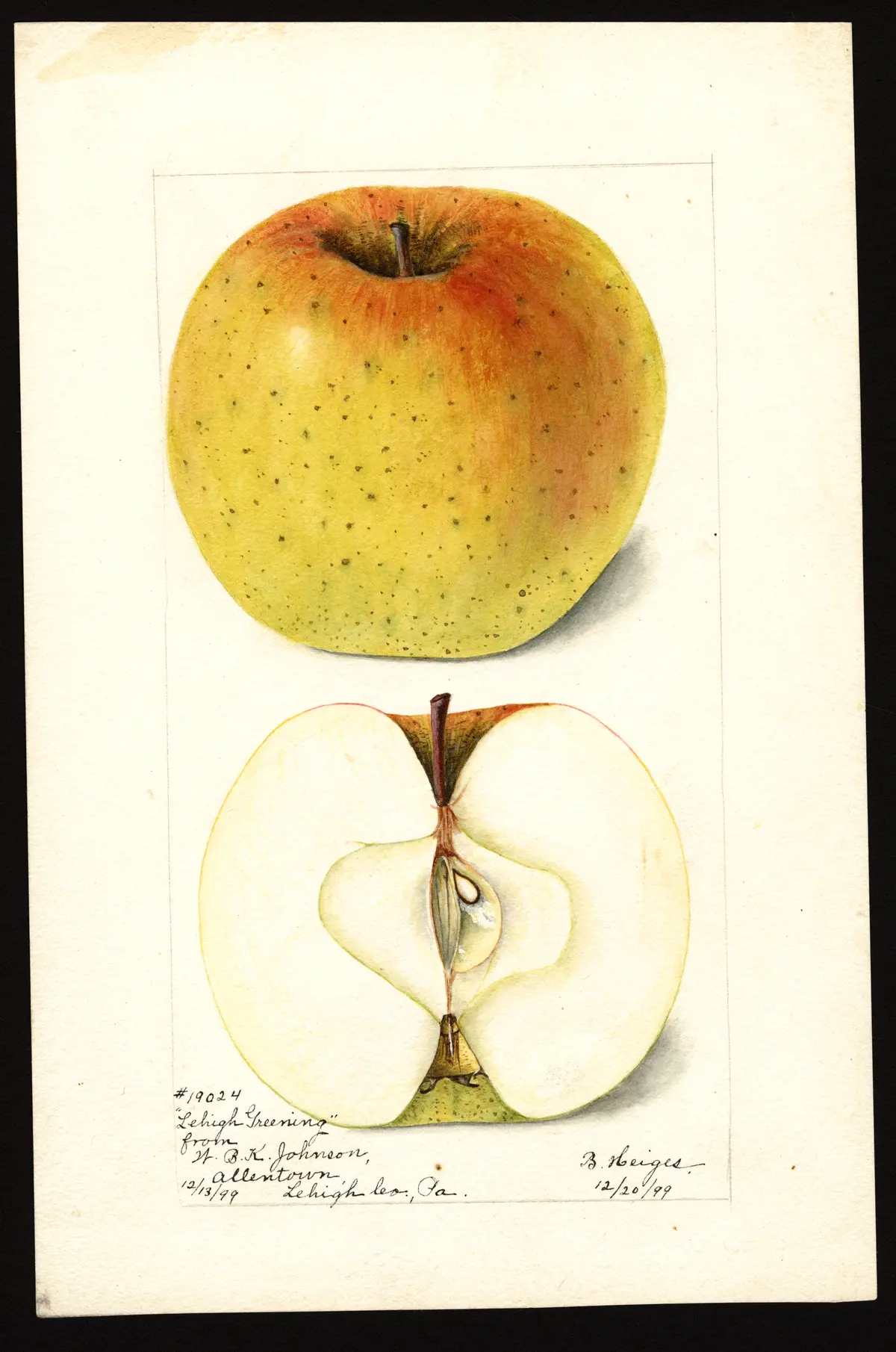
USDA Pomological Watercolor Collection
Lehigh Greening
Origin/History
Lehigh Greening originated in Lehigh County, Pennsylvania. Beach (1905) reports it had been grown in Lehigh County for about sixty years, placing its cultivation there from roughly the mid-1840s; Hedrick (1922) states it has been grown in Lehigh County, Pennsylvania, since 1840 at least. Budd-Hansen (1914) simply gives the origin as Pennsylvania. Hedrick notes that its true origin is not known beyond this county-level association.
Beach classes the variety as belonging to the French Pippin type, noting that it was at one point suspected of being identical with French Pippin but that further comparison led him to believe it is distinct. Hedrick describes it as being of the Pippin rather than of the Greening type, though he adds that the two groups are very similar, and remarks that were there not several other better sorts of its kind, the variety would be rated as an excellent green winter-apple.
Tree
Tree moderately vigorous (Beach) to vigorous (Hedrick), wide-spreading and open in form. Branches rather stout and crooked. Twigs medium to long, irregularly curved, stout to rather slender, with internodes short to above medium. Bark clear dark reddish-brown mingled with olive-green, slightly mottled with scarf-skin, and slightly pubescent. Lenticels scattering, rather conspicuous, medium in size, round or slightly elongated, raised but slightly if at all. Buds set deeply in the bark, above medium to rather small, broad, flat, obtuse, appressed, and quite pubescent.
Fruit
Size
Medium to large (Beach, Hedrick); Budd-Hansen describes the fruit as very large; Lowther gives the size as medium. Pretty uniform in size and shape.
Form
Roundish oblate to roundish conic (Beach, Hedrick); Budd-Hansen gives roundish; Lowther gives oblate. Ribbed but faintly if at all; sides sometimes unequal.
Surface
Budd-Hansen describes the surface as moderately smooth with leather-cracking and erupted dots.
Stem
Medium to long (Beach, Hedrick), moderately slender (Beach) to slender (Hedrick); Budd-Hansen simply gives medium.
Cavity
Acute to acuminate (Beach) or acute (Hedrick), medium in depth to deep (Beach) or medium in depth (Hedrick), narrow to moderately wide (Beach) or narrow (Hedrick), sometimes lipped, more or less russeted and often with outspreading russet rays. Budd-Hansen describes the cavity as large, regular, deep, and russeted.
Calyx
Medium in size, somewhat open (Beach) to open (Hedrick); Budd-Hansen gives calyx medium, partially reflexed, with the eye large and partially open. Lobes medium to long, rather narrow, acuminate, often somewhat separated at the base.
Basin
Usually rather large (Beach) or large (Hedrick, Budd-Hansen), abrupt, moderately deep to rather shallow (Beach) or shallow (Hedrick) or deep (Budd-Hansen), moderately wide (Beach) or wide (Hedrick), regular (Budd-Hansen), gently furrowed. Budd-Hansen adds that the basin is leather-cracked.
Skin
Dark green in the fall but eventually becoming waxen yellow, occasionally with a thin blush of bright red (Beach, Hedrick). Budd-Hansen gives the color as greenish yellow with a bronze blush on the exposed side, and describes the skin itself as thick and tenacious. Lowther simply gives yellow.
Dots
Numerous, submerged or pale areolar with russet point (Beach, Hedrick). Budd-Hansen describes the dots as numerous, variable, and russet.
Flesh and flavor
Flesh yellowish-white (Beach) to yellow (Hedrick, Budd-Hansen), firm, moderately fine or a little coarse (Beach) or fine (Hedrick) or medium fine (Budd-Hansen), rather crisp (Beach) or crisp (Hedrick), tender, juicy. Budd-Hansen adds "breaking" to the flesh texture. Sprightly, mild subacid (Beach, Hedrick) or sprightly subacid (Budd-Hansen), aromatic (Beach, Hedrick). Quality good or sometimes very good (Beach), good or very good (Hedrick), good to very good (Budd-Hansen); Lowther gives quality as good.
Core and seeds
Calyx tube rather long and wide (Beach) or long and wide (Hedrick), broadly funnel-shape. Stamens median to basal (Beach) or median (Hedrick). Core medium to small (Beach) or small (Hedrick) or medium (Budd-Hansen), usually abaxile (Beach, Hedrick); Budd-Hansen describes the core as oval and clasping. Cells symmetrical, wide open. Core lines slightly clasping (Beach) or clasping (Hedrick). Carpels pointed ovate to broadly cordate, tufted. Seeds numerous (Beach, Hedrick), medium in size, rather dark brown (Beach) or dark brown (Hedrick), somewhat elongated (Beach) or elongated (Hedrick), plump, acute to acuminate (Beach) or acute (Hedrick). Budd-Hansen, in contrast, describes the seeds as few, medium, plump, and brown.
Season
January to May (Beach, Hedrick). Winter (Budd-Hansen, Lowther). Beach notes it is an excellent keeper.
Uses
Desirable rather for market and culinary uses than for dessert (Beach). Lowther gives the use as both kitchen and market.
Subtypes/Variants
Not described in source.
Other
Beach describes Lehigh Greening as an attractive apple of the French Pippin type, of good size and an excellent keeper.
Book Sources
Described in 4 period pomological works
View original book sources (4)
— S.A. Beach, The Apples of New York, Vol. 1 (1905)LEHIGH GREENING.
REFERENCES. 1. Van Deman, U. S. Pom. Rpt., 1891:390. 2. Butz, Penn. Sta. An. Rpt., 1892:107. fig. 3. Van Deman, Am. Pom. Soc. Rpt., 1895:72. 4. Am. Pom. Soc. Cat., 1899:18. 5. Johnson, Rural N. Y., 62:19, 370. 1903. figs. 6. Budd-Hansen, 1903:115.
An attractive apple of the French Pippin type, of good size and an excellent keeper. It was mentioned on page 134 as possibly identical with French Pippin. Further comparison leads us to believe that it is distinct. It is desirable rather for market and culinary uses than for dessert.
Historical. It has been grown in Lehigh county, Pennsylvania, for about sixty years (5).
TREE.
Tree moderately vigorous; branches rather stout and crooked. Form wide-spreading, open. Twigs medium to long, irregularly curved, stout to rather slender; internodes short to above medium. Bark clear dark reddish-brown mingled with olive-green, slightly mottled with scarf-skin, slightly pubescent. Lenticels scattering, rather conspicuous, medium in size, round or slightly elongated, raised but slightly if at all. Buds set deeply in the bark, above medium to rather small, broad, flat, obtuse, appressed, quite pubescent.
FRUIT.
Fruit medium to large, pretty uniform in size and shape. Form roundish oblate to roundish conic, ribbed but faintly if at all; sides sometimes unequal. Stem medium to long, moderately slender. Cavity acute to acuminate, medium in depth to deep, narrow to moderately wide, sometimes lipped, more or less russeted and often with outspreading russet rays. Calyx medium in size, somewhat open; lobes medium to long, rather narrow, acuminate, often somewhat separated at the base. Basin usually rather large, abrupt, moderately deep to rather shallow, moderately wide, gently furrowed. Skin dark green in the fall but eventually becoming waxen yellow, occasionally with a thin blush of bright red. Dots numerous, submerged or pale areolar with russet point. Calyx tube rather long and wide, broadly funnel-shape. Stamens median to basal. Core medium to small, usually abaxile; cells symmetrical, wide open; core lines slightly clasping. Carpels pointed ovate to broadly cordate, tufted. Seeds numerous, medium in size, rather dark brown, somewhat elongated, plump, acute to acuminate. Flesh yellowish-white, firm, moderately fine or a little coarse, rather crisp, tender, juicy, sprightly, mild subacid, aromatic, good or sometimes very good.
Season January to May.
— J.L. Budd & N.E. Hansen, American Horticultural Manual, Part II: Systematic Pomology (1914)Lehigh Greening. — Origin, Pennsylvania.
Fruit very large, roundish; surface moderately smooth with leather-cracking and erupted dots; skin thick, tenacious; color greenish yellow, with bronze blush on exposed side; dots numerous, variable, russet; cavity large, regular, deep, russeted; stem medium; basin large, regular, deep, furrowed and leather-cracked; calyx medium, partially reflexed; eye large, partially open. Core medium, oval, clasping; seeds few, medium, plump, brown; flesh yellow, medium fine, breaking, juicy; flavor sprightly subacid; quality good to very good. Winter. (U. S. Div. of Pomology.)
— Granville Lowther (ed.), Encyclopedia of Practical Horticulture (1914)Lehigh (also known as L. Greening). Size: medium. Form: oblate. Color: yellow. Quality: good. Use: both kitchen and market. Season: winter.
— U.P. Hedrick, Cyclopedia of Hardy Fruits (1922)LEHIGH GREENING.
Lehigh Greening is of the Pippin rather than of the Greening type, though the two groups are very similar. Were there not several other better sorts of its kind, the variety would be rated as an excellent green winter-apple. Its origin is not known, but it has been grown in Lehigh County, Pennsylvania, since 1840 at least.
Tree vigorous, wide-spreading, open; branches stout, crooked.
Fruit medium to large, uniform in size and shape, round-oblate to round-conic, sides sometimes unequal; stem medium to long, slender; cavity acute, medium in depth, narrow, sometimes lipped, russeted and often with outspreading russet rays; calyx open; lobes narrow, acuminate, often separated at the base; basin large, abrupt, shallow, wide, gently furrowed; skin dark green becoming waxen yellow, occasionally with a thin blush of bright red; dots numerous, submerged or pale areolar with russet point; calyx-tube long and wide, broadly funnel-shape; stamens median; core small, abaxile; cells symmetrical, wide open; core-lines clasping; carpels pointed-ovate to broadly cordate, tufted; seeds numerous, medium in size, dark brown, elongated, plump, acute; flesh yellow, firm, fine, crisp, tender, juicy, sprightly, mild subacid, aromatic; good or very good; January to May.