Lilly Of Kent
Apple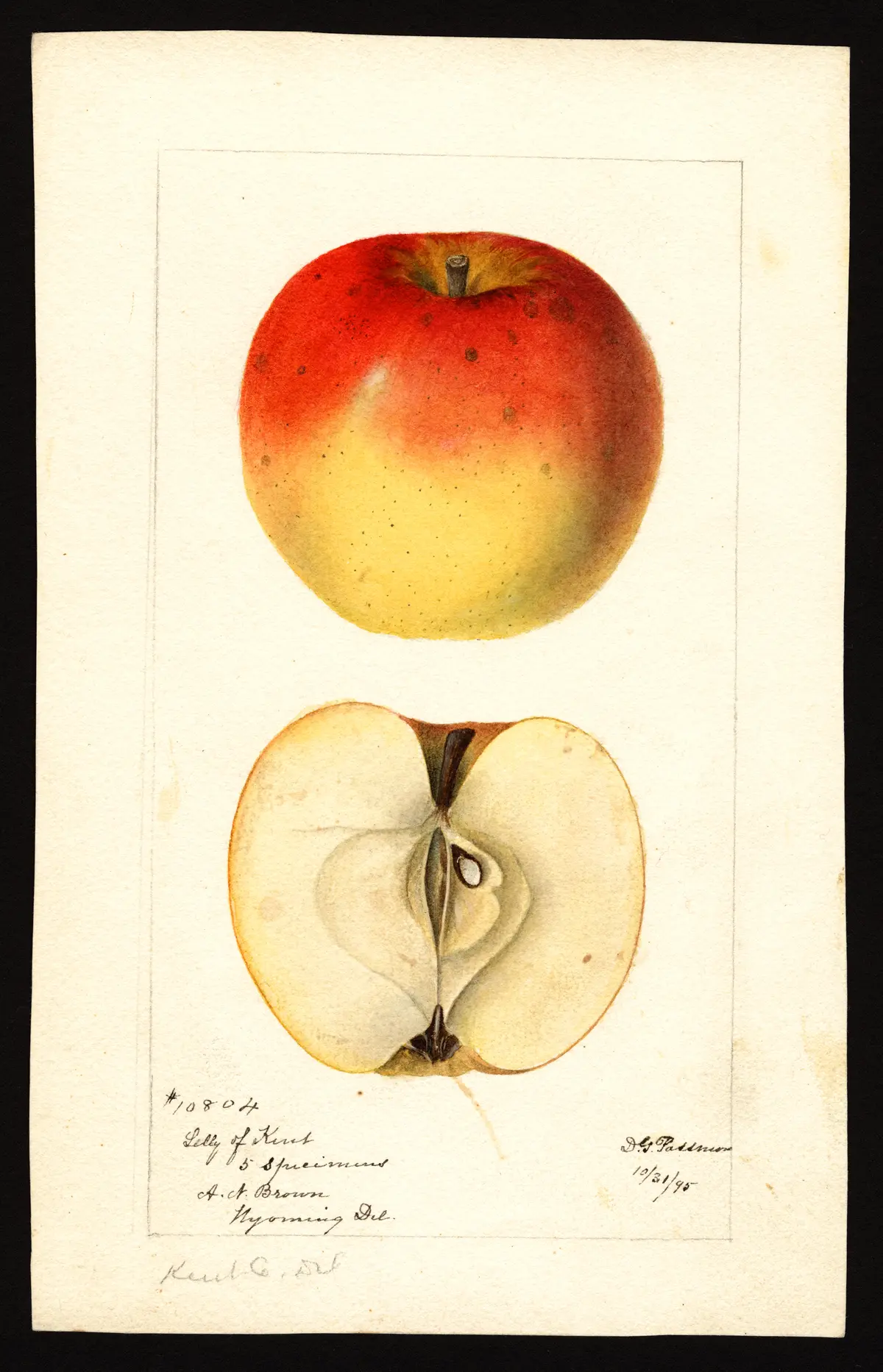
USDA Pomological Watercolor Collection
Lilly Of Kent
Origin/History
Lilly Of Kent originated in Delaware. It was a variety of recent introduction as of 1891, when it was first noted by Van Deman in the U.S. Pomological Report. By 1898, Powell reported that it was being planted to considerable extent in some portions of Delaware. It was listed in the American Pomological Society Catalog in 1899. As of 1905, Beach noted it had not yet been sufficiently tested in New York to determine whether it was desirable for that region. The detailed fruit description in Budd-Hansen (1914) is attributed to the U.S. Division of Pomology.
Tree
Not described in source.
Fruit
Size
Large. Consistent across all sources.
Form
Globular (Beach; Budd-Hansen); more specifically described by Budd-Hansen as globular truncate. The surface is smooth.
Stem
Short and stout (Budd-Hansen).
Cavity
Regular, medium depth, deep (Budd-Hansen).
Calyx
Long, stout, and straight. Eye large and open (Budd-Hansen).
Basin
Irregular, medium, slightly furrowed and folded (Budd-Hansen).
Skin
Color green (Lowther; Budd-Hansen); Beach describes it as green or yellowish-green. Budd-Hansen gives the most detailed color description: green with shades of yellow and bronze. Dots are few, light in appearance, and brown (Budd-Hansen).
Flesh and Flavor
Flesh greenish yellow, fine-grained, and juicy. Flavor mild subacid. Quality rated very good (Budd-Hansen; Lowther). Beach independently describes the flavor as subacid and quality as good.
Core and Seeds
Core large, roundish, and clasping. Seeds few, large, plump, and light brown (Budd-Hansen).
Season
Late winter (Budd-Hansen). Beach characterizes Lilly Of Kent as a very late keeper.
Uses
Suited for both kitchen and market use (Lowther).
Subtypes/Variants
Not described in source.
Other
Not described in source.
Book Sources
Described in 3 period pomological works
Nursery Catalog Sources
Found in 2 catalogs (1901–1913) from Illinois
- Benjamin Buckman (personal inventory) , Farmingdale , Illinois — 1901 — listed as Lily of Kent
- Benjamin Buckman (personal inventory) , Farmingdale , Illinois — 1913 — listed as Lily of Kent
View original book sources (3)
— S.A. Beach, The Apples of New York, Vol. 1 (1905)LILLY OF KENT.
REFERENCES. 1. Van Deman, U. S. Pom. Rpt., 1891:390. 2. Wright, Am. Gard., 17:34. 1896. 3. Powell, Del. Sta. Bul., 38:19. 1898. 4. Am. Pom. Soc. Cat., 1899:18. 5. Ragan, U. S. Pom. Bul., 8:18. 1899. 6. Budd-Hansen, 1903:115.
SYNONYM. LILY OF KENT (2, 3).
Fruit large, globular, green or yellowish-green, subacid, good in quality and a very late keeper. This is a variety of recent introduction (1). It has not yet been sufficiently tested in New York to determine whether or not it is a desirable variety for this region. It originated in Delaware and is being planted to considerable extent in some portions of that state (3).
— Granville Lowther (ed.), Encyclopedia of Practical Horticulture (1914)Lilly (L. of Kent). Size: large. Form: re. Color: green. Quality: very good. Use: both kitchen and market.
— J.L. Budd & N.E. Hansen, American Horticultural Manual, Part II: Systematic Pomology (1914)Lilly of Kent. — Origin, Delaware.
Fruit large, globular truncate, surface smooth; color green, with shades of yellow and bronze; dots few, light and brown; cavity regular, medium, deep; stem short, stout; basin irregular, medium, slightly furrowed and folded; calyx long, stout, straight; eye large, open. Core large, roundish, clasping; seeds few, large, plump, light brown; flesh greenish yellow, fine-grained, juicy; flavor mild subacid; quality very good. Late winter. (U. S. Div. of Pomology.)