Lincoln Coreless
Pear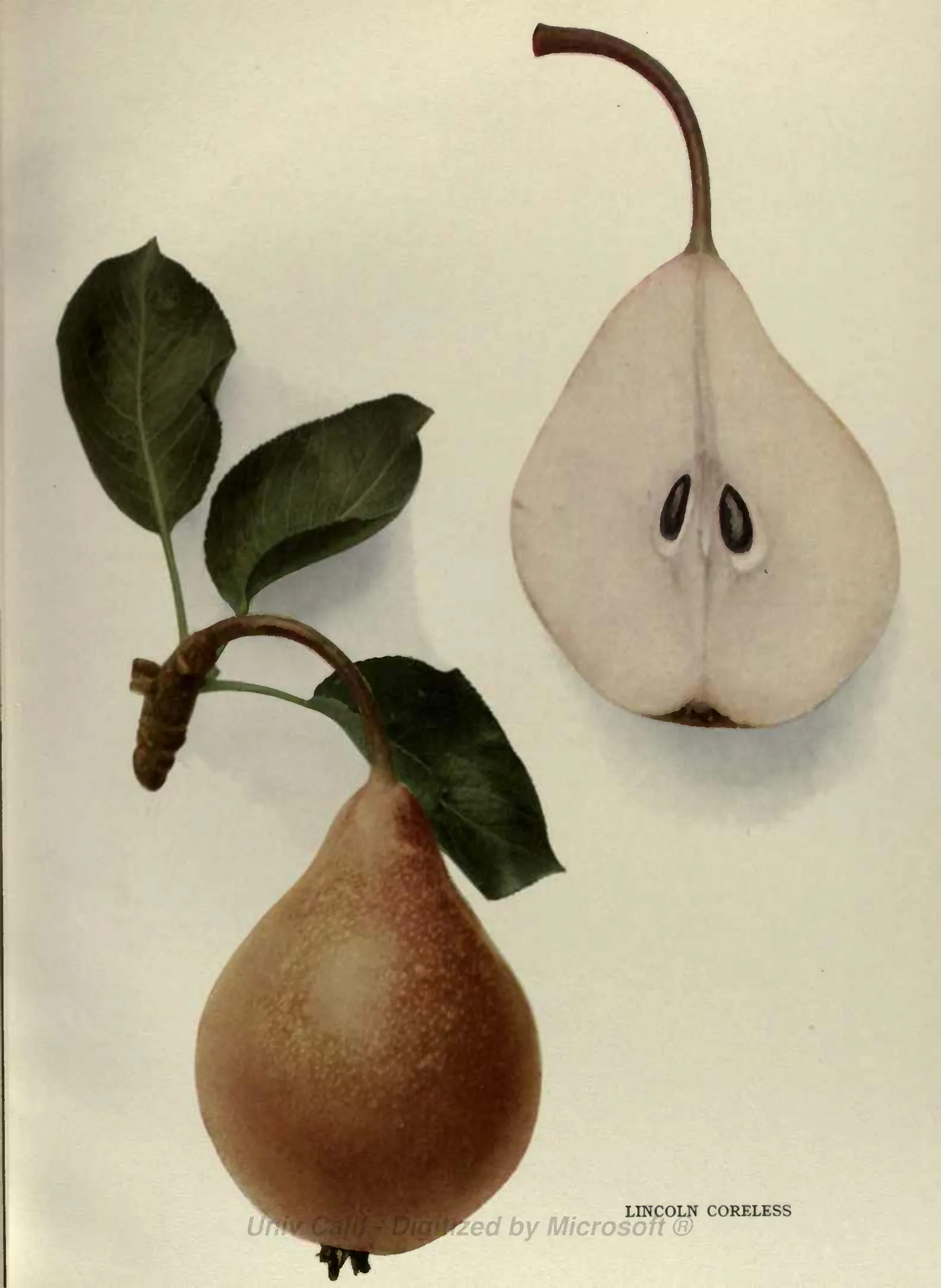
Lincoln Coreless
Origin/History
Lincoln Coreless originated in Lincoln County, Tennessee, near the Alabama line, about 1830. The original tree was rated as productive and free from blight, and young trees propagated from it have been unusually healthy and vigorous. The variety was introduced about 1890 by William Parry of Parry, New Jersey.
The variety receives attention only because the pear is a monstrosity and a curiosity. The fruits are enormous in size, outweighing all other pears unless it be those of the Pound. They are unique in having a very small core and few or sometimes no seeds. They are further characterized by very late maturity, ripening later than those of any other pear on the grounds of the New York State Experiment Station and keeping until April. The catalogs describe the trees as "blight proof," but they blight on the Station grounds. The variety is worth growing only as an interesting curiosity.
(References: Parry Cat. 9, fig. 1891; Ann. Hort. 185. 1892; Ill. Hort. Soc. Rpt. 137. 1894; Ibid. 52, 178. 1896; Rural N. Y. 64:256. 1905.)
Tree
Size and habit: Hedrick (1921) describes the tree as small, vigorous, upright, very dense, and pyramidal; Hedrick (1922) gives the size as medium to small. Both agree it is hardy and an uncertain bearer.
Trunk: Shaggy.
Branches: Smooth, zigzag, reddish-brown mingled with ash-gray (1921), marked with small lenticels.
Branchlets: Short to medium, dull brown, smooth, glabrous, with conspicuous lenticels.
Leaf-buds: Large, obtuse, plump, appressed.
Leaves: 3 in. long, 1¾ in. wide, elongated-oval, leathery; apex taper-pointed; margin finely serrate. Petiole reddish; Hedrick (1921) gives petiole length as 1½ in., while Hedrick (1922) gives 1¾ in. Stipules very long.
Flower-buds: Short, obtuse, plump, free.
Flowers: Very large and showy; Hedrick (1921) gives diameter as 1½ in. across, while Hedrick (1922) gives 1¾ in. across. Average 6 buds in a cluster.
Pedicels: 1⅜ in. long, thick, pubescent, pale green.
Fruit
Size: Very large, uniform in size. Hedrick (1921) gives dimensions as 4½ in. long and 3 in. wide; Hedrick (1922) gives 5¼ in. long and 4½ in. wide. Thomas (1903) describes the fruit simply as large.
Form: Obovate-acute-pyriform, somewhat ribbed, with unequal sides.
Stem: 1¾ in. long, thick, curved.
Cavity: Obtuse, shallow, narrow, russeted, furrowed, often lipped.
Calyx: Open, large; lobes separated at the base, narrow, acute.
Basin: Very shallow, narrow, obtuse, furrowed.
Skin: Very thick, tough, coarse and granular, smooth, dull. Color greenish-yellow; Thomas (1903) describes the color simply as yellow. The cheek exposed to the sun is enlivened by a blush: Hedrick (1921) describes this as a "bright blush" and "handsome blush" that makes the fruits rather attractive despite their grossness; Hedrick (1922) specifies this as a "handsome pinkish-red blush."
Dots: Many, brownish-russet, very conspicuous.
Flesh: Yellowish-white, very firm, granular at the core, crisp, tough, medium juicy, rather bitter and astringent.
Core: Closed, with clasping core-lines. Very small; seeds few and often abortive, or sometimes absent entirely.
Calyx-tube: Long, wide, conical.
Seeds: Few, narrow, often abortive, acute.
Quality: Poor.
Season
Fruit ripe in February (Hedrick); Thomas (1903) characterizes the season as late winter. Fruits keep until April.
Uses
Worthless for dessert; a coarse makeshift for culinary purposes. Grown chiefly as a curiosity on account of its enormous size, nearly coreless character, and exceptionally late keeping season.
Subtypes/Variants
Not described in source.
Other
Not described in source.
Book Sources
Described in 3 period pomological works
Nursery Catalog Sources
Found in 17 catalogs (1890–1936) from Maryland, Massachusetts, New Jersey, New York, Oregon, Pennsylvania, Washington
- William H. Moon Co. , Morrisville, Bucks County , Pennsylvania — 1890
- Rogers Nursery Co. , Moorestown , New Jersey — 1893
- Green's Nursery Co. (Charles A. Green) , Rochester , New York — 1894
- The Lovett Company , Little Silver , New Jersey — 1896
- Reading Nursery , Jacob W. Manning, Proprietor, Reading , Massachusetts — 1898
- Brown Brothers Co. , Continental Nurseries, Rochester, NY (also operated from Toronto, Canada) — 1899
- Central Experimental Farm , Dominion Department of Agriculture, Agassiz, British Columbia (under test; Bulletin No. 3, Second Series) — 1900
- Washington Nursery Co. , Toppenish , Washington — 1901
- Brown Brothers Co. , Continental Nurseries, Rochester, NY (also operated from Toronto, Canada) — 1901
- The Dalles Nurseries , The Dalles , Oregon — 1906
- Russellville Nursery Co. , Montavilla Station, Portland, OR (three miles east of Portland, one mile from Montavilla car line) — 1907
- Carlton Nursery Co. , Carlton , Oregon — 1909
- Wm. J. Corse (successor to Robert Sinclair / Sinclair Nurseries) , Baltimore , Maryland — 1909
- Washington Nursery Company , Toppenish , Washington — 1909
- Pacific Nursery Company , Portland , Oregon — 1912
- Washington Nursery Company , Toppenish , Washington — 1912
- Hudson's Wholesale Nurseries , Tangent , Oregon — 1936
View original book sources (3)
— U.P. Hedrick, The Pears of New York (1921)LINCOLN CORELESS
- Parry Cat. 9, fig. 1891. 2. Ann. Hort. 185. 1892. 3. Ill. Hort. Soc. Rpt. 137. 1894. 4. Ibid. 52, 178. 1896. 5. Rural N. Y. 64:256. 1905.
The product of Lincoln Coreless is worthless for dessert, and but a coarse makeshift for culinary purposes. The variety receives attention only because the pear is a monstrosity and a curiosity. The fruits are enormous in size, outweighing all other pears unless it be those of the Pound. They are unique in having a very small core and few or sometimes no seeds. They are further characterized by very late maturity, ripening later than those of any other pear on the grounds of this Station and keeping until April. While usually rather dull greenish-yellow in color, the cheek is often enlivened by a bright blush which makes the fruits rather attractive despite their grossness. The catalogs describe the trees as "blight proof," but they blight on the grounds of this Station. The variety is worth growing only as an interesting curiosity.
According to William Parry, Parry, New Jersey, Lincoln Coreless originated in Lincoln County, Tennessee, near the Alabama line, about 1830. The original tree was rated as productive and free from blight, and young trees propagated from it have been unusually healthy and vigorous. The variety was introduced about 1890 by William Parry.
Tree small, vigorous, upright, very dense, pyramidal, hardy, an uncertain bearer; trunk shaggy; branches smooth, zigzag, reddish-brown mingled with ash-gray, marked with small lenticels; branchlets short to medium, dull brown, smooth, glabrous, with conspicuous lenticels.
Leaf-buds large, obtuse, plump, appressed. Leaves 3 in. long, 1¾ in. wide, elongated-oval, leathery; apex taper-pointed; margin finely serrate; petiole 1½ in. long, reddish; stipules very long. Flower-buds short, obtuse, plump, free; flowers 1½ in. across, very large and showy, average 6 buds in a cluster; pedicels 1⅜ in. long, thick, pubescent, pale green.
Fruit ripe in February; very large, 4½ in. long, 3 in. wide, uniform in size, obovate-acute-pyriform, somewhat ribbed, with unequal sides; stem 1¾ in. long, thick, curved; cavity obtuse, shallow, narrow, russeted, furrowed, often lipped; calyx open, large; lobes separated at the base, narrow, acute; basin very shallow, narrow, obtuse, furrowed; skin very thick, tough, coarse and granular, smooth, dull; color greenish-yellow, with a handsome blush on the cheek exposed to the sun; dots many, brownish-russet, very conspicuous; flesh yellowish-white, very firm, granular at the core, crisp, tough, medium juicy, rather bitter and astringent; quality poor. Core closed, with clasping core-lines; calyx-tube long, wide, conical; seeds few, narrow, often abortive, acute.
— John J. Thomas, The American Fruit Culturist (1903)Lincoln Coreless. Large, pyriform, yellow. Late winter.
— U.P. Hedrick, Cyclopedia of Hardy Fruits (1922)LINCOLN CORELESS. The product of Lincoln Coreless is worthless for dessert, and but a coarse makeshift for culinary purposes. The variety receives attention only because the pear is a monstrosity and a curiosity. The fruits are enormous in size, outweighing all other pears unless it be those of the Pound. They are unique in having a very small core and few or sometimes no seeds. They are further characterized by very late maturity, ripening later than any other pear and keeping until April. While usually rather dull greenish-yellow in color, the cheek is often enlivened by a bright blush which makes the fruits attractive despite their grossness. The catalogs describe the trees as "blight proof," but they blight. Lincoln Coreless originated in Lincoln County, Tennessee, about 1830.
Tree medium to small, vigorous, upright, very dense, pyramidal, hardy, an uncertain bearer; trunk shaggy; branches smooth, zigzag, reddish-brown, marked with small lenticels. Leaves 3 inches long, 1¾ inches wide, elongated-oval, leathery; apex taper-pointed; margin finely serrate; petiole 1¾ inches long, reddish; stipules very long. Flowers 1¾ inches across, very large and showy, average six buds in a cluster. Fruit ripe in February; very large, 5¼ inches long, 4½ inches wide, uniform in size, obovate-acute-pyriform, somewhat ribbed, with unequal sides; stem 1¾ inches long, thick, curved; cavity obtuse, shallow, narrow, russeted, furrowed, often lipped; calyx open, large; lobes separated at the base, narrow, acute; basin very shallow, narrow, obtuse, furrowed; skin very thick, tough, coarse and granular, smooth, dull; color greenish-yellow, with a handsome pinkish-red blush on the cheek exposed to the sun; dots many, brownish-russet, very conspicuous; flesh yellowish-white, very firm, granular at the core, crisp, tough, medium juicy, rather bitter and astringent; quality poor; core closed, with clasping core-lines; calyx-tube long, wide, conical; seeds few, narrow, often abortive, acute.