London Pippin
Apple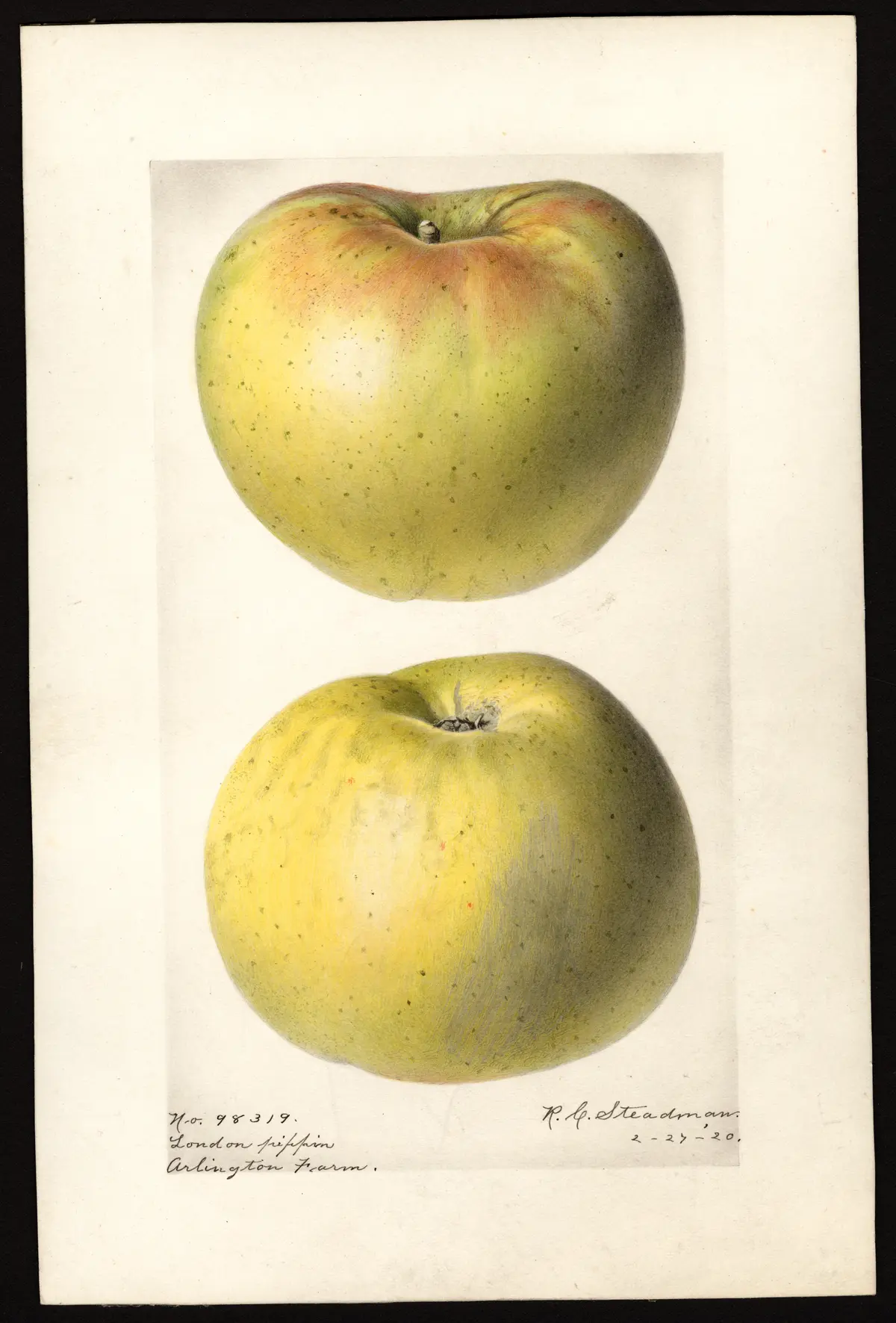
USDA Pomological Watercolor Collection
London Pippin
Origin / History
A very old English apple (Downing). Bunyard places its origin probably in the sixteenth century, and notes it as a valuable late fruit, little cultivated in England by 1920 but much grown in Australia and exported back to England. Thomas reports it was much cultivated in Northern Virginia, where its large size and handsome appearance caused it to sell well in the Washington market. French name Pepin de Londres; German London Peppin (Bunyard).
Tree
A moderate grower, productive (Downing). Productive (Thomas). Growth vigorous; fertile (Bunyard). Hansen reports that specimens from the Iowa Experiment Station orchard at Ames, Iowa, were not promising as to hardiness. Leaf oval, upfolded, undulating, held out, finely serrate (Bunyard).
Fruit
Size: Large (Downing, Hansen); large or very large (Thomas); medium, 3 by 2¾ inches (Bunyard).
Form: Roundish, slightly conical, flattened at base (Downing). Roundish, truncated, slightly conical, obscurely ribbed (Hansen). Roundish, slightly flattened, obtuse-conical (Thomas). Round conical, irregular (Bunyard).
Stem: Medium (Hansen). Very short (Thomas). Slender, rather short (Bunyard).
Cavity: Deep, wide, regular, russeted (Hansen). Deep, narrow (Bunyard). (Downing and Thomas do not describe.)
Calyx / Eye: Small, closed (Downing). Closed (Hansen). Large (Thomas). Closed (Bunyard).
Basin: Shallow, small, ribbed (Hansen). Smooth and even (Thomas). Shallow, with five prominent ribs (Bunyard).
Skin / Color: Yellow, with a tinge of red in the sun (Downing). Surface yellow; dots large, suffused, white, few (Hansen). Greenish yellow (Thomas). Yellowish-green with a dull brown-red flush (Bunyard).
Flesh / Flavor: White, rather firm, subacid; good (Downing). White, juicy, fine grained, subacid; good (Hansen). Subacid, of a good second-rate flavor (Thomas). Crisp, white, acid (Bunyard).
Core / Seeds: Core small, barely clasping (Hansen). Not described in the other sources.
Season
November to February (Downing). Early winter (Hansen, Thomas). Culinary, till March (Bunyard). Keeps without shrivelling (Bunyard).
Uses
Mostly valued for cooking or drying (Downing). Culinary (Bunyard). Sold well in the Washington market on account of its large size and handsome appearance (Thomas).
Subtypes / Variants
Not described in source.
Other
Bunyard cites Ronalds, p. 14, and notes "Royal Somerset" as an erroneous association.
Book Sources
Described in 4 period pomological works
Nursery Catalog Sources
Found in 3 catalogs (1900–1913) from Illinois
- Central Experimental Farm , Dominion Department of Agriculture, Agassiz, British Columbia (under test; Bulletin No. 3, Second Series) — 1900
- Benjamin Buckman (personal inventory) , Farmingdale , Illinois — 1901
- Benjamin Buckman (personal inventory) , Farmingdale , Illinois — 1913
View original book sources (4)
— A.J. Downing, The Fruits and Fruit Trees of America (1900)London Pippin. Five-Crowned Pippin. New London Pippin. Royal Somerset A very old English Apple, mostly valued for cooking or drying. Tree a moderate grower, productive. Fruit large, roundish, slightly conical, flattened at base, yellow, with a tinge of red in the sun. Calyx small, closed. Flesh white, rather firm, subacid. Good. November to February.
— N.E. Hansen, A Study of Northwestern Apples (1902)London Pippin—Specimens from Iowa Experiment Station orchard, Ames, Iowa; tree not promising as to hardiness—Fruit large, roundish, truncated, slightly conical, obscurely ribbed; surface yellow; dots large, suffused, white, few; cavity deep, wide, regular, russeted; stem medium; basin shallow, small, ribbed; calyx closed. Core small, barely clasping; flesh white, juicy, fine grained, subacid, good. Early winter.
— John J. Thomas, The American Fruit Culturist (1903)London Pippin. Large or very large, roundish, slightly flattened, obtuse-conical; greenish yellow; stalk very short; calyx large, in a smooth even basin; flesh sub-acid, of a good second-rate flavor. Early winter. Much cultivated in Northern Virginia; and from its large size and handsome appearance sells well in the Washington market. Productive.
— E.A. Bunyard, A Handbook of Hardy Fruits (1920)LONDON PIPPIN. Ronalds, p. 14. F., Pepin de Londres ; G., London Peppin. [Citron d'Hiver, Five Crown Pippin, Royal Somerset (error).] Culinary, till March, medium, 3 by 2¾, round conical, irregular. Colour, yellowish-green with dull brown-red flush. Flesh, crisp, white, acid. Eye, closed, in a shallow basin which has five prominent ribs. Stem, slender, rather short in a deep narrow cavity. Growth, vigorous ; fertile. Keeps without shrivelling. Leaf, oval, upfolded, undulating, held out, finely serrate. Origin, dates probably from the sixteenth century. A valuable late fruit little cultivated but much grown in Australia and exported to this country.