Longfield
Apple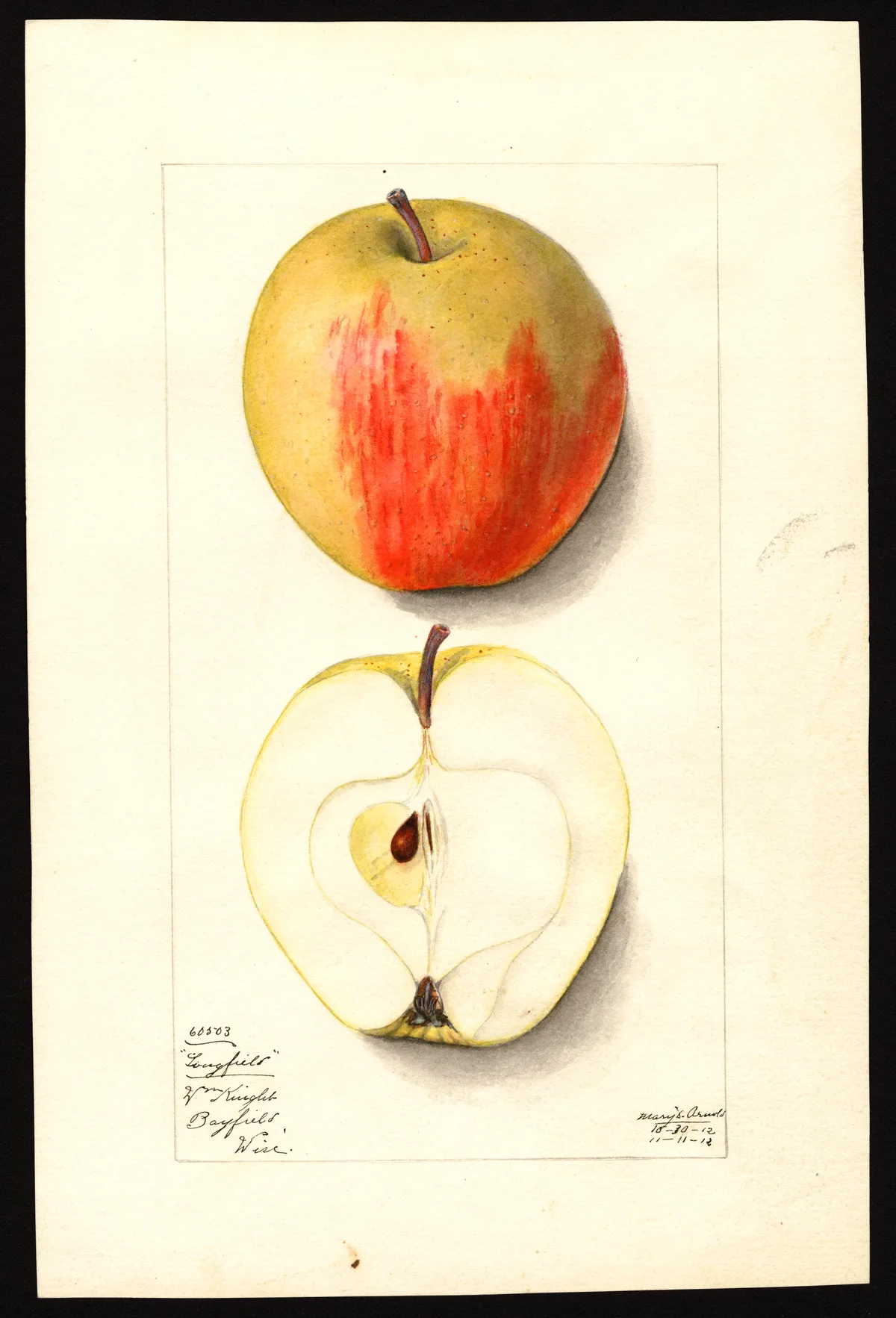
USDA Pomological Watercolor Collection
Longfield
Origin / History
Longfield originated in Russia. It was first imported from Russia by the United States Department of Agriculture in 1870; later it was imported from various European sources for the Iowa Agricultural College by Professor Budd-Hansen and others. By the early 1900s it was frequently listed by nurserymen and being planted to a limited extent in various parts of New York State and most of the Northern States, though it had not yet come to be commonly known among New York fruit growers. Hedrick (1922) considered it the best dessert fruit of a hundred or more sorts imported from Russia, though noting it falls below the average of the apples of its nativity in several other characters. By 1922 it was widely grown in the United States and Canada. The Central Experimental Farm at Agassiz, BC planted it in the spring of 1890.
Historical group context (Hansen, 1902): Longfield Group — Longfield, 161; 57 M.; English Pippin, 587; Good Peasant (spurious); 387 (spurious). J. Sexton reported: "No. 31 M is the true Good Peasant as received by Professor Budd direct from Moscow, but some Anisim scions were mixed with it, and the No. 387 spurious was simply mistaken for No. 587. We find 31 M hardier than Longfield and a good bearer." A. G. Tuttle reported: "I have 300 Longfield in orchard, and think it hardier than Duchess and that it will bear more abuse than any tree I know of, not excepting Hibernal. Longfield is a great annual bearer, a good table apple, and the leaf never scabs."
Tree
Tree of moderate, spreading, pendulous growth (Hansen 1902, Budd-Hansen 1914); a strong, spreading, drooping grower with grayish woolly leaves and shoots (Hansen 1902, Longfield Group description). Medium in size, very hardy and very productive; an early and very heavy annual bearer — in fact it bears such heavy crops that the fruit is liable to be deficient in size, requiring much care in thinning so the fruit will not be deficient in size (Beach 1905, Lowther 1914). A. G. Tuttle considered it hardier than Duchess and able to bear more abuse than any tree he knew, not excepting Hibernal. Hedrick (1922) notes the trees are extremely hardy and, though small in size, exceedingly productive. The Central Experimental Farm (1900) reported it as a weak grower at Agassiz, BC, but an early and constant bearer of fruit. Stark Bros. (1910) describe it as moderately hardy in one passage and very hardy in another, productive from the ground up, and a good bearer.
Form roundish or spreading, dense, rather low, with short, moderately stout (Beach) to short, stout (Hedrick), crooked branches and drooping laterals filled with small spurs. Twigs medium in length, curved, moderately stout (Beach) — Lowther gives "medium to stout"; terminal buds large; internodes short. Bark dark brown, lightly streaked with scarfskin; pubescent. Lenticels scattering, medium size, oval, not raised. Buds medium size, broad, plump, obtuse, free, slightly pubescent. Leaf never scabs (per A. G. Tuttle).
Fruit
Size
Medium (Hansen 1902, Thomas 1903, Budd-Hansen 1914, Central Experimental Farm 1900, Stark Bros. 1910); usually below medium (Beach 1905, Lowther 1914, Hedrick 1922). Hansen's Longfield Group description gives size "4 to 5." Uniform in size and shape.
Form
Roundish conical (Hansen 1902, Budd-Hansen 1914), round-conic (Thomas 1903, Beach 1905, Hedrick 1922), conical (Central Experimental Farm 1900); regular (Thomas); unequal, often obscurely angular (Hansen 1902, Budd-Hansen 1914); slightly ribbed (Beach 1905) to ribbed (Hedrick 1922).
Stem
Short (Hansen 1902, Budd-Hansen 1914, Hedrick 1922); large, slender (Thomas 1903); medium to short, rather slender (Beach 1905); long (Hansen's Longfield Group description).
Cavity
Regular, deep, narrow, acuminate, with stellate russet (Hansen 1902, Budd-Hansen 1914); narrow (Thomas 1903); deep, smooth (Hansen Longfield Group); acuminate to acute, medium to rather deep, narrow, quite symmetrical, usually slightly russeted (Beach 1905); acuminate, deep, narrow, symmetrical, usually russeted (Hedrick 1922).
Calyx
Half open, segments large, divergent (Hansen 1902, Budd-Hansen 1914, Hansen Longfield Group); small, leafy, closed or partly open; lobes long, rather narrow, acute to acuminate (Beach 1905); small, leafy, closed or partly open; lobes long, narrow, acute (Hedrick 1922).
Basin
Narrow, abrupt, wrinkled (Hansen 1902, Budd-Hansen 1914); small (Thomas 1903); flat, ribbed (Hansen Longfield Group); small, shallow to medium in depth, narrow, somewhat abrupt, slightly furrowed and wrinkled (Beach 1905); small, shallow, narrow, abrupt, furrowed and wrinkled (Hedrick 1922).
Skin
Surface smooth, polished, clear waxen yellow, with a lively red blush (Hansen 1902, Budd-Hansen 1914); yellow (Thomas 1903); shady side yellow with greenish bloom, sunny side yellow and red with small gray dots in skin (Hansen Longfield Group); thin, tender, smooth, glossy, pale waxen yellow or whitish usually with a lively pinkish blush but not striped (Beach 1905); thin, tender, smooth, glossy, pale waxen-yellow with a lively blush but not striped (Hedrick 1922); yellowish with a pale blush on sunny side, and a little russety (Central Experimental Farm 1900). Prevailing effect attractive bright pale yellow partly blushed with lively red (Beach); bright yellow blushed with lively red (Hedrick). Decidedly attractive in appearance for a yellow apple. Its color is so delicate that it shows bruises very readily; trees and fruit must be handled with great care in marketing.
Dots
Distinct, few, large, yellowish (Hansen 1902, Budd-Hansen 1914); small gray dots in skin (Hansen Longfield Group, sunny side); few, small, inconspicuous, whitish, usually submerged (Beach 1905); few, small, inconspicuous, white, submerged (Hedrick 1922).
Flesh / Flavor
Very white, very tender and juicy, pleasant, brisk subacid, good (Hansen 1902, Budd-Hansen 1914); white, melting, juicy, sub-acid, quality good (Thomas 1903); white, fine grained; flavor slightly subacid, aromatic (Hansen Longfield Group); nearly white, fine, crisp, very tender, juicy, subacid, sprightly, aromatic, good to very good (Beach 1905); crisp, white, fine, very tender and of pleasant quality (Lowther 1914); white, fine, crisp, very tender, juicy, subacid, sprightly, aromatic; good to very good (Hedrick 1922); white, juicy, mildly sub-acid, pleasant, quality good (Central Experimental Farm 1900). Stark Bros. (1910) describe an "ably lasting flavor" of good and pleasing quality. Classed among the fancy dessert apples; also good for culinary uses / cookery. Hedrick (1922) notes the apples are excellent in quality, handsome in appearance, and very good in cookery.
Core / Seeds / Calyx tube
Core closed, clasping; cells ovate, entire; tube funnel-shaped, long; stamens median; seeds few, large, long, plump, pointed (Hansen 1902, Budd-Hansen 1914). Core closed (Hansen Longfield Group). Beach (1905): Calyx tube narrow and elongated, often extending to the core. Stamens basal to median. Core medium to above, axile or nearly so; cells symmetrical, not uniformly developed, closed or partly open; core lines clasping the funnel cylinder. Carpels roundish, slightly emarginate. Seeds rather large, moderately dark brown, long, acute approaching acuminate. Hedrick (1922): calyx-tube narrow and elongated, often extending to the core; stamens basal; core medium, axile; cells symmetrical, not uniformly developed, closed or partly open; core-lines clasping the funnel cylinder; carpels round, emarginate; seeds large, dark brown, long, acute.
Season
October, November (Hansen 1902, Budd-Hansen 1914); a fine fall or early winter apple (Thomas 1903); November to January (Hansen Longfield Group); September to October or later (Beach 1905); September and October, but in cold storage sometimes held until winter, especially if grown in the North (Lowther 1914); September to October (Hedrick 1922); October to December (Central Experimental Farm 1900); late fall and early winter apple (Stark Bros. 1910).
Storage behavior: Not well adapted for holding outside of cold storage. In ordinary storage its commercial limit at Geneva (NY) is late September or early October; in cold storage it may be kept till December; but as grown further north it may be kept through the winter (Beach 1905). Hedrick (1922) notes the apples do not take high rank in the market as they can be kept but for a short time after harvesting, and their delicate color and tender flesh bruise with the least roughness of touch.
Uses
A fancy dessert apple; also good for culinary uses / cookery. Recommended for planting for home use and for local and special markets on account of the hardiness and productiveness of the tree and the beauty and good quality of the fruit (Beach 1905). A very good apple for home use in all regions where hardiness is an important factor (Hedrick 1922). A good table apple (A. G. Tuttle). A valuable apple for northern planting; a good commercial variety (Stark Bros. 1910).
Subtypes / Variants
Not described in source.
Other
Marketing/handling: It is necessary to handle this fruit with great care because ordinarily its texture is so very tender and its color so delicate that it shows bruises very readily (Beach 1905, Lowther 1914, Hedrick 1922).
Hansen's Longfield Group historical numbering (1902): Longfield, 161; 57 M.; English Pippin, 587; Good Peasant (spurious); 387 (spurious) — see Origin / History above for the accompanying remarks by J. Sexton and A. G. Tuttle on the relationship of these accession numbers and on relative hardiness vs. Duchess and Hibernal.
Book Sources
Described in 6 period pomological works
Nursery Catalog Sources
Found in 17 catalogs (1891–1921) from Illinois, Missouri, Nebraska, Oregon, Washington
- Missouri Nursery Co. , Louisiana , Missouri — 1891
- The Vineland Nurseries (Kelsey & Co. , Proprietors), St. Joseph, Missouri (Office: 13th and Atchison Sts., 2 Blocks East of the Citizens St. Car Line) — 1894
- J.V. Cotta (Cotta Nursery) , Carroll County , Illinois — 1898
- Central Experimental Farm , Dominion Department of Agriculture, Agassiz, British Columbia (under test; Bulletin No. 3, Second Series) — 1900
- Washington Nursery Co. , Toppenish , Washington — 1901
- Benjamin Buckman (personal inventory) , Farmingdale , Illinois — 1901
- Phoenix Nursery Company (W. E. Rossney , President; Sidney Tuttle, Vice-President), Bloomington , Illinois — 1904
- Stark Bros. Nurseries & Orchards Co. , Louisiana , Missouri — 1906
- Washington Nursery Company , Toppenish , Washington — 1909
- Stark Bros. Nurseries & Orchards Co. , Louisiana , Missouri — 1910
- Galbraith Nursery Co. (DeWitt Hansen , Pres.-Mgr.), Fairbury , Nebraska — 1911
- Pacific Nursery Company , Portland , Oregon — 1912
- Stark Bros. Nurseries & Orchards Co. , Louisiana , Missouri — 1912
- Washington Nursery Company , Toppenish , Washington — 1912
- Benjamin Buckman (personal inventory) , Farmingdale , Illinois — 1913
- Union Nurseries , J.B. Weaver & Sons, Union , Oregon — 1915
- Benedict Nursery Co. , Portland , Oregon — 1921
View original book sources (8)
— N.E. Hansen, A Study of Northwestern Apples (1902)Longfield—Origin, Russia; tree of moderate, spreading, pendulus growth; an early heavy annual bearer—Fruit medium, roundish conical, unequal, often obscurely angular; surface smooth, polished, clear waxen yellow, with a lively red blush; dots distinct, few, large, yellowish; cavity regular, deep, narrow, acuminate, with stellate russet; stem short; basin narrow, abrupt, wrinkled; calyx half open, segments large, divergent. Core closed, clasping; cells ovate, entire; tube funnel-shaped, long; stamens median; seeds few, large, long, plump, pointed; flesh very white, very tender and juicy, pleasant, brisk subacid, good. October, November.
" LONGFIELD GROUP.
Longfield, 161; 57 M.; English Pippin, 587; Good Peasant (spurious); 387 (spurious).
DESCRIPTION: Longfield—Size, 4 to 5; form, roundish conical; color, shady side yellow with greenish bloom, sunny side yellow and red with small gray dots in skin; cavity, deep, smooth; stem, long; basin, flat, ribbed; calyx, half open; core, closed; flesh, white, fine grained; flavor, slightly subacid, aromatic; season, November to January; origin, Russia; tree, strong, spreading, drooping grower, grayish woolly leaves and shoots.
J. Sexton: No. 31 M is the true Good Peasant as received by Professor Budd direct from Moscow, but some Anisim scions were mixed with it, and the No. 387 spurious was simply mistaken for No. 587. We find 31 M hardier than Longfield and a good bearer.
A. G. Tuttle: I have 300 Longfield in orchard, and think it hardier than Duchess and that it will bear more abuse than any tree I know of, not excepting Hibernal. Longfield is a great annual bearer, a good table apple, and the leaf never scabs. "
(Rus. Nom. Com.)
— John J. Thomas, The American Fruit Culturist (1903)Longfield.* Medium, round-conic, regular; yellow; cavity narrow; stem large, slender; basin small; flesh white, melting, juicy, sub-acid, quality good. A fine fall or early winter apple. Fig. 374. Russian.
— S.A. Beach, The Apples of New York, Vol. 2 (1905)LONGFIELD.
REFERENCES. [1-12 on preceding page.] 13. Am. Pom. Soc. Cat., 1889:8. 14. Gibb, Can. Hort., 12:27. 1889. 15. Ib., 13:207, 216, 301. 1890. 16. Budd, Ia. Agr. Coll. Bul, 1890:19. 17. Ia. Sta. Bul., 19:536. 1892. 18. Can. Hort., 15:29. 1892. 19. Taylor, Me. Pom. Soc. Rpt., 1892:57, 58. 20. Bailey, An. Hort., 1892:243. 21. Amer. Gard., 14:50, 177, 305. 1893. 22. Can. Hort., 16:204, 360. 1893. 23. Craig, Ont. Fr. Gr. Assn. An. Rpt., 26:16. 1894. 24. Beach, N. Y. Sta. An. Rpt., 13:582. 1894. 25. Troop, Ind. Sta. Bul, 53:123. 1894. 26. Craig, Can. Dept. Agr. Rpt., 1894:126. figs. 27. Freeborn, Nat. Nurseryman, 2:133. 1894. 28. Van Deman, Rural N. Y., 55:848. 1896. 29. Munson, Me. Sta. Rpt., 1896:75. 30. Stinson, Ark. Sta. Bul, 43:105. 1896. 31. Buckman, Rural N. Y., 56:39. 1897. 32. Waugh, Vt. Sta. Bul, 61:31. 1897. 33. Thomas, 1897:291. fig. 34. Am. Gard., 19:650, 682. 1898. 35. Rural N. Y., 57:736, 819. 1898. 36. Troop, Ind. Sta. Rpt., 1899:80. 37. Hansen, S. D. Sta. Bul, 76:67. 1902. fig. 38. Munson, Me. Sta. An. Rpt., 18:84, 85, 87, 95. 1902. 39. Powell and Fulton, U. S. B. P. I. Bul, 48:47. 1903. 40. Farrand, Mich. Sta. Bul, 205:45. 1903. 41. Budd-Hansen, 1903:116. 42. Beach and Clark, N. Y. Sta. Bul, 248:129. 1904.
SYNONYMS. English Pippin (26). 57 M (16). 56 M (2, 3, 6, 10). Good Peasant (9). LANGERFELDSKOE (1, 4, 5, 7, 13). Langerfeldskoe (8). LONGFIELD (2, 3, 6, 8, 9, 10, 11, 12, 14, 15, 16, 17, 18, 19, 20, 21, 22, 23, 24, 25, 26, 27, 28, 29, 30, 31, 32, 33, 34, 35, 36, 37, 38, 39, 40, 41, 42). Longfield (4, 7). Long-Reid's Apple (1, 5). No. 161 (2, 3, 6, 8, 16, 24, 29, 37).
The fruit of Longfield is usually below medium size but decidedly attractive in appearance for a yellow apple, being clear waxen yellow, lightly blushed with bright red. Its flesh is white, crisp, fine, very tender and of pleasant quality. It may well be classed among the fancy dessert apples; it is good also for culinary uses. In marketing this fruit it is necessary to handle it with great care because ordinarily its texture is so very tender and its color so delicate that it shows bruises very readily. It is not well adapted for holding outside of cold storage. In ordinary storage its commercial limit at Geneva is late September or early October (42) and in cold storage it may be kept till December (42); but as grown further north it may be kept through the winter (26). The tree is a moderate grower, very hardy and very productive; in fact it bears such heavy crops that the fruit is liable to be deficient in size. On account of the hardiness and productiveness of the tree and the beauty and good quality of the fruit Longfield is recommended for planting for home use and for local and special markets.
Historical. Longfield was first imported from Russia by the United States Department of Agriculture in 1870; later it was imported from various European sources for the Iowa Agricultural College by Professor Budd-Hansen, and others. It is now frequently listed by nurserymen (20) and is being planted to a limited extent in various parts of the state, but it has not yet come to be commonly known among New York fruit growers.
TREE.
Tree medium in size with short, moderately stout, crooked branches and drooping laterals filled with small spurs. Form roundish or spreading, dense, rather low. Twigs medium in length, curved, moderately stout; terminal buds large; internodes short. Bark dark brown, lightly streaked with scarfskin; pubescent. Lenticels scattering, medium size, oval, not raised. Buds medium size, broad, plump, obtuse, free, slightly pubescent.
FRUIT.
Fruit medium to small, usually below medium; uniform in size and shape. Form roundish conic, slightly ribbed. Stem medium to short, rather slender. Cavity acuminate to acute, medium to rather deep, narrow, quite symmetrical, usually slightly russeted. Calyx small, leafy, closed or partly open; lobes long, rather narrow, acute to acuminate. Basin small, shallow to medium in depth, narrow, somewhat abrupt, slightly furrowed and wrinkled.
Skin thin, tender, smooth, glossy, pale waxen yellow or whitish usually with a lively pinkish blush but not striped. Dots few, small, inconspicuous, whitish, usually submerged. Prevailing effect attractive bright pale yellow partly blushed with lively red.
Calyx tube narrow and elongated, often extending to the core. Stamens basal to median.
Core medium to above, axile or nearly so; cells symmetrical, not uniformly developed, closed or partly open; core lines clasping the funnel cylinder. Carpels roundish, slightly emarginate. Seeds rather large, moderately dark brown, long, acute approaching acuminate.
Flesh nearly white, fine, crisp, very tender, juicy, subacid, sprightly, aromatic, good to very good.
Season September to October or later.
— J.L. Budd & N.E. Hansen, American Horticultural Manual, Part II: Systematic Pomology (1914)Longfield.—Origin, Russia; tree of moderate, spreading, pendulous growth; an early and very heavy annual bearer.
Fruit medium, roundish conical, unequal, often obscurely angular; surface smooth, polished, clear waxen yellow, with a lively red blush; dots distinct, few, large, yellowish; cavity regular, deep, narrow, acuminate, with stellate russet; stem short; basin narrow, abrupt, wrinkled; calyx half open; segments large, divergent. Core closed, clasping; cells ovate, entire; tube funnel-shaped, long; stamens median; seeds few, large, long, plump, pointed; flesh very white, very tender and juicy, pleasant, brisk, subacid, good. October, November.
— Granville Lowther (ed.), Encyclopedia of Practical Horticulture (1914)Longfield
The fruit of the Longfield is below the medium in size, but is decidedly attractive in appearance for a yellow apple, being clear waxen yellow, lightly blushed with bright red. Its flesh is crisp, white, fine, very tender and of pleasant quality. It is classed among the fancy dessert apples and is good for cooking. In marketing this fruit it is necessary to handle it with more than ordinary care, because its texture is so tender, and its color so delicate, that it shows bruises very readily. Its season is September and October; but in cold storage it is sometimes held until winter, especially if grown in the North.
The tree is a moderate grower, very hardy and very productive, and requires much care in thinning, in order that the fruit may not be deficient in size. Form roundish or spreading, dense, rather low. Twigs medium to stout, large terminal buds, internodes short. Bark dark brown, lightly streaked with scarf skin; pubescent.
Historical. The Longfield was imported from Russia by the United States department of Agriculture in 1870. Later it was imported from various European sources for the Iowa Agricultural College. It is now frequently listed by nurserymen, and is being planted to a limited extent in most of the Northern States.
— U.P. Hedrick, Cyclopedia of Hardy Fruits (1922)LONGFIELD. English Pippin. Good Peasant. Longfield is the best dessert fruit of a hundred or more sorts imported from Russia, though it falls below the average of the apples of its nativity in several other characters. The apples do not take high rank in the market as they can be kept but for a short time after harvesting, and their delicate color and tender flesh bruise with the least roughness of touch. Besides being excellent in quality, the apples are handsome in appearance and very good in cookery. The trees are extremely hardy, and, though small in size, exceedingly productive. It is a very good apple for home use in all regions where hardiness is an important factor. The variety was introduced from Russia by the United States Department of Agriculture in 1870, and is now widely grown in the United States and Canada. Tree medium in size, round or spreading, dense, low, with short, stout, crooked branches and drooping laterals filled with small spurs. Fruit medium, uniform in size and shape, round-conic, ribbed; stem short, slender; cavity acuminate, deep, narrow, symmetrical, usually russeted; calyx small, leafy, closed or partly open; lobes long, narrow, acute; basin small, shallow, narrow, abrupt, furrowed and wrinkled; skin thin, tender, smooth, glossy, pale waxen-yellow with a lively blush but not striped; dots few, small, inconspicuous, white, submerged; prevailing effect bright yellow blushed with lively red; calyx-tube narrow and elongated, often extending to the core; stamens basal; core medium, axile; cells symmetrical, not uniformly developed, closed or partly open; core-lines clasping the funnel cylinder; carpels round, emarginate; seeds large, dark brown, long, acute; flesh white, fine, crisp, very tender, juicy, subacid, sprightly, aromatic; good to very good; September to October.
— Central Experimental Farm, Central Experimental Farm, Agassiz BC — Catalogue of Fruit Trees under Test (Bulletin No. 3, 1900) (1900)Planted Spring 1890. Tree a weak grower, but an early and constant bearer of fruit. Fruit medium, conical. Skin yellowish with a pale blush on sunny side, and a little russety. Flesh white, juicy, mildly sub-acid, pleasant, quality good. Season October to December.
— Stark Bros. Nurseries & Orchards Co., Stark Bros. Year Book (1910) (1910)A Russian origin, Medium size, after exam ably lasting flavor. Moderately hardy. A valuable apple for northern planting. Tree is productive from the ground-up. Very hardy, productive and a good bearer. Late fall and early winter apple. The quality is good and pleasing. A good commercial variety. NCS