Lubsk Queen
Apple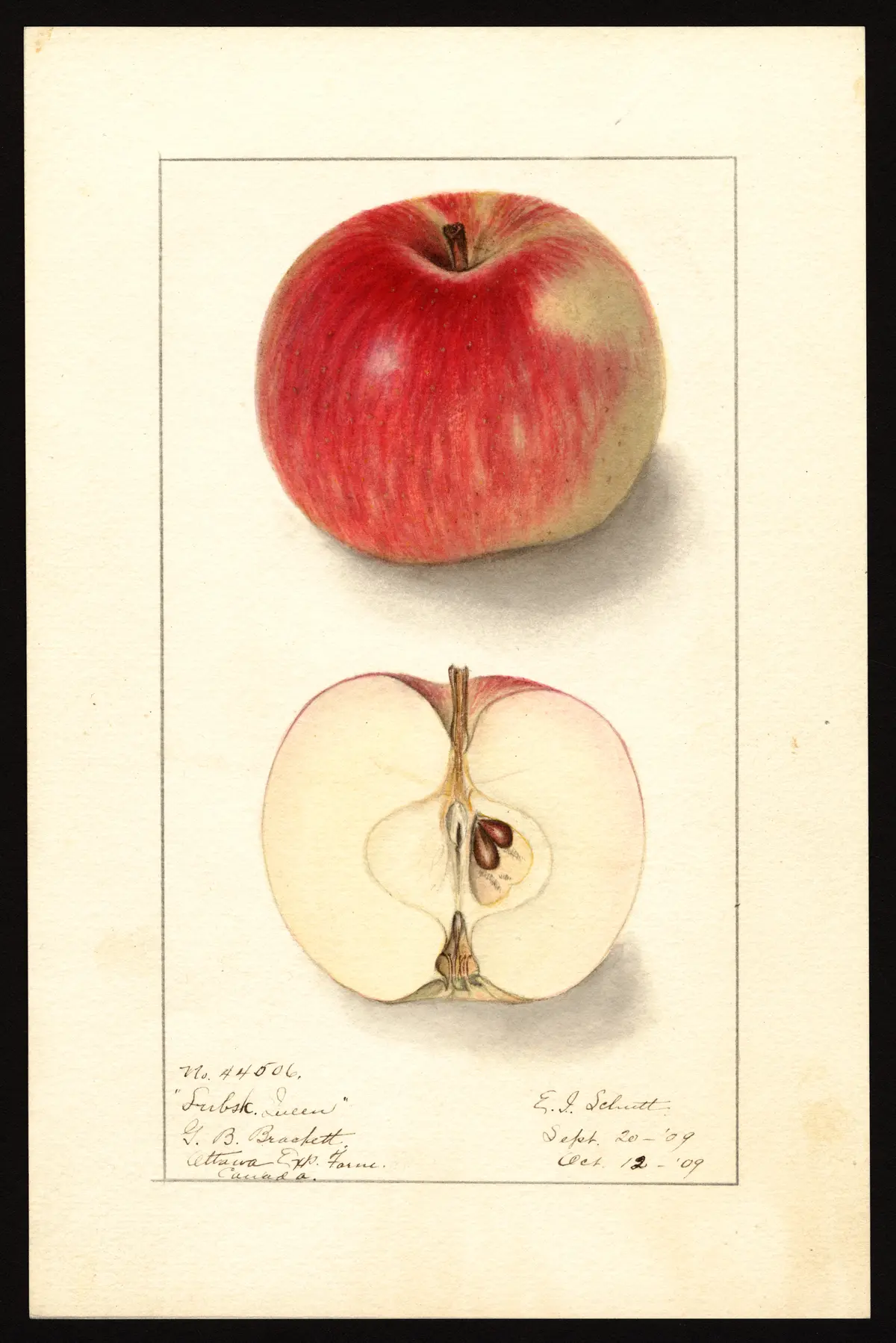
USDA Pomological Watercolor Collection
Lubsk Queen
Origin / History
Origin Russia (Hansen 1902; Budd & Hansen 1914; Thomas 1903; Fisher 1963). A fruit of remarkable beauty, always attracting much attention wherever exhibited (Hansen 1902; Budd & Hansen 1914). Hansen (1902), citing the Russian Nomenclature Commission, notes that this is "Not the Lubsk Queen of Tuttle, which is much like the White Pigeon." Fisher (1963) records the variety as the parent of Kendall (per the U.S. Horticultural Field Station, Cheyenne, Wyoming, station number A33386, received from AES, Brookings, S.D.). Also reported from the Agricultural Experiment Station, North Dakota State University, Fargo (station number 10663), and noted under the names "Lunowerapfel" (PI No. 132011, received from Germany 1939, reported by the U.S. Plant Introduction Station, Glenn Dale, Maryland) and "Lusoff" (received from Hort. Field Sta., Cheyenne, Wyo. 1956).
Tree
Vigorous, medium, upright (Budd & Hansen 1914). Medium upright, good grower (Hansen 1902, quoting Rus. Nom. Com.). Hardy but blight susceptible (Fisher 1963, NdM report).
Fruit
Size
Medium to large (Hansen 1902; Budd & Hansen 1914). Medium (Thomas 1903). Fisher (1963, NdM) records 6 per pound.
Form
Regular, round, truncated (Hansen 1902; Budd & Hansen 1914). Rather round, flattened at the ends (Hansen 1902, quoting Rus. Nom. Com.). Medium, irregular oblique (Thomas 1903). Oblate (Fisher 1963).
Stem
Medium to long (Hansen 1902; Budd & Hansen 1914). Medium long (Hansen 1902, quoting Rus. Nom. Com.). Medium (Thomas 1903).
Cavity
Rather small, acute, slightly russeted (Hansen 1902; Budd & Hansen 1914). Small, acute (Thomas 1903). Smooth, regular, greenish (Hansen 1902, quoting Rus. Nom. Com.).
Calyx
Closed; segments long, pointed (Hansen 1902; Budd & Hansen 1914). Closed (Hansen 1902, quoting Rus. Nom. Com.).
Basin
Wide, shallow, regular, with generally five fine corrugations around the eye (Hansen 1902; Budd & Hansen 1914). Wide, rather shallow (Thomas 1903). Broad, much wrinkled (Hansen 1902, quoting Rus. Nom. Com.).
Skin / Surface
Surface very smooth, polished and wax-like, a brilliant white, more or less covered with solid light rosy red, with delicate white bloom; a self-colored apple, but sometimes with short red splashes on lighter ground (Hansen 1902; Budd & Hansen 1914). White, more or less covered with rosy red; very smooth, polished and waxy (Thomas 1903). Polished waxy white, with bright blush on sun side (Hansen 1902, quoting Rus. Nom. Com.). Peach with pink cheek (Fisher 1963, NdM). Fisher (1963, WyC, under "Lusoff") describes the fruit as attractive with dull scurf skin. Dots white, minute, numerous (Hansen 1902; Budd & Hansen 1914); numerous fine, irregular, gray dots showing through the skin (Hansen 1902, quoting Rus. Nom. Com.).
Flesh / Flavor
Flesh snow-white, firm, juicy, fine-grained, subacid, good (Hansen 1902; Budd & Hansen 1914). Snow white, firm, juicy, sub-acid, very good (Thomas 1903). Nearly white; flavor pleasant acid (Hansen 1902, quoting Rus. Nom. Com.). Fisher (1963, WyC, under "Lusoff") reports flesh green-white, quality poor; the NdM report rates fruit "fair." Fisher (1963) further notes "No commercial value."
Core / Seeds
Core closed; cells ovate, slit; tube long, funnel-shaped; stamens marginal (Hansen 1902; Budd & Hansen 1914). Seeds nine, plump (Hansen 1902); seeds not many, plump (Budd & Hansen 1914).
Season
August, September (Hansen 1902; Budd & Hansen 1914; Hansen 1902 quoting Rus. Nom. Com.). Late autumn; keeps well in cold storage until March (Thomas 1903). Middle August (Fisher 1963, NdM); middle October (Fisher 1963, WyC under "Lusoff").
Uses
Keeps well in cold storage until March (Thomas 1903). Fisher (1963) reports "No commercial value."
Subtypes / Variants
Not described in source.
Other
A fruit of remarkable beauty (Hansen 1902; Budd & Hansen 1914); described parenthetically as "a beautiful fruit" (Hansen 1902, quoting Rus. Nom. Com.). Thomas (1903) references Fig. 380. Hansen (1902) cautions that this variety is "Not the Lubsk Queen of Tuttle, which is much like the White Pigeon."
Book Sources
Described in 5 period pomological works
Nursery Catalog Sources
Found in 2 catalogs (1900–1913) from Illinois
- Central Experimental Farm , Dominion Department of Agriculture, Agassiz, British Columbia (under test; Bulletin No. 3, Second Series) — 1900
- Benjamin Buckman (personal inventory) , Farmingdale , Illinois — 1913
View original book sources (4)
— N.E. Hansen, A Study of Northwestern Apples (1902)Lubsk Queen. (Lubsk Reinette, No. 444)
Lubsk Queen (No. 444)—Origin, Russia. A fruit of remarkable beauty, always attracting much attention wherever exhibited—Fruit medium to large, regular, round, truncated; surface very smooth, polished and waxlike, a brilliant white, more or less covered with solid light rosy red, with delicate white bloom, a self-colored apple, but sometimes with short red splashes on lighter ground; dots white, minute, numerous; cavity rather small, acute, slightly russeted; stem medium to long; basin wide, shallow, regular, with generally five fine corrugations around the eye; calyx closed, segments long, pointed. Core closed; cells ovate, slit; tube long, funnel-shaped; stamens marginal; seeds nine, plump; flesh snow white, firm, juicy, fine grained, subacid, good. August, September.
" LUBSK QUEEN. DESCRIPTION : Lubsk Queen—Size, medium to large; form, rather round, flattened at the ends; color, polished waxy white, with bright blush on sun side, with numerous fine, irregular, gray dots showing through the skin, (a beautiful fruit) ; cavity, smooth, regular, greenish; stem, medium long; basin, broad, much wrinkled; calyx closed; flesh, nearly white; flavor, pleasant acid; season, August and September; tree, medium upright, good grower; origin, Russia. Not the Lubsk Queen of Tuttle, which is much like the White Pigeon. " (Rus. Nom. Com. )
— John J. Thomas, The American Fruit Culturist (1903)Lubsk Queen. Medium, irregular oblique; white, more or less covered with rosy red; very smooth, polished and waxy; cavity small, acute; stem medium; basin wide, rather shallow; flesh snow white, firm, juicy, sub-acid, very good. Late autumn. Keeps well in cold storage until March. Fig. 380. Russian.
— J.L. Budd & N.E. Hansen, American Horticultural Manual, Part II: Systematic Pomology (1914)Lubsk Queen (Lubsk Reinette, No. 444).— Origin, Russia. A fruit of remarkable beauty, always attracting much attention wherever exhibited; tree vigorous, medium, upright.
Fruit medium to large, regular, round, truncated; surface very smooth, polished and wax-like, a brilliant white, more or less covered with solid light rosy red, with delicate white bloom, a self-colored apple, but sometimes with short red splashes on lighter ground; dots white, minute, numerous; cavity rather small, acute, slightly russeted; stem medium to long; basin wide, shallow, regular, with generally five fine corrugations around the eye; calyx closed; segments long, pointed. Core closed; cells ovate, slit; tube long, funnel-shaped; stamens marginal; seeds not many, plump; flesh snow-white, firm, juicy, fine-grained, subacid, good. August, September.
— H.H. Fisher (USDA ARS), A Survey of Apple Clones in the United States (1963)Lubsk Queen. Reported by the Agricultural Experiment Station, North Dakota State University, Fargo, North Dakota (NdM), received from Station, station number 10663: Fruit 6 per pound, oblate, peach with pink cheek, fair. Middle August. Blight susceptible. Hardy. Also reported by the U.S. Horticultural Field Station, Cheyenne, Wyoming (WyC), received from AES, Brookings, S.D., station number A33386: Russian origin. Lunowerapfel: PI No. 132011, received from Germany 1939, reported by the U.S. Plant Introduction Station, Glenn Dale, Maryland (MdG). Lusoff: received from Hort. Field Sta., Cheyenne, Wyo. 1956, reported by the U.S. Horticultural Field Station, Cheyenne, Wyoming (WyC): Parent of Kendall. Fruit attractive, dull scurf skin, flesh green-white. Quality poor. Middle October. No commercial value.