Lyman Prolific
Apple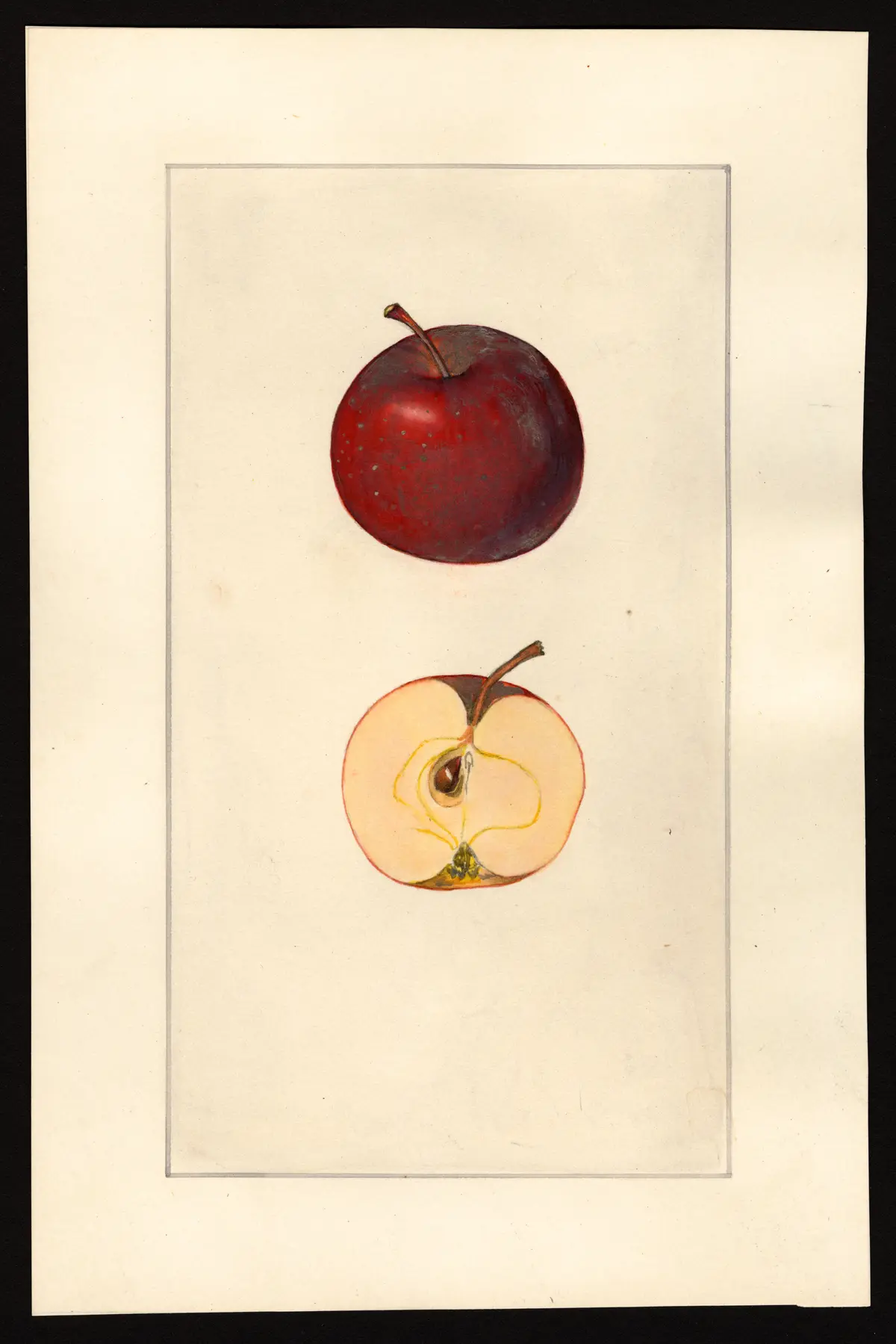
USDA Pomological Watercolor Collection
Lyman Prolific
Origin and History
Lyman Prolific is documented in a 1963 USDA survey of apple clones in the United States under Plant Introduction number 148403. Multiple accessions were maintained at different U.S. horticultural institutions and in Canada during this period.
Tree
Not described in source.
Fruit
Size and Form: Fruit size varies between accessions. One accession produces fruit at approximately 12 per pound (approximately 1.5 inches diameter), described as round-oblate. Another accession is described as small and conical.
Skin: Color is red. One accession exhibits approximately 90% stripes, described as "unattrac." (unattractive). The striped accession suggests variable surface patterning across different clones.
Flesh and Flavor: Flavor descriptions vary by accession. One accession is described as tart and astringent. Another is described as subacid, slightly astringent, with fair quality.
Core and Seeds: Not described in source.
Stem and Cavity: Not described in source.
Calyx and Basin: Not described in source.
Season
Harvest timing varies by accession. One accession matures in middle September; another in early September.
Uses
One accession is described as suitable for jelly and identified as a crab apple.
Tree Characteristics and Agronomic Notes
One accession was reported as blight resistant and hardy, noted by the Northern Great Plains Field Station, Mandan, North Dakota.
Subtypes/Variants
At least four distinct accessions of Lyman Prolific were in cultivation and maintained at different U.S. institutions:
Glenn Dale, Maryland accession (NJa and Graham Horticultural Experiment Station, Grand Rapids, Michigan): Details not provided beyond Plant Introduction number.
Strands Nursery accession (Station number A33665; U.S. Horticultural Field Station, Cheyenne, Wyoming): Small, conical fruit; 90% stripes, unattractive; subacid, slightly astringent flesh with fair quality; early September maturity.
A.P. Stevenson accession (Dunstan, Manitoba, Canada; Northern Great Plains Field Station, Mandan, North Dakota): Fruit 12 per pound, red, round-oblate; tart, astringent; suitable for jelly; middle September maturity; blight resistant; hardy.
Glenn Dale, Maryland accession (U.S. Horticultural Field Station, Cheyenne, Wyoming): Details overlap with other Glenn Dale accession; specifics not fully distinguished in source.
Other
Multiple accessions were received and preserved at distinct U.S. horticultural institutions, including the Northern Great Plains Field Station (Mandan, North Dakota), the U.S. Horticultural Field Station (Cheyenne, Wyoming), the Graham Horticultural Experiment Station (Grand Rapids, Michigan), and a New Jersey institution (NJa).
Book Sources
Described in 2 period pomological works
View original book sources (1)
— H.H. Fisher (USDA ARS), A Survey of Apple Clones in the United States (1963)Lyman Prolific carries USDA Plant Introduction number 148403. One accession was received from Glenn Dale, Maryland, and is held by NJa and the Graham Horticultural Experiment Station, Grand Rapids, Michigan. A second accession was received from Strands Nursery, Taylors Falls, Minnesota, under station number A33665, and is held by the U.S. Horticultural Field Station, Cheyenne, Wyoming. A third accession was received from A.P. Stevenson, Dunstan, Manitoba, Canada; fruit 12 per pound, red, round-oblate, tart, astringent; jelly crab; middle September; blight resistant; hardy; reported by the Northern Great Plains Field Station, Mandan, North Dakota. A fourth accession was received from Glenn Dale, Maryland; fruit small, conical, 90% stripes, unattrac.; flesh subacid, slightly astringent, fair; early September; reported by the U.S. Horticultural Field Station, Cheyenne, Wyoming.