Madame Eliza
Pear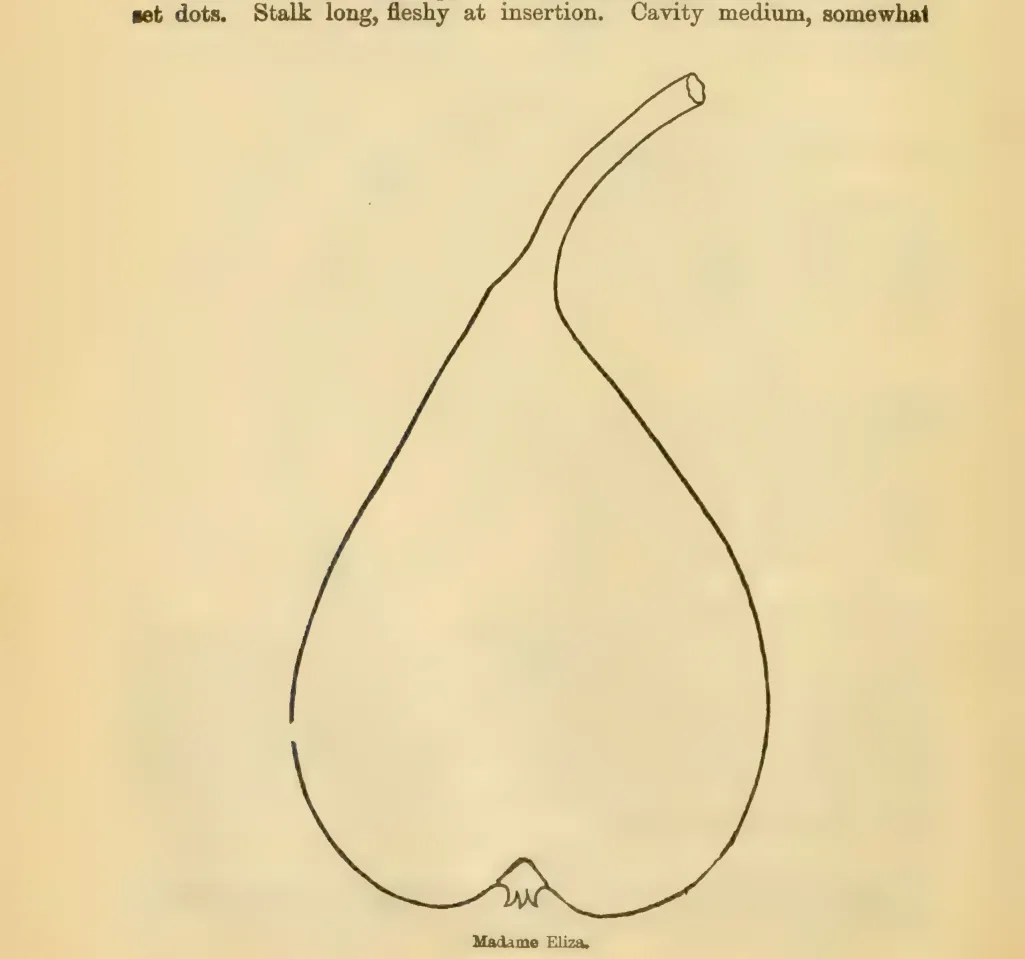
Origin & History
Raised in Belgium. Downing identifies Madame Eliza as one of Bivort's seedlings, named in honor of the wife of the well-known pomologist L. E. Berckmans. Hedrick, however, states it was raised in the seed beds of Van Mons and first bore fruit in 1848. Described as excellent in Belgium; Downing notes it "so far here sustains its foreign character," while Elliott calls it "promising well here."
Tree
Vigorous and productive. The habit is rather open and irregular in form (Downing), with Elliott more pointedly describing it as "awkward, rather crooked, and declining," noting the tree is hardy despite its ungainly shape. Elliott also observes very narrow leaves. Wood is stout (Elliott).
Young shoots show some variation across sources: dull olive yellow brown (Downing), olive gray (Elliott), or greenish-brown (Thomas). Thomas describes the shoots as erect, which contrasts with Elliott's characterization of a declining habit.
Fruit
Size: Large.
Form: Pyriform, with sources differing on the specifics. Downing describes it as oblong ovate acute pyriform. Hedrick calls it obtuse-pyriform, often rather irregular in its upper half. Thomas says pyriform, approaching pyramidal.
Stem: Long, inclining, fleshy at insertion, or set by a lip (Downing).
Cavity: Not described in source.
Calyx: Small, partially closed. Segments small, erect (Downing).
Basin: Abrupt, uneven, russeted (Downing).
Skin: Smooth (Elliott). The ground color progresses from green to yellow at maturity: Elliott and Thomas describe it as bright green becoming almost yellow; Hedrick specifies greenish-yellow passing to lemon-yellow at maturity; Downing gives the mature color as pale whitish yellow with a few traces of russet. Surface markings include numerous small dots — Downing describes them as small russet dots thickly sprinkled over the surface, while Hedrick calls them numerous small blackish-gray dots.
Flesh & Flavor: Fine, melting, sweet, and perfumed. The flesh color varies by source: white (Downing); white, a little yellow next the skin (Hedrick); rosy (Elliott). Hedrick notes it is free from grit. The texture is described as buttery by both Elliott and Thomas. The juice is abundant — Downing says juicy, Hedrick says full of rich saccharine juice, and Elliott says abounding with sweet juice. Hedrick adds a vinous quality. The aroma is delicately perfumed (Downing) or very agreeably perfumed (Elliott). Downing rates it "Very good"; Hedrick rates it "first" quality; Thomas calls it "agreeable."
Core & Seeds: Not described in source.
Season
October (Downing). November (Elliott, Thomas). September to November (Hedrick).
Uses
Not described in source.
Subtypes & Variants
Not described in source.
Other
Not described in source.
Book Sources
Described in 4 period pomological works
View original book sources (4)
— A.J. Downing, The Fruits and Fruit Trees of America (1900)Madame Eliza.
One of Bivort's seedlings, and named in honor of the wife of the well-known pomologist, L. E. Berckmans. The tree is vigorous, rather open and irregular in form, productive. Young wood dull olive yellow brown. It is a Pear described as excellent in Belgium, and so far here sustains its foreign character.
Fruit large, oblong ovate acute pyriform, pale whitish yellow, a few traces of russet, and thickly sprinkled with small russet dots. Stalk long, inclining, fleshy at insertion, or by a lip. Calyx small, partially closed. Segments small, erect. Basin abrupt, uneven, russeted. Flesh white, fine, juicy, melting, sweet, delicately perfumed. Very good. October.
— U.P. Hedrick, The Pears of New York (1921)Madame Élisa. 1. Ann. Pom. Belge 4:31, fig. 1856. 2. Downing Fr. Trees Am. 808, fig. 1869. Raised in the seed beds of Van Mons and first bore fruit in 1848. Fruit large, obtuse-pyriform, often rather irregular in its upper half, greenish-yellow passing to lemon-yellow at maturity, with numerous small blackish-gray dots; flesh white, a little yellow next the skin, fine, melting, free from grit, full of rich saccharine juice, vinous; first; Sept. to Nov.
— F.R. Elliott, The Western Fruit Book (1865)MADAME ELIZA.
Foreign. Tree, vigorous, wood stout. Fruit, large, pyriform : skin, smooth, bright green, and becomes almost yellow at maturity ; flesh, rosy, fine, buttery, melting, abounding with sweet juice, very agreeably perfumed. November. (Al. Pom.) Excellent in Belgium, promising well here. The tree is hardy, but has an awkward, rather crooked, and declining habit, and very narrow leaves. The young shoots are olive gray.
— John J. Thomas, The American Fruit Culturist (1903)Madame Eliza. Large, pyriform, approaching pyramidal; skin green, becoming nearly yellow; flesh buttery, melting, sweet, perfumed, agreeable. November. Shoots greenish-brown, erect. Belgian.