Magog
Apple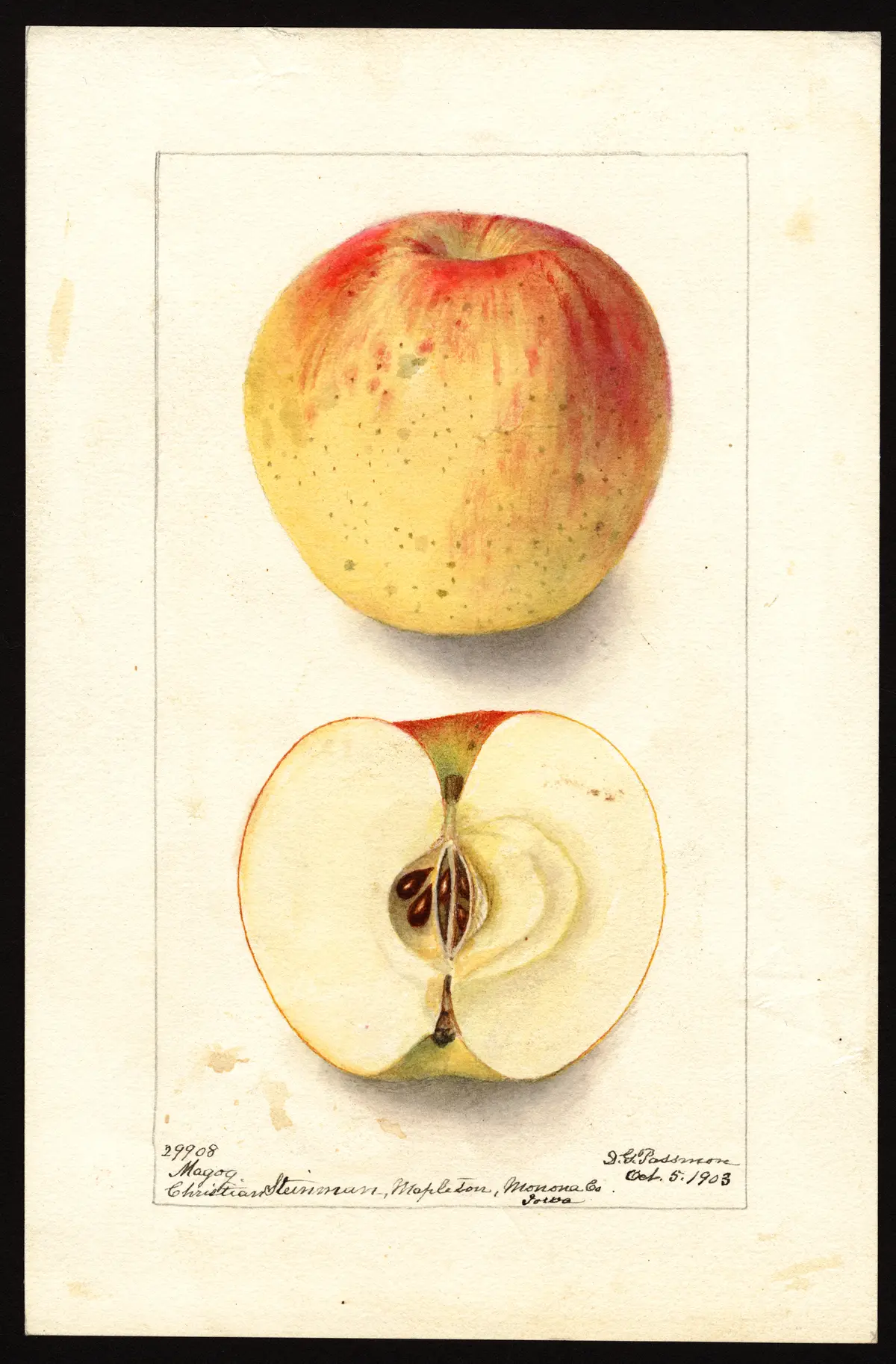
USDA Pomological Watercolor Collection
Magog
Origin/History
Magog was raised from seed by William Warren of Newport, Vermont (Downing; Beach; Budd-Hansen). Hedrick places its origin at Newport, Vermont, about 1870. Beach notes it has been planted to a considerable extent in portions of Northern New England, Northern New York, and the adjoining parts of Canada, and was still propagated in a few nurseries as of 1892. Hedrick adds that its culture is confined to New England, Canada, and the Great Plains, being most popular in the last-named region, and observes that the variety "has been on probation for nearly a half century — not good enough to recommend and too good to condemn." Dr. Hoskins, who propagated it for several years, said in 1894: "It is a fair but uneven keeper, and might be well described as not quite valuable enough to retain, yet hardly deserving to be cast aside." Beach notes it is reported as being very hardy in Northern New York, a good grower and a good bearer, and is not recommended for planting except perhaps for home use in localities where its superior hardiness gives it an advantage over ordinary varieties of its season. Downing valued it for its extreme hardiness, vigor, productiveness, and long keeping. The Central Experimental Farm (Agassiz BC) record notes their tree was planted Spring 1890.
Tree
Tree very hardy (Downing), thrifty and vigorous (Downing; Budd-Hansen), with an upright spreading head (Downing; Budd-Hansen; Beach; Hedrick). Beach describes the tree as moderately vigorous, with form upright spreading or roundish; the Central Experimental Farm calls it a strong and upright grower, and very productive. Downing reports it bears every year, but large crops in even years; Beach found that as fruited at their Station the tree is a moderately good grower, comes into bearing rather young, and yields moderate to good crops nearly annually. Budd-Hansen call it productive.
Twigs short to medium, straight or nearly so, rather slender; internodes short to medium (Beach). Bark dark brown or brownish-red, lightly streaked with scarfskin, pubescent (Beach). Lenticels scattering, small, oval, not raised (Beach). Buds small to above medium, plump, obtuse, free, slightly pubescent (Beach).
Fruit
Size: Downing and Budd-Hansen describe the fruit as medium or nearly so. Beach gives medium to large, averaging above medium, rather uniform in size but variable in shape. Hedrick calls it large, uniform in size but variable in shape. Lowther calls it large in size. The Central Experimental Farm reports medium size.
Form: Roundish inclining to oblong (Downing; Budd-Hansen; Central Experimental Farm). Beach: roundish to oblong, inclined to conic or somewhat ovate, regular or faintly ribbed; sides often unequal. Hedrick: round-oblong, sometimes conic or ovate, regular or faintly ribbed, sides often unequal. Lowther: roundish oblate.
Stem: Short, small (Downing; Budd-Hansen). Beach: medium to short, moderately thick to rather slender. Hedrick: short, thick.
Cavity: Acute or approaching acuminate, medium in depth, medium to rather narrow, usually smooth, occasionally lipped, often irregularly russeted (Beach). Hedrick: acute, medium in depth, narrow, usually smooth, occasionally lipped, often irregularly russeted.
Calyx: Closed (Downing; Budd-Hansen; Beach; Hedrick). Beach: medium to small, closed; lobes medium length, rather narrow, acute to acuminate. Hedrick: small, closed; lobes narrow, acute.
Basin: Medium, corrugated (Downing; Budd-Hansen). Beach: usually medium in width and depth, sometimes rather abrupt, coarsely wrinkled. Hedrick: medium in width and depth, sometimes abrupt, coarsely wrinkled.
Skin: Light yellow, shaded and faintly striped and splashed with light red over half the fruit (Downing; Budd-Hansen). Beach: thin, tough, smooth, waxy, pale greenish or yellow, lightly washed and mottled with thin brownish-red, sparingly striped and splashed with deeper red; prevailing effect yellow. Hedrick: thin, tough, smooth, waxy, pale yellow, lightly washed and mottled with thin brownish-red, sparingly striped and splashed with deeper red; prevailing effect yellow. Lowther describes the color simply as green. Central Experimental Farm: greenish yellow, partly covered with red.
Dots: Numerous, light, submerged, areolar, brown and russet (Beach; Hedrick).
Flesh/Flavor: Yellowish, a little coarse, moderately juicy, mild subacid (Downing; Budd-Hansen). Beach: tinged with yellow, rather firm, medium to rather fine-grained, tender, very juicy, sprightly, pleasant subacid, aromatic, good. Hedrick: yellow, firm, fine-grained, tender, very juicy, sprightly, pleasant subacid, aromatic; good. Central Experimental Farm: nearly white, juicy, mildly sub-acid, quality medium. Lowther rates quality very good. Beach summarizes overall as of good size, rather attractive appearance, and good to very good quality, especially for culinary uses.
Core/Seeds: Core medium (Downing; Budd-Hansen — Budd-Hansen add "fair to good"). Beach: core large to medium, abaxile; cells open; core lines clasping the funnel cylinder. Hedrick: core large, abaxile; cells open; core-lines clasping the funnel cylinder. Calyx tube medium in width, long, conical to funnel-shape with long cylinder (Beach); Hedrick: calyx-tube long, conical, with long cylinder. Stamens nearly marginal (Beach); Hedrick: marginal. Carpels long ovate to broadly obcordate, sometimes tufted (Beach); Hedrick: broad-obcordate, sometimes tufted. Seeds light brown, small to medium, rather wide, short, very plump, obtuse to broadly acute (Beach); Hedrick: light brown, small, wide, short, plump, obtuse.
Season
December to March (Downing; Budd-Hansen). October to January or later (Beach; Hedrick). Lowther: ripens in winter. Central Experimental Farm: December. Beach notes the keeping quality of the fruit varies in different seasons but its commercial limit in ordinary storage appears to be October, and that it remains in season to January or possibly later. Downing valued it for its long keeping; Hoskins called it "a fair but uneven keeper."
Uses
Lowther: used for both kitchen and market. Beach: good to very good quality, especially for culinary uses; not recommended for planting except perhaps for home use in localities where its superior hardiness gives it an advantage over ordinary varieties of its season.
Subtypes/Variants
Not described in source.
Other
Lowther notes: "No division reporting stations are recorded."
Book Sources
Described in 5 period pomological works
- Beach, The Apples of New York Vol. 2 (1905)
- Downing, Fruits and Fruit Trees of America (1900) — listed as Magog Red Streak
- Lowther (ed.), Encyclopedia of Practical Horticulture (1914)
- Hedrick, Cyclopedia of Hardy Fruits (1922)
- Budd & Hansen, Systematic Pomology (1914) — listed as Magog Red Streak
Nursery Catalog Sources
Found in 3 catalogs (1900–1913) from Illinois
- Central Experimental Farm , Dominion Department of Agriculture, Agassiz, British Columbia (under test; Bulletin No. 3, Second Series) — 1900 — listed as Magog Red Streak
- Benjamin Buckman (personal inventory) , Farmingdale , Illinois — 1901
- Benjamin Buckman (personal inventory) , Farmingdale , Illinois — 1913
View original book sources (6)
— A.J. Downing, The Fruits and Fruit Trees of America (1900)Magog Red Streak.
Raised from seed by William Warren, Newport, Vermont; tree very hardy, thrifty and vigorous, an upright spreading head; bears every year, but large crops in even years; valued for its extreme hardiness, vigor, productiveness, and long keeping.
Fruit medium or nearly so, roundish inclining to oblong; skin light yellow, shaded and faintly striped and splashed with light red over half the fruit; stalk short, small; calyx closed; basin medium, corrugated; flesh yellowish, a little coarse, moderately juicy, mild subacid; core medium. December, March.
— S.A. Beach, The Apples of New York, Vol. 2 (1905)MAGOG.
REFERENCES. 1. Downing, 1876:56 app. 2. Thomas, 1885:516. 3. Can. Hort., 13:174. 1890. 4. Bailey, An. Hort., 1892:243. 5. Hoskins, Am. Gard., 15:256. 1894. 6. Beach, N. Y. Sta. An. Rpt., 15:273. 1896. 7. Am. Pom. Soc. Cat., 1899:18. 8. Powell and Fulton, U. S. B. P. I. Bul., 48:48. 1903. 9. Budd-Hansen, 1903:122. 10. Farrand, Mich. Sta. Bul., 205:45. 1903. 11. Beach and Clark, N. Y. Sta. Bul., 248:130. 1904.
SYNONYMS. MAGOG (4, 8, 10). MAGOG Red Streak (7, 9). MAGOG RED STREAK (1, 2, 3, 5, 6). Magog Red Streak (4, 11).
Fruit of good size, rather attractive appearance and good to very good quality, especially for culinary uses. Dr. Hoskins, who propagated it for several years, said in 1894: "It is a fair but uneven keeper, and might be well described as not quite valuable enough to retain, yet hardly deserving to be cast aside." It is reported as being very hardy in Northern New York, a good grower and a good bearer. As fruited at this Station the tree is a moderately good grower, comes into bearing rather young and yields moderate to good crops nearly annually. The keeping quality of the fruit varies in different seasons but its commercial limit in ordinary storage appears to be October. It remains in season to January or possibly later (11). It is not recommended for planting except perhaps for home use in localities where its superior hardiness gives it an advantage over ordinary varieties of its season.
Historical. Originated by Wm. Warren, Newport, Vt. (1). It has been planted to a considerable extent in portions of Northern New England, Northern New York and the parts of Canada adjoining. It is still propagated in a few nurseries (4).
TREE.
Tree moderately vigorous. Form upright spreading or roundish. Twigs short to medium, straight or nearly so, rather slender; internodes short to medium. Bark dark brown or brownish-red, lightly streaked with scarfskin, pubescent. Lenticels scattering, small, oval, not raised. Buds small to above medium, plump, obtuse, free, slightly pubescent.
FRUIT.
Fruit medium to large, averaging above medium, rather uniform in size but variable in shape. Form roundish to oblong, inclined to conic or somewhat ovate, regular or faintly ribbed; sides often unequal. Stem medium to short, moderately thick to rather slender. Cavity acute or approaching acuminate, medium in depth, medium to rather narrow, usually smooth, occasionally lipped, often irregularly russeted. Calyx medium to small, closed; lobes medium length, rather narrow, acute to acuminate. Basin usually medium in width and depth, sometimes rather abrupt, coarsely wrinkled.
Skin thin, tough, smooth, waxy, pale greenish or yellow, lightly washed and mottled with thin brownish-red, sparingly striped and splashed with deeper red. Dots numerous, light, submerged, areolar, brown and russet. Prevailing effect yellow.
Calyx tube medium in width, long, conical to funnel-shape with long cylinder. Stamens nearly marginal.
Core large to medium, abaxile; cells open; core lines clasping the funnel cylinder. Carpels long ovate to broadly obcordate, sometimes tufted. Seeds light brown, small to medium, rather wide, short, very plump, obtuse to broadly acute.
Flesh tinged with yellow, rather firm, medium to rather fine-grained, tender, very juicy, sprightly, pleasant subacid, aromatic, good.
Season October to January or later.
— J.L. Budd & N.E. Hansen, American Horticultural Manual, Part II: Systematic Pomology (1914)Magog Red Streak.—Raised from seed by William Warren, Newport, Vermont; tree thrifty, vigorous, upright, spreading, productive. Fruit medium or nearly so, roundish, inclining to oblong; light yellow, shaded and faintly striped and splashed with light red over half the fruit; stem short, small; calyx closed; basin medium, corrugated; flesh yellowish, a little coarse, moderately juicy, mild subacid; Core medium, fair to good. December, March.
— Granville Lowther (ed.), Encyclopedia of Practical Horticulture (1914)Magog (also known as M. Red Streak) is large in size, roundish oblate in form, green in color, very good in quality, used for both kitchen and market, and ripens in winter. No division reporting stations are recorded.
— U.P. Hedrick, Cyclopedia of Hardy Fruits (1922)MAGOG.
Magog Red Streak.
Magog has been on probation for nearly a half century — not good enough to recommend and too good to condemn. If worth growing at all, it is only in northern latitudes where hardiness is necessary. The variety originated at Newport, Vermont, about 1870, and its culture is confined to New England, Canada, and the Great Plains, being most popular in the last-named region.
Tree vigorous, upright-spreading. Fruit large, uniform in size but variable in shape, round-oblong, sometimes conic or ovate, regular or faintly ribbed, sides often unequal; stem short, thick; cavity acute, medium in depth, narrow, usually smooth, occasionally lipped, often irregularly russeted; calyx small, closed; lobes narrow, acute; basin medium in width and depth, sometimes abrupt, coarsely wrinkled; skin thin, tough, smooth, waxy, pale yellow, lightly washed and mottled with thin brownish-red, sparingly striped and splashed with deeper red; dots numerous, light, submerged, areolar, brown and russet; prevailing effect yellow; calyx-tube long, conical, with long cylinder; stamens marginal; core large, abaxile; cells open; core-lines clasping the funnel cylinder; carpels broad-obcordate, sometimes tufted; seeds light brown, small, wide, short, plump, obtuse; flesh yellow, firm, fine-grained, tender, very juicy, sprightly, pleasant subacid, aromatic; good; season, October to January or later.
— Central Experimental Farm, Central Experimental Farm, Agassiz BC — Catalogue of Fruit Trees under Test (Bulletin No. 3, 1900) (1900)Planted Spring 1890. Tree a strong and upright grower, and very productive. Fruit of medium size, roundish, oblong. Skin greenish yellow, partly covered with red. Flesh nearly white, juicy, mildly sub-acid, quality medium. Season December.