Mala Carle
Apple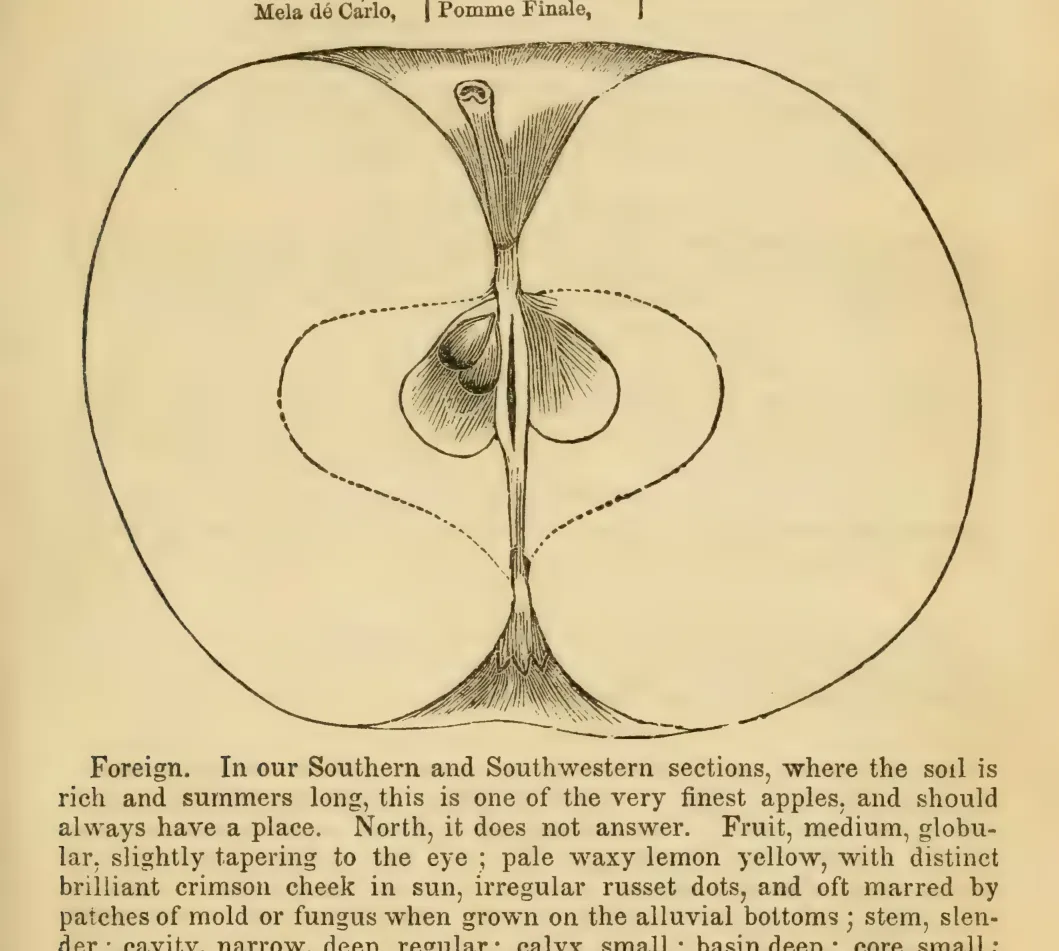
Mala Carle
Origin/History
Mala Carle is an old variety of Italian origin, native to the territory of Finale, in Liguria. As Lindley wrote: "The Malcarle is a native of the territory of Finale, in Liguria. It is an important article of trade in the whole Genoese territory, and of exportation to Nice, Marseilles, Barcelona and Cadiz. The climate of the Italian territory is so entirely different from that of England, that we cannot expect the delicate Malcarle should succeed here, unless trained against a south or southeast wall, and in a warm and kind soil. Its great beauty in the dessert renders it an interesting object of cultivation." It is the most celebrated of all apples in Italy and the South of Europe. The variety was referenced in American pomological literature as early as 1832 (Kenrick) and appeared in the American Pomological Society catalog in 1889.
Tree
Not described in source.
Fruit
Size and Form: Medium in size, very regularly shaped, globular, a little narrow and slightly tapering towards the eye.
Stem: Slender.
Cavity: Narrow, deep, and regular.
Calyx: Small.
Basin: Deep.
Skin: Smooth, with a delicate waxen appearance. Pale lemon yellow in the shade, with a distinct, brilliant crimson cheek next the sun, the two colors often joining in strong contrast. Elliott notes the presence of irregular russet dots, and that fruit grown on alluvial bottoms is often marred by patches of mold or fungus.
Flesh and Flavor: White, not very juicy (Downing), tender, with a delicate, slightly rose-perfumed flavor. Downing rates it Good; Elliott rates it "best."
Core and Seeds: Core small. Seeds round, ovate pointed.
Season
Downing gives September to January; Elliott gives October to January.
Uses
Dessert. An important article of trade and export throughout the Genoese territory and into Nice, Marseilles, Barcelona, and Cadiz.
Subtypes/Variants
Not described in source.
Other
Mala Carle is well adapted to the South and Southwest, where the soil is rich and dry and summers long, and south of New York it becomes beautiful and fine. It does not succeed as far north as New York (Downing, Beach), and Elliott states flatly that "North, it does not answer." The variety requires a warm and dry soil to attain perfection.
Book Sources
Described in 3 period pomological works
Nursery Catalog Sources
Found in 2 catalogs (1901–1913) from Illinois
- Benjamin Buckman (personal inventory) , Farmingdale , Illinois — 1901
- Benjamin Buckman (personal inventory) , Farmingdale , Illinois — 1913
View original book sources (3)
— A.J. Downing, The Fruits and Fruit Trees of America (1900)Mala Carle.
Pomme Finale. Charles Apple. Mela di Carlo. Mela Carla. Pomme de Charles.
The Mala Carle is the most celebrated of all Apples in Italy and the South of Europe, whence it comes. Here or in New England it does not always attain perfection, but south of New York it becomes beautiful and fine, as it needs a warm and dry soil.
Fruit of medium size, very regularly shaped, a little narrow towards the eye. Skin smooth, with a delicate waxen appearance, pale lemon yellow in the shade, with a brilliant crimson cheek next the sun, the two colors often joining in strong contrast. Flesh white, not very juicy, but tender, and with a delicate, slightly rose-perfumed flavor. Good. September to January.
— S.A. Beach, The Apples of New York, Vol. 1 (1905)MALA CARLE.
REFERENCES. 1. Kenrick, 1832:79. 2. Floy-Lindley, 1833:39. 3. Manning, 1838:61. 4. Downing, 1845:116. 5. Thomas, 1849:182. 6. Cole, 1849:116. 7. Emmons, Nat. Hist. N. Y., 3:82. 1851. 8. Elliott, 1854:146. fig. 9. Hooper, 1857:56. 10. Warder, 1867:725. 11. Fitz, 1872:168. 12. Hogg, 1884:144. 13. Am. Pom. Soc. Cat., 1889:10. 14. Bailey, An. Hort., 1892:243.
SYNONYMS. Charles Apple (1, 2, 4, 8). MALCARLE (2). Malcarle (1). Mai Carle (7). MALE CARLE (4, 5, 8, 9, 10, 11). Male Carle (6, 12). MARLE CARLE (7). MELA CARLA (1, 3, 12). Mela Carlo (2, 4, 5, 8, 9). Mela de Carlo (8). Mela di Carlo (4). Pomme de Charles (4, 5, 8). Pomme Finale (1, 4, 8).
A very beautiful delicate skinned apple with white, tender, perfumed flesh. It is well adapted to certain regions of the South (11) but it does not succeed as far north as New York (4).
Historical. This is an old variety of Italian origin. Lindley says of it: "The Malcarle is a native of the territory of Finale, in Liguria. It is an important article of trade in the whole Genoese territory, and of exportation to Nice, Marseilles, Barcelona and Cadiz. The climate of the Italian territory is so entirely different from that of England, that we cannot expect the delicate Malcarle should succeed here, unless trained against a south or southeast wall, and in a warm and kind soil. Its great beauty in the dessert renders it an interesting object of cultivation" (2).
— F.R. Elliott, The Western Fruit Book (1865)Male Carle. Mela Carla, | Pomme de Charles, | Charles Apple. Mela de Carlo, | Pomme Finale,
Foreign. In our Southern and Southwestern sections, where the soil is rich and summers long, this is one of the very finest apples, and should always have a place. North, it does not answer. Fruit, medium, globular, slightly tapering to the eye ; pale waxy lemon yellow, with distinct brilliant crimson cheek in sun, irregular russet dots, and oft marred by patches of mold or fungus when grown on the alluvial bottoms ; stem, slender ; cavity, narrow, deep, regular ; calyx, small ; basin deep ; core, small ; seeds, round, ovate pointed ; flesh, white, tender, delicate rose perfume ; "best." October to January.